
 Search Articles


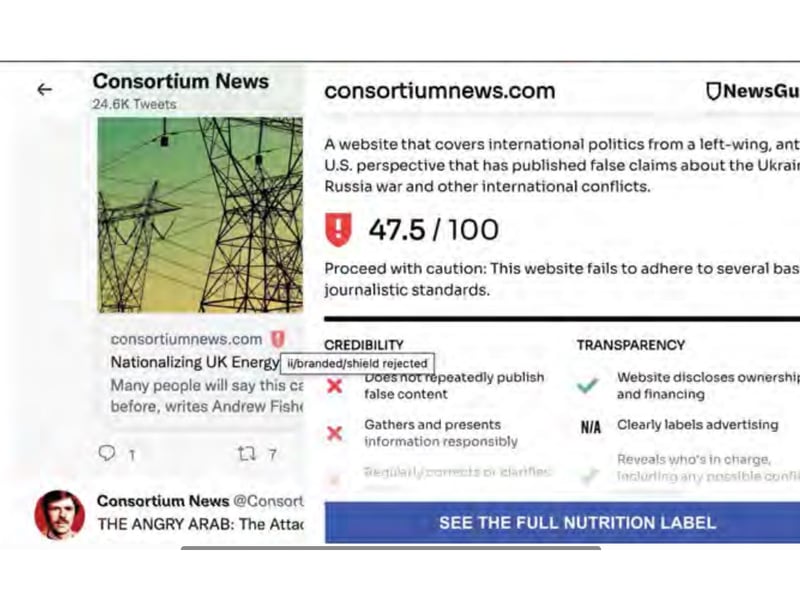
MANHATTAN (CN) — NewsGuard, a New York-based firm that studies and tracks online misinformation, prevailed Wednesday morning against a $13 million defamation suit lobbed by an independent new website over its flagging of the accuracy of the site’s Ukraine-Russia war reporting.
Consortium for Independent Journalism, which publishes the nonprofit Consortium News website, sued NewsGuard in August 2023 for its labeling of the website’s reporting as harboring a “left-wing, anti-U.S. perspective” and being a purveyor of “false content” in its reporting about the Ukraine-Russia war and other international conflicts.
NewsGuard ultimately awarded Consortium News a news reliability score of 47.5 out of 100 for its “nutrition label,” finding that the site failed three categories: “does not repeatedly publish false content,” “gathers and presents information responsibly,” and “regularly corrects or clarifies errors.”
The score was accompanied by a red (now blue) flag and a warning: “Proceed with Caution: This website generally fails to maintain basic standards of accuracy and accountability.”
“By placing the red flag warning (or the blue warning in later instances), appended to works that NewsGuard has not read, NewsGuard has acted to defame, libel and slander Consortium News’ entire production and its writers, recklessly and without regard to the truth,” the website wrote in its defamation complaint.
Represented by New Jersey attorney Bruce Agran, Consortium News argued in its complaint that NewsGuard identified no “false content” but disputes the opinion of five Consortium News commentaries on matters concerning Ukraine and Syria.
Consortium claimed NewsGuard consequently labeled all of the website’s 20,000-plus articles and videos as purveying “false content” and failing to meet minimum journalistic standards while actually only reviewing just five of them.
The nonprofit news publisher sought $13.6 million in damages and an injunction to prevent further defamatory actions by the media rating agency.
Granting NewsGuard’s motion to dismiss Consortium’s amended complaint on Wednesday, U.S. District Judge Katherine Failla found that Consortium News had argued “virtually no non-conclusory allegations of actual malice.”
“Indeed, far from alleging that NewsGuard knew its statements to be false, Consortium News effectively concedes the truth of the ‘anti-U.S. perspective’ label, and acknowledges that ‘reasonable people’ could differ as to the truth or falsity of its reporting, undercutting any suggestion that NewsGuard knew its criticisms to be false and published those criticisms despite knowing them to be false,” she wrote in ruling. “And, Consortium News further concedes that it failed to respond to NewsGuard’s queries about the accuracy of its reporting. These allegations are fatal to any plausible showing of actual malice.”
NewsGuard co-CEO Gordon Crovitz said Wednesday the company is “gratified but not surprised by this court determination."
In its motion to dismiss, NewsGuard argued the First Amendment claims should be tossed because its government contract as a private company did not turn it into a state actor.
NewsGuard defended its nutrition label assessing Consortium News’ trustworthiness as a protected opinion.
“The Nutrition Label is an evaluative rating system that, as a matter of law, is ‘inherently subjective’ and ‘incapable of being proven false,’” it argued in a court filing.
The Consortium News website was founded in 1995 by Robert Parry, a longtime Associated Press and Newsweek reporter who helped break the Iran-Contra scandal and the Contras’ involvement in cocaine smuggling in the 1980s.
Celebrating the website’s 30th anniversary in 2025, Consortium News carries the motto: “When the intelligence is questionable come to the place where the intelligence is questioned.”
Representatives for Consortium News did not immediately respond to request for comment Wednesday.
 Follow @jruss_jruss
Subscribe to our free newsletters
Our weekly newsletter Closing Arguments offers the latest about ongoing trials, major litigation and rulings in courthouses around the U.S. and the world, while the monthly Under the Lights dishes the legal dirt from Hollywood, sports, Big Tech and the arts.