
 Search Articles


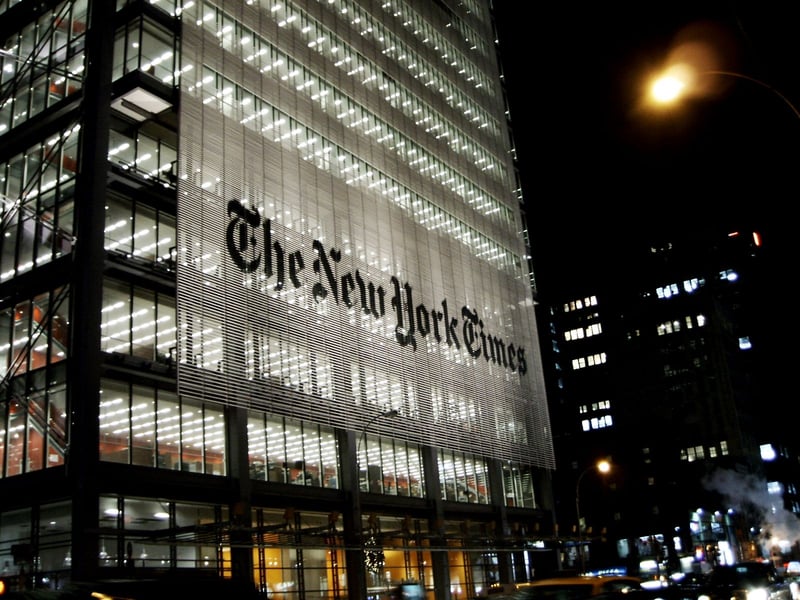
TAMPA, Fla. (CN) — Just days after President Donald Trump hit The New York Times with a $15 billion defamation lawsuit, a federal judge dismissed the complaint on Friday, calling it “decidedly improper and impermissible.”
In a four-page decision, U.S. District Judge Steven Merryday chided Trump’s attorneys for not following federal rules requiring “a short and plain statement of the claim.”
“As every lawyer knows (or is presumed to know), a complaint is not a public forum for vituperation and invective — not a protected platform to rage against an adversary,” Merryday wrote. “A complaint is not a megaphone for public relations or a podium for a passionate oration at a political rally or the functional equivalent of the Hyde Park Speakers’ Corner.”
“Although lawyers receive a modicum of expressive latitude in pleading the claim of a client, the complaint in this action extends far beyond the outer bound of that latitude,” the judge added.
Trump filed his lawsuit on Sept. 15 in Tampa federal court, accusing The New York Times of “spreading false and defamatory content” and acting as a “full-throated mouthpiece of the Democratic Party.”
In the 85-page complaint, Trump goes at length praising his 2024 election victory, real estate achievements and his “remarkable performance as the star of ‘The Apprentice’" while attacking The New York Times for “repugnant distortions and fabrications.”
In addition to The New York Times, Trump’s suit named reporters Susanne Craig, Russ Buettner, Peter Baker and Michael S. Schmidt, and Penguin Random House, which published “Lucky Loser: How Donald Trump Squandered His Father’s Fortune and Created the Illusion of Success.” That book was written by Craig and Buettner.
“These publications were created with a backward methodology: the authors started with a desired narrative for the Book and the Articles, and then, to achieve that narrative, they falsified, distorted, and manipulated facts, while otherwise accurate information was, and remains, available from public and private sources,” Trump wrote. “To hastily churn out the book and the articles right before the presidential election, with them appealing as crude works of paparazzi rather than as public interest reports, defendants chose politics over truth.”
In his order, a seemingly exasperated Merryday wrote that a reader “must endure” and “labor through allegations” before coming to the end of the complaint to find “only two simple counts of defamation.”
Merryday, a George H.W. Bush appointee, noted that his order “suggests nothing about the truth of the allegations or the validity of the claims but addresses only the manner of the presentation of the allegations in the complaint.”
The judge gave Trump 28 days to amend his complaint, which must be 40 pages or less.
The New York Times did not immediately respond to a request for comment, but in a statement released on Tuesday, a spokesperson said the lawsuit “has no merit” and “lacks any legitimate legal claims and instead is an attempt to stifle and discourage independent reporting."
Trump’s attorneys — Alejandro Brito, Edward Paltzik and Daniel Epstein — did not respond to a request for comment.
Since taking office, Trump has frequently used the courts to go after media outlets for perceived defamation.
Most recently, Trump targeted the Wall Street Journal and Rupert Murdoch over an article detailing a ribald letter Trump supposedly sent to Jeffrey Epstein for his 50th birthday. He is seeking $10 billion in that defamation lawsuit.
 Follow @alexbpickett
Subscribe to our free newsletters
Our weekly newsletter Closing Arguments offers the latest about ongoing trials, major litigation and rulings in courthouses around the U.S. and the world, while the monthly Under the Lights dishes the legal dirt from Hollywood, sports, Big Tech and the arts.