
 Search Articles


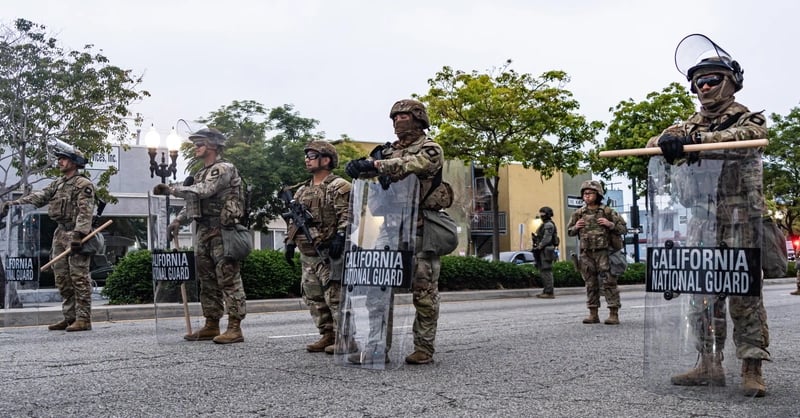
SAN FRANCISCO (CN) — U.S. District Judge Charles R. Breyer grilled the federal government on Wednesday about the continued presence of federal troops in Los Angeles during the final day of arguments over the legality of President Donald Trump sending the National Guard into the city earlier this summer during immigration protests.
“Why is the federalized National Guard, even though it’s been drawn down, still in place? What is the threat today? What was the threat yesterday? It’s the absence of any limits to a national police force — that’s what I am sitting here trying to figure out,” the Bill Clinton appointee said.
The three-day bench trial focuses on the Posse Comitatus Act, a federal law that blocks federal troops from participating in regular civilian law enforcement except when authorized by the Constitution or Congress.
While the first two days of arguments were dedicated to reviewing the evidence, the third day was to determine if Breyer can indeed rule on the case.
Shortly into the defense’s opening argument that California has no cause of action to enforce the Posse Comitatus Act, Breyer questioned Deputy Assistant Attorney General Eric Hamilton about the Justice Department’s position that the Posse Comitatus Act is a criminal act without civil remedies.
Even if there was a scenario where the facts were not in dispute, and the president committed a clear violation of the Posse Comitatus Act, Breyer said, given the Supreme Court’s recent decision on presidential immunity, he concluded the remedy would be: “Too bad. So sad. It’s over. And that’s the end of the case. Even though it’s a violation of the Posse Comitatus Act.”
During the state’s arguments, California Deputy Attorney General Megan Strong said the Justice Department’s claim that there is no civil remedy “defies the basic principles of federalism.”
“It lacks basic common sense that a state that is being occupied by a standing army that has engaged in unlawful conduct within the state’s border … has no legal recourse to challenge the unlawful conduct of troops,” she said.
Hamilton also argued that the president has the authority to federalize national guardsmen under specific circumstances such as “rebellion,” and that the single-sentence Posse Comitatus Act acknowledges there will be exceptions.
Breyer contended that the Posse Comitatus Act “contemplates” exceptions, such as those authorized by the Constitution or Congress. However, he said that exceptions are in the context of an insurrection.
“Is it the government’s position that what was occurring in the state of California … that there was an insurrection?” Breyer asked.
“We’ve not made that argument,” Hamilton responded.
Breyer pressed Hamilton further on the differences between an insurrection and a rebellion, noting Trump’s order justified the deployment of federal troops because of a “rebellion,” and questioned what forms of breaking federal law would allow a response from federal forces.
Hamilton said that whether there was or wasn’t a rebellion “isn’t relevant” to the trial on a potential Posse Comitatus Act violation, as the Ninth Circuit of Appeals previously ruled that the president lawfully deployed the National Guard.
The third argument the Justice Department presented was that California lacked standing to sue, saying the state fails on all three injuries they claim: physical and economic health and well-being of their citizens, fiscal harm and federalism.
Strong pushed back on the claim that California has suffered harm as a result of the deployment of federal troops, citing evidence of distressed citizens and a threat to the state’s police power.
“There is the idea that the state where this standing army is deployed and defendants are violating the law, that that state is not harmed and not able to bring this claim, is implausible. Of course, the state has suffered harm and been injured,” she said.
In response to Breyer’s question about equitable relief, given that there are no historical cases, Strong said there is no precedent since the federal government was engaging in “unprecedented conduct.”
“The fact that there is no case addressing this exact scenario is a result of the fact that the federal government has never used the military in this manner in such disregard of the law,” she said.
During the defense’s rebuttal, Breyer continued to echo his concerns from the second day of trial on the limits of deploying the military.
“What limiting factors are there? Once you have a force in place … and the threat subsides, what then? How does one look at this national police force that goes out where the threat was and starts executing other laws?”
Strong noted in California’s rebuttal that 300 members of the National Guard are still deployed in LA, saying, “that is certainly enough to constitute a Posse Comitatus Act violation and these violations are ongoing through today.”
The trial wrapped without a ruling. This case was filed in the Northern District of California and heard at the Phillip Burton Federal Courthouse in San Francisco.
 Follow @mhattridge_
Subscribe to our free newsletters
Our weekly newsletter Closing Arguments offers the latest about ongoing trials, major litigation and rulings in courthouses around the U.S. and the world, while the monthly Under the Lights dishes the legal dirt from Hollywood, sports, Big Tech and the arts.