Search Articles


OMAHA, Neb. (CN) — A federal judge on Thursday lambasted the government’s account of an immigration arrest in Nebraska last summer even as he sentenced the accused, Gabriel Hurtado-Cariaco, to a reduced charge in the plea-bargained case.
“What happened here was at best a misrepresentation — I’m not going to use the word lie,” said Chief U.S. District Judge Robert F. Rossiter Jr. “To refer to him as a terrorist, an attempted murderer … is just not borne out by the evidence, and is troubling.”
Rossiter, a Barack Obama appointee, sentenced Hurtado-Cariaco to 14 months in prison, but said time served should be considered. Hurtado-Cariaco had previously pleaded guilty to a charge of assaulting and resisting a federal officer with infliction of bodily injury.
When Hurtado-Cariaco’s attorney Richard H. McWilliams said his client had already been locked up since his arrest a little more than a year ago, and that simply sentencing Hurtado-Cariaco to time served would eliminate a bureaucratic headache, Rossiter said: “I understand and I have looked at that. But that is the sentence.”
Indeed, Rossiter was careful to not let Hurtado-Cariaco off the hook. He said there was “no doubt” he was guilty of what he had pleaded to.
“He injured federal officers, who were, for one reason or another, masked,” the judge said.
As part of the agreement, prosecutors dropped charges of material support to Tren de Aragua, assaulting and resisting a federal officer with the infliction of bodily injury, and two counts of resisting a federal officer.
After the hearing, Donald J. Kleine of the U.S. Attorney’s Office in Omaha immediately left the courtroom and declined to comment. In court, he said he did not object to a sentence within federal sentencing guidelines — 12 to 18 months — which was what Rossiter ultimately imposed.
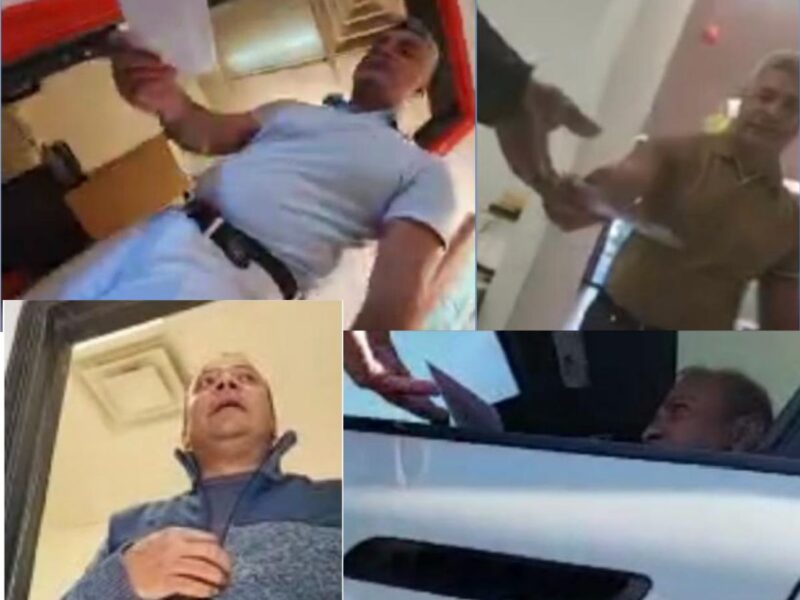
Videos shot by two bystanders contradicted the account of U.S. Immigration and Customs Enforcement officers. The videos were not shown in court but were referenced by Rossiter in his decision.
ICE’s version of events
According to ICE in a criminal complaint last year, two agents — one from the FBI and the other from ICE — stopped Hurtado-Cariaco outside his apartment building in the Omaha suburb of Bellevue with an immigration warrant for his arrest on June 18, 2025.
He exited his vehicle with his hands up. But as the two agents approached him, they claim he threw himself against the ICE agent, knocking her into the air and causing her to knock her head on the ground.
During the fight, the feds said Hurtado-Cariaco attempted to put the ICE agent into a chokehold — considered by officers to be deadly force. The FBI agent then put Hurtado-Cariaco in a chokehold, which caused him to release the ICE agent. Hurtado-Cariaco broke free and fled on foot. He was later apprehended at his apartment.
ICE said it suspected he was a Tren de Aragua member or close associate due to “a prominent tattoo of a clock with an ‘all seeing eye’” on one of his forearms, and also because he said he preferred to go to a federal prison in Colorado, where he knew people.
The ICE agent was admitted to a local hospital due to the possibility of a broken elbow and a concussion, according to a Homeland Security Investigations special agent.
A grand jury later charged Hurtado-Cariaco in a superseding indictment with material support to Tren de Aragua, assaulting and resisting a federal officer with the infliction of bodily injury, and two counts of resisting a federal officer.
The arrest was highly publicized. The Department of Homeland Security dubbed him a “Tren de Aragua gang member” and said he tried to kill a law enforcement officer.
A Fox News article deemed him among the ‘worst of the worst," up there with someone accused by authorities of preying on children and another suspected in a beheading.
That was decidedly not the portrait painted by anyone in court Thursday. Rossiter said there was no evidence Hurtado-Cariaco had put an agent in a chokehold.
McWilliams called to the stand the two bystanders who had recorded much of the encounter via their phones.
One of them, Victor Aragon, testified that the two agents returned to the scene immediately after the struggle. One pointed at the ground and they were discussing something.
“Did she seem in physical distress of any kind?” McWilliams asked him, referring to the assaulted agent.
“No,” Aragon said. “I saw her walking and moving around normal.”
McWilliams asked both witnesses to describe their feelings after hearing the government’s version of events when the incident was publicized. Kleine objected on relevance grounds, and Rossiter sustained his objection.
“This is a good person,” McWilliams said to Rossiter about his client. “I don’t think there are many people who come into this court who have been so vilified by the United States and by the media.”
He was “not a criminal illegal alien,” McWilliams said. He was not a member of Tren de Aragua.
“He was a tortured dissident who had his toenails ripped out by the Maduro regime,” McWilliams said.
Unwavering faith
Hurtado-Cariaco was a member of the Venezuelan military who deserted, fleeing the country first to Columbia, then through Mexico to the U.S. border, getting robbed along the way by cartel members. He secured a work permit in the United States. The only thing that changed, he said, was the U.S. government’s attitude and position toward Venezuelans.
“It makes McCarthyism look intellectual and rational,” he said, adding that federal agents “lied about him. I don’t know of any other way to put that.”
In brief comments, Kleine disagreed. He described the arrest as a “heated moment” and pointed out Hurtado-Cariaco had pleaded guilty to a felony.
“The government disagrees with several assertions that Mr. McWilliams said, including his assertion that the agents in this case lied,” Kleine said.
When asked for comment and sent specific questions about the case and the issues raised during the hearing, a Department of Homeland Security statement to Courthouse News on Monday echoed comments following Hurtado-Cariaco’s arrest last year and did not directly address the sentencing or Rossiter’s or McWilliams’ remarks.
Hurtado-Cariaco spoke through a translator. He blamed previous experiences with law enforcement violence in Venezuela and Mexico — where police beat him up and took his phone — for his decision to panic when approached by the federal agents.
“I still carry with me the trauma,” he said. “And for that reason, I ran away in fear.”
It was not said in court what may happen to Hurtado-Cariaco once he is out of prison. But with a felony conviction, he likely faces an uphill climb to stay in the United States.
“I still believe with utmost certainty that this is the best country in the world,” he told Rossiter.
 Follow @nelson_aj
Subscribe to our free newsletters
Our weekly newsletter Closing Arguments offers the latest about ongoing trials, major litigation and rulings in courthouses around the U.S. and the world, while the monthly Under the Lights dishes the legal dirt from Hollywood, sports, Big Tech and the arts.