
 Search Articles


MANHATTAN (CN) — A federal judge on Friday ruled against a group of pro-Palestine Columbia University students seeking a court order prohibiting the university’s cooperation with Republican lawmakers to crack down on student activism.
The suing students include Mahmoud Khalil, the 30-year-old Palestinian whom the Trump administration is trying to deport for his work as a student organizer of Columbia’s tent encampment protest last spring.
Khalil and the other seven students, who are pseudonymous in the 36-page lawsuit, asked a federal court for an order barring the school from sharing the identities and records of pro-Palestinian protesters with the Republican-led Committee on Education and the Workforce in the House of Representatives. The students claim the federal government unlawfully threatened to cut off $400 million in funding to Columbia to encourage the school to identify protesters to the lawmakers.
U.S. District Judge Arun Subramanian, a Joe Biden appointee in the Southern District of New York, acknowledged at a court hearing last week that the plaintiffs have a high bar to clear. As it stands, their current complaint and motion papers “fail to address some threshold requirements they need to satisfy to obtain this wide-ranging relief.”
Khalil and the other plaintiffs never addressed their standing to challenge the threats to Columbia’s funding, Subramanian wrote in a three-page ruling. And regarding the records Columbia already turned over to Congress prior to this lawsuit being filed, “plaintiffs can’t enjoin what’s already done,” the judge said.
“As to any further production of records, Columbia says it doesn’t intend to produce any at the present time,” Subramanian added. “And for their part, the congressional defendants aren’t currently asking for any further records.”
Though Subramanian denied the students’ motion for a temporary restraining order, he did stipulate that Columbia must “advise the plaintiffs and the court” before sharing any additional information about student protesters with Congress.
The judge also acknowledged that Khalil and the other plaintiffs may file an amended complaint to address the current lawsuit’s shortcomings. If and when they do, Subramanian said they’re free to ask for another restraining order.
At last week’s hearing, Subramanian probed a congressional attorney on the lawmakers’ intended use for Columbia’s student protester information. The lawyer, Todd Tatelman, told the judge that he doesn’t believe the students’ identities will be publicly shared for the sake of disclosure. But he couldn’t rule out the possibility that the records would be turned over to “an administrative agency for some kind of enforcement effort.”
“At this point, I cannot rule anything out, your honor,” Tatelman said.
The students claim that Congress’ demand for these records is “clearly intended” to chill the protected speech of the university’s students by exposing them to negative publicity and encouraging the school to punish them for their activism.
“It does chill speech, they feel targeted,” Amy Greer, one of the students’ attorneys, told the court last week. “They are frightened when they see their own identities are vilified.”
The students filed their lawsuit against Congress and Columbia on March 13, the same day the Trump administration threatened to withhold $400 million in federal funds from the university if it didn’t comply with several demands to tackle “antisemitism,” including a mask ban on campus and restricting the school’s Middle East Studies department.
The school has since ceded to the administration’s demands to retain its funding.
Khalil, the only named suing student in the lawsuit, remains locked up at an ICE facility in Louisiana as the Trump administration continues its effort to revoke his green card and deport him to Syria.
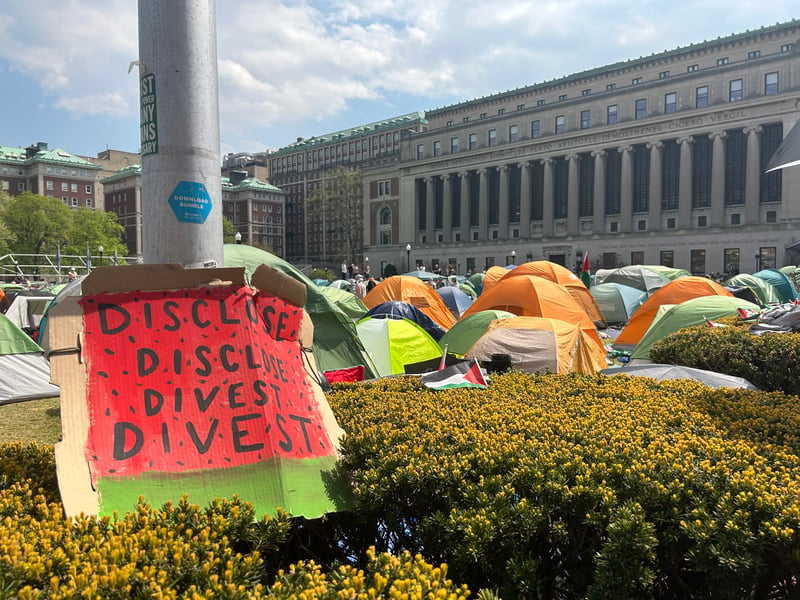
Columbia has become a key target of the Trump administration after its tent encampment, pitched to protest the university’s investment in Israel, gained national attention among the broader pro-Palestine movement. President Donald Trump called the encampment and ensuing protests on campus antisemitic and pledged to punish the university for failing to quell them sooner.
 Follow @Uebey
 Follow @uebey.bsky.social
Subscribe to our free newsletters
Our weekly newsletter Closing Arguments offers the latest about ongoing trials, major litigation and rulings in courthouses around the U.S. and the world, while the monthly Under the Lights dishes the legal dirt from Hollywood, sports, Big Tech and the arts.