
 Search Articles


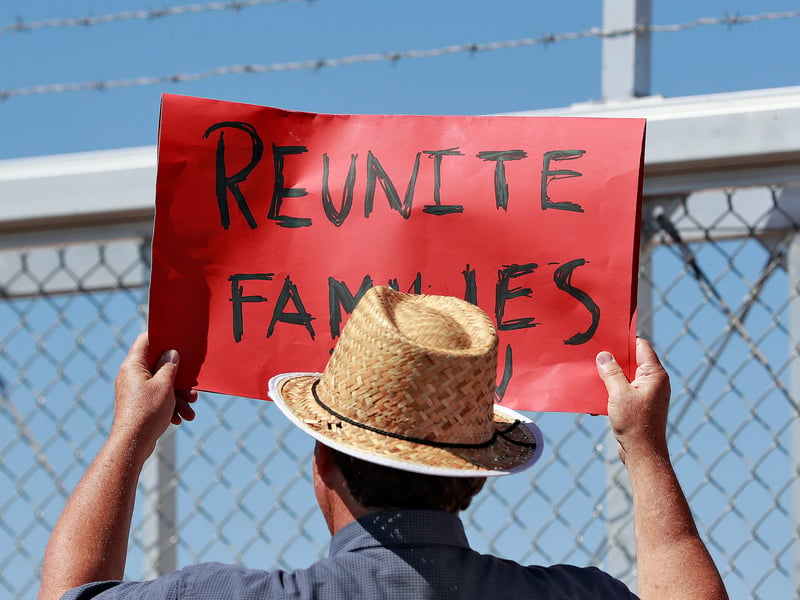
SAN DIEGO (CN) — The federal government violated the terms of a settlement relating to President Donald Trump’s policy that separated immigrant children from their parents, by failing to adequately provide legal advice to thousands of asylum seekers involved in the suit, a federal judge in San Diego ruled Wednesday.
Finalized at the end of 2023, the settlement between some 9,000 class members and the federal government mandates that Trump’s “zero-tolerance” policy on immigration, or a similar policy, can’t be reenacted by a presidential administration for eight years. It also funds efforts to reunite some 4,500 to 5,000 children separated as a result of the policy with their parents in the U.S, and calls for a pathway for asylum in the U.S.. It further requires certain benefits to be provided for those affected by the policy, like work authorization, housing, medical care and legal services and advice.
The Acacia Center for Justice was handling such legal support services until the Trump administration cut off funding for it and referred class members to seek legal advice from a list of pro bono organizations.
It takes a lot of time and expertise to properly advise someone and their family to apply for asylum, and few pro bono firms can do that without some type of mentorship, American Civil Liberties Union attorney Lee Gelernt, who represents migrant families, argued in a court Wednesday.
Acacia had such expertise and the desire and ability to reach out to the thousands of class members to advise them of their legal rights, but since the government took over last month in what Gelernt said he suspected was a Department of Government Efficiency initiative, they haven’t placed a single class member with an attorney yet.
“Right now, we’re a month into this and people’s lives are at stake and the government doesn’t have a plan,” he said. “These are not technical issues. If people don’t get legal advice, they’re going to get reseparated from their children.”
As long as the government remains in compliance with the language of the settlement, it should be able to try alternative methods of providing such services, attorney for the government Daniel Schutrum-Boward said.
Before the reconfiguration of the program for legal services, “the government was doing more than the settlement called for,” he said.
The plaintiffs can’t prove that anybody has been denied legal advice, he added, saying more time is required to show that the program is working.
But U.S. District Judge Dana Sabraw, a George W. Bush appointee who has overseen the case since 2018, didn’t buy the government’s line of reasoning. The plaintiffs came forward with enough evidence to prove that the government breached the settlement, he said.
His bench ruling did not describe what remedies the plaintiffs would be granted to get the government to follow the settlement. Sabraw said he would aim to include them in a written order by next week at the latest.
Before ending the hearing Sabraw asked Schutrum-Boward if any of the class members have been detained or deported by U.S. Immigration and Customs Enforcement.
Schutrum-Boward said three had been detained.
After the hearing, Gelernt said that three people had recently been detained, but more had probably been detained in recent weeks.
“If you provide a list to ICE, are they going to stop deporting class members, or is that something they’re not prepared to do voluntarily?” Sabraw asked.
ICE already has a list of the class members, Schutrum-Boward said, but he did not know why members were being detained and deported, unless they had a prior criminal conviction.
The parole dates of more than 400 people in the class expired in May 2025, the plaintiffs said in their motion to enforce the settlement. More than hundred people this month have expiring parole dates and 142 in July face the same deadline.
“Without parole, these class members have no lawful status in the United States and are therefore subject to ICE arrest, detention, and removal. Any class member who is arrested and detained will be reseparated from their family. Further, parole provides the basis for work authorization for many class members, meaning that when they lose one, they will lose the other.” the plaintiffs said in their motion.
They added that even more at risk are class members who still have standing removal orders.
“They are a high priority for immigration enforcement, and if arrested, they face deportation without further notice or hearing,” they add. “What is more, these class members cannot take steps toward asylum until their removal orders are rescinded in accordance with the terms of the settlement, and this process requires expert legal assistance which is now unavailable.”
The lawsuit was originally filed in 2018 on behalf of a Congolese mother and her six-year-old daughter who had been separated at the border. ICE sent the mother and daughter to detention sites thousands of miles apart, without providing any meaningful contact for months.
After images of children held in cages and audio of children in federal custody crying and begging for their parents went public, public, political and legal pressures forced the Trump administration to sign an executive order to stop the family separation program in the summer of 2018. Sabraw then issued a nationwide injunction and ordered the federal government to reunite all of the children separated by the policy within 30 days.
Since that ruling, the federal government asked for more time to find parents of children separated at the border because of challenges arising from poor record-keeping.
According to a status report filed in October 2023, attorneys trying to reunify families made contact with the parents of 1,126 separated children. At the time, the parents of 72 children couldn’t be found. Most were believed to have been deported.
Subscribe to our free newsletters
Our weekly newsletter Closing Arguments offers the latest about ongoing trials, major litigation and rulings in courthouses around the U.S. and the world, while the monthly Under the Lights dishes the legal dirt from Hollywood, sports, Big Tech and the arts.