
 Search Articles


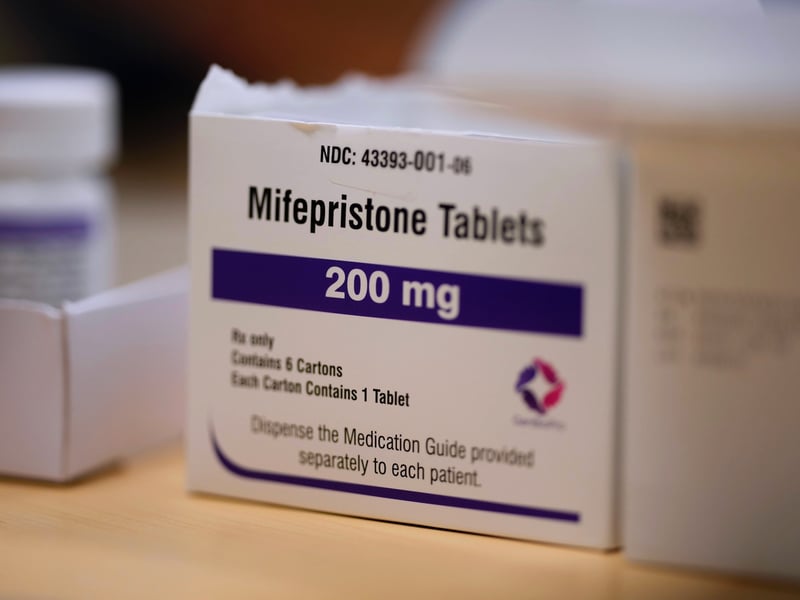
(CN) — A group of blue states that sued for access to mifepristone and misoprostol may now find limited availability to the two drugs administered as medication abortion.
On Tuesday, U.S. District Judge Thomas Rice reversed his own injunction that blocked the federal government from limiting access to mifepristone in Washington state, Oregon and 16 other states and Washington, DC.
“Now that the court has a full record, it is not the court’s role to review the scientific evidence and decide whether mifepristone’s benefits outweigh its risks … . That is precisely FDA’s role,” Rice wrote. “It appears FDA fully considered the important aspect of the issues in this case and came to a reasonable conclusion. The court cannot find, based on the full record before it, that the FDA was arbitrary and capricious in its decision.”
According to the Administrative Procedure Act — which the plaintiff states sued under — a court can only set aside an agency action if the agency is found to have acted arbitrarily and capriciously.
But Rice, a Barack Obama appointee, found the Food and Drug Administration didn’t ignore federal laws and properly changed the rules to remove an in-person dispensing requirement and add a pharmacy-certification requirement.
During the Covid-19 quarantine, the Biden administration had partially implemented a policy that allowed pregnant people to obtain the medication via mail or other methods that didn’t require an in-person visit. In 2023, the FDA officially adopted the process but added the certification requirement.
Led by Washington and Oregon, the states had claimed in a February 2023 lawsuit filed in the Eastern District of Washington that the FDA’s pharmacy requirement places undue burdens on the states’ doctors, pharmacies and patients by making the drugs harder to access and more dangerous for those traveling from states that have made abortion illegal.
The states had claimed the FDA failed to consider a 2022 Canadian study that concluded there was no difference in adverse effects between when Canada dispensed the drug with and without similar restrictions.
The FDA said the study was beyond the cut-off date it established because “had FDA declined to establish a cut-off date, it would never have completed its review.”
Rice agreed. “The FDA did not ignore the laws that apply nor the regulations. The FDA reviewed materials between March 29, 2016 and July 26, 2021, not the subsequent Canadian study," he wrote.
Granting summary judgment to the FDA, which countered a motion for summary judgment from the plaintiffs, Rice said that the agency correctly analyzed research on mifepristone and determined that it qualified for a “risk evaluation and mitigation strategy” that considers if a particular drug’s benefits outweigh its risks.
In 2000, the FDA approved mifepristone, typically used in combination with misoprostol to end early pregnancies. Mifepristone interrupts early pregnancy by blocking the effect of progesterone, a hormone that maintains a pregnancy. Misoprostol causes uterine contractions that cause miscarriage.
The states argued the strategy was unnecessary and asked for the mifepristone change to be remanded to the FDA, claiming that since its approval, “studies have proven that the REMS does nothing to promote patient safety, but does harm patients by artificially limiting access and delaying time-sensitive care.”
But the FDA said “based on its review, FDA found evidence sufficient to support eliminating the in-person dispensing requirement, so long as pharmacy certification was added and the other existing REMS elements were retained.”
In April 2023, Rice had sided with the states to bar the FDA from “altering the status quo and rights as it relates to the availability of mifepristone” for plaintiffs — consisting of Washington state and Oregon, along with Arizona, Colorado, Connecticut, Delaware, Illinois, Michigan, Nevada, New Mexico, Rhode Island, Vermont, Hawaii, Maine, Maryland, Minnesota, Pennsylvania and the District of Columbia.
However, that ruling had conflicted with a same-day injunction out of Texas, where Donald Trump-appointed U.S. District Judge Matthew Kacsmaryk ruled the FDA should not have approved the abortion drug at all.
Subscribe to our free newsletters
Our weekly newsletter Closing Arguments offers the latest about ongoing trials, major litigation and rulings in courthouses around the U.S. and the world, while the monthly Under the Lights dishes the legal dirt from Hollywood, sports, Big Tech and the arts.