
 Search Articles


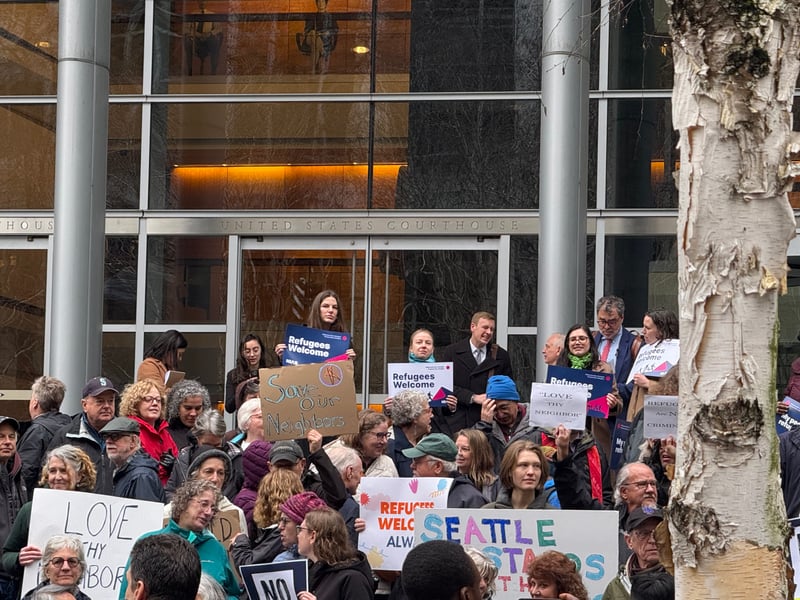
SEATTLE (CN) — A federal judge must wrestle with if the Trump administration is defying his court order to admit refugees and whether the court has the authority to proceed amid a pending appeal and new injunction precedent.
At issue is whether individuals approved for travel under U.S. Refugee Admission Program — whose travel was abruptly canceled in the first days of Donald Trump’s presidency — remain protected by a preliminary injunction, even after an appeals court narrowed the scope.
During an emergency hearing held remotely on Monday, U.S. District Judge Jamal Whitehead questioned both the government and the plaintiffs — three refugee aid organizations and nine individual refugees — about how the recent U.S. Supreme Court decision limiting nationwide injunctions impacts this case.
“Even from a practical standpoint, nationwide relief is necessary to provide meaningful relief in this case,” argued Jonathan Hawley, attorney with Perkins Coie, representing the plaintiffs.
But the government argued that the Supreme Court made clear what it had long argued: nationwide injunctions are overbroad in scope. Plus, while the court has the authority to move forward with the case and consider the plaintiffs’ motion for class certification, doing so would be impractical, Justice Department attorney Joseph McCarter argued.
Whitehead, a Joe Biden appointee, issued a preliminary injunction barring the government from implementing certain provisions of an executive order targeting the U.S. Refugee Admission Program on Feb. 28. The government appealed to the Ninth Circuit, which then partially stayed that injunction.
The appeals court clarified that the preliminary injunction may remain in effect, but only to those who had been approved and conditionally admitted to enter the country as a refugee on or before Jan. 20.
The plaintiffs argued this exception applied to thousands of refugees whose travel plans were abruptly canceled, but the government suggested a far smaller group of 160 people — a number it arrived at by looking at planned arrivals set for two weeks around Jan. 20. Whitehead, after receiving further clarification from the Ninth Circuit, reluctantly accepted the government’s estimate.
However, the plaintiffs accused the government of refusing to admit even that small group of refugees based on Trump’s recent travel ban.
“The June 4 travel ban is the latest obstacle that defendants have manufactured to avoid compliance with the preliminary injunction,” Hawley said. Of the 120 injunction-protected refugees who are still outside of the United States, the defendants have excluded two-thirds from admission based on the ban — which the plaintiffs pointed out specifically stated it was not intended to limit refugee admission.
The government conceded that the language of the ban specifically addresses people traveling with visas, which aren’t issued for those entering under the U.S. Refugee Admission Program, but argued that the general language supports the decision to narrow the pool of injunction-protected refugees further.
“Essentially, yes, there is a practical effect of the new proclamation on the government’s ability to carry out the injunction, but that’s not to say the government is flouting the court’s order at all,” David Kim, Justice Department attorney representing the government, argued.
The plaintiffs also suggested that the Ninth Circuit’s clarification order could be interpreted to expand the pool of protected refugees to those whose travel plans were canceled even before Jan. 20.
“There’s good reason to question defendant’s good faith assessment of why travel was canceled in the lead-up to the refugee ban,” Hawley said. “The fact that there might have been pretextual cancelations in the run-up to the executive order might explain why there are only 160 injunction-protected refugees in the two-week period after Jan. 20.”
Given that Biden has set a limit of 125,000 refugee admissions for the fiscal year of 2025, Hawley noted that it would make more sense for there to be thousands of refugees to have had travel planned for that two-week window rather than hundreds.
“The idea that the government might have proactively canceled some travel because of the refugee ban is not only probable but likely,” Hawley said.
“So, how far back do I go? 2024, 2023? Where is the line — is there a line?” Whitehead asked. Hawley explained that December 2024 is an appropriate place to start.
The government pushed back on the notion that it used the forthcoming order to cancel travel and argued that setting a December limit was “arbitrary line-drawing.”
While Whitehead recognized the government’s position, he also noted that the Ninth Circuit’s brief orders left a lot open to interpretation.
“It doesn’t say anything about the reason for the cancellation or the timing of the cancellation,” Whitehead remarked.
Whitehead indicated he would release an order regarding compliance framework within the week.
Subscribe to our free newsletters
Our weekly newsletter Closing Arguments offers the latest about ongoing trials, major litigation and rulings in courthouses around the U.S. and the world, while the monthly Under the Lights dishes the legal dirt from Hollywood, sports, Big Tech and the arts.