
 Search Articles


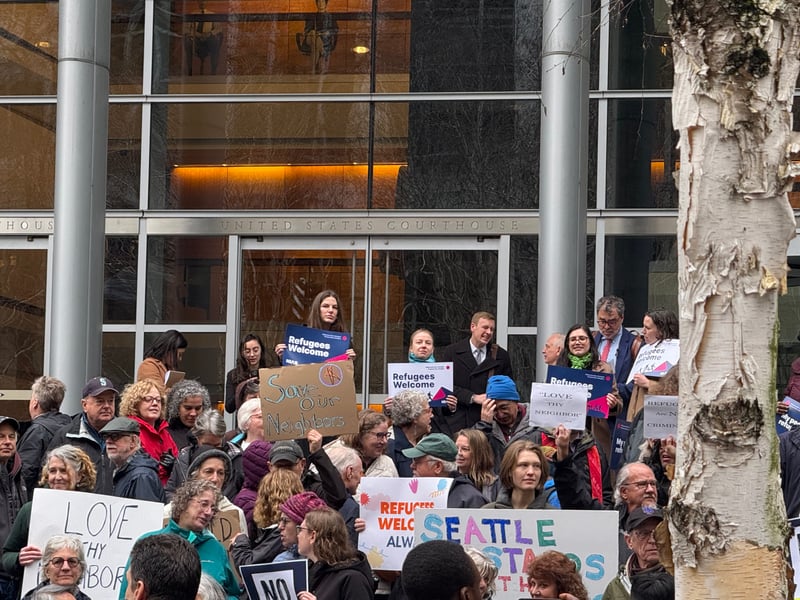
SEATTLE (CN) — The government must begin admitting all those who were set to enter the United States and had their travel approved through the U.S. Refugee Admission Program before President Donald Trump took office and quickly tried to shutter the program, a federal judge ordered on Monday.
Rather than admit and resettle the mere 160 people the government identified as having had travel scheduled for within two weeks of Jan. 20 — the day Trump issued an executive order calling for refugee admissions to come to a halt — the government will have to admit closer to 12,000 refugees, U.S. District Judge Jamal Whitehead determined in the order.
The court and the government’s dueling interpretations of a Ninth Circuit Court of Appeals order regarding which refugees were exempt from the appeals court’s stay on Whitehead’s injunction came to light during a status conference last week.
The Barack Obama-appointed judge firmly rejected the government’s conservative estimate.
“The government’s interpretation is, to put it mildly, ‘interpretive jiggery-pokery’ of the highest order,” Whitehead wrote.
After Whitehead issued a preliminary injunction preventing the government from fully suspending refugee admissions, the Ninth Circuit issued a brief order staying the order except as it applied to people conditionally approved for refugee status before Jan. 20.
The Ninth Circuit didn’t define “conditional approval,” which led to conflicting interpretations about who is protected under the injunction. The appeals court then clarified that its previous order only pertained to individuals who met three conditions on or before Jan. 20: had an approved refugee application, were cleared for travel to the United States and had “arranged and confirmable travel plans to the United States.”
“It is surprising that there could be any disagreement about the meaning of a judicial order that articulates three specific criteria in plain, straightforward language,” Whitehead wrote.
Yet, the government took this to mean those who had arranged and confirmable travel plans set to take place within two weeks of Jan. 20, a reading that the plaintiffs — three refugee aid organizations and nine individual refugees — and Whitehead criticised as straying too far from the plain text of the order.
“Had the Ninth Circuit intended to impose a two-week limitation — one that would reduce the protected population from about 12,000 to 160 individuals — it would have done so explicitly,” Whitehead wrote. “The Ninth Circuit is capable of imposing temporal limitations when it intends to do so.”
“This court will not entertain the government’s result-oriented rewriting of a judicial order that clearly says what it says,” Whitehead wrote. “The government is free, of course, to seek further clarification from the Ninth Circuit. But the government is not free to disobey statutory and constitutional law — and the direct orders of this court and the Ninth Circuit — while it seeks such clarification.”
For the immediate future, the government must process, admit and provide resettlement services to refugees protected by Whitehead’s injunction.
To make sure the government carries out its obligations, Whitehead ordered the government to meet certain benchmarks within the coming weeks. Within one week, the government must instruct agency offices and staff to resume processing the cases of injunction-protected refugees, provide an update on the status of each individual plaintiff’s case, and reinstate cooperative agreements with resettlement support partners to the extent necessary to admit and resettle the exempt refugees.
Within two weeks, the government must notify all injunction-protected refugees that the government will resume processing their cases, restore funding to resettlement support centers as needed to process cases and renew travel plans that may have lapsed while the program has been shuttered.
The government has three weeks to fully resume post-arrival services for refugees and four weeks to make sure that all injunction-protected refugees can finish the steps required to travel to and enter the country.
In addition to the weekly requirements, the government must submit a report detailing its completion of each compliance measure within three days of completing each one.
Should the government believe that any of the outlined measures aren’t feasible, Whitehead directed it to confer with the plaintiffs and agree on modified compliance measures.
Subscribe to our free newsletters
Our weekly newsletter Closing Arguments offers the latest about ongoing trials, major litigation and rulings in courthouses around the U.S. and the world, while the monthly Under the Lights dishes the legal dirt from Hollywood, sports, Big Tech and the arts.