
 Search Articles


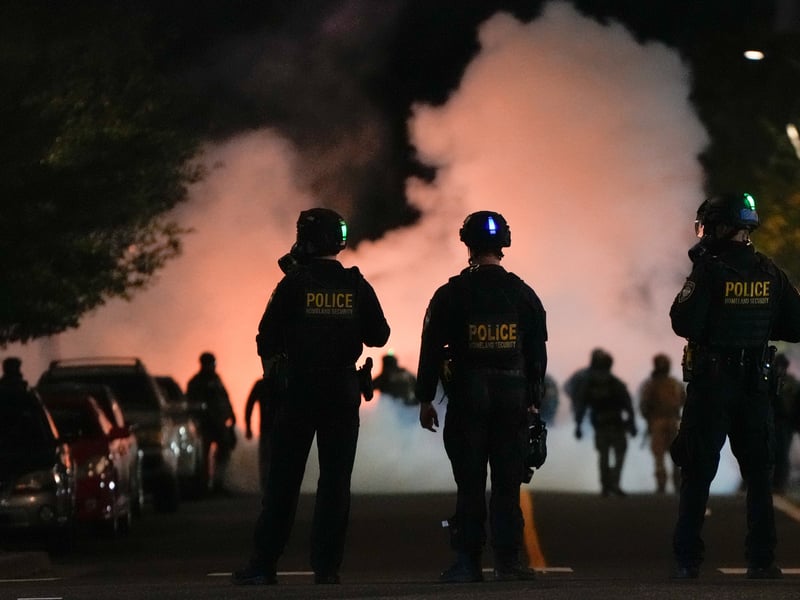
PORTLAND, Ore. (CN) — The residents of a low-income apartment complex neighboring the Portland, Oregon, Immigration and Customs Enforcement facility returned to federal court on Wednesday seeking to keep tear gas deployed at protesters out of their homes.
The federal government argued the officers deploying the chemicals are serving a government interest in controlling unruly crowds, but U.S. District Judge Amy Baggio appeared incredulous.
“There’s no legitimate governmental objective to putting tear gas in the homes of the people who happen to live down the street, is there?” the Joe Biden appointee asked.
Nine residents at Gray’s Landing, a low-income apartment building that sits diagonally across the street from the ICE facility in southwest Portland, joined forces with the apartment’s management companies and sued the federal government over the chemical deployment in December.
The residents accuse the defendants, which include ICE and the Department of Homeland Security, of deploying chemical munitions at crowds of protesters without any consideration of the impact on the nearby apartment complex. They say the emissions waft into the residents’ homes, affecting their health for days or weeks following the sprays.
The plaintiffs argue that the errant chemicals are depriving them of their due process right to bodily integrity and that the federal agents are deliberately indifferent to the impact the chemicals have on the residents.
“Here, the government is actively pumping toxic chemicals into the air right outside the plaintiffs’ windows,” said Stephen Wirth, attorney with Jacobson Lawyers Group representing the plaintiffs. “There are no circumstances in which a person would consent to being teargassed.”
During an evidentiary hearing on Friday, the plaintiffs took the stand to describe the impact the chemical agents have had on them. Some have worn gas masks to bed, others slept in the closet or bathroom to avoid the chemicals and several have said they made repeated visits to the doctor to deal with new or worsening medical conditions.
The plaintiffs say that the federal agents have done nothing to mitigate the effect on Gray’s Landing residents and accused them of regularly deploying chemicals without warning or cause.
“The fact that defendants regularly fail to follow their own policies is strong evidence they know their conduct is wrong, and their persistence shocks the conscience,” Wirth said. “This is a truly egregious abuse of executive power.”
The hearing came just a day after U.S. District Judge Michael Simon, a Barack Obama appointee, extended a temporary restraining order in a separate lawsuit blocking federal agents from using chemical or projectile munitions outside the ICE facility unless there was a threat of physical harm.
While that order has stopped officers from deploying chemicals, the residents argue that a preliminary injunction in their case is needed.
However, the federal government argued that not only are the federal agents authorized to deploy chemicals, but also that ruling in favor of the plaintiffs would irrationally expand due process protections.
The consequences of an order in favor of the residents would mean that law enforcement officers would violate the clause when they deploy any munition that inadvertently drifts into nearby homes or businesses, argued Samuel Holt with the Justice Department.
“That is not the law and should not be the law,” Holt said, imploring Baggio to consider the broad practical effects of such a ruling.
Baggio pushed back.
“Under your theory, could federal officials detonate or deploy unlimited chemical munitions in the face of a protest so as to create a city-wide cloud of chemicals and no one who suffered collateral damage would have a right to come to court?” Baggio asked.
The government responded that it was hard to know when, if ever, the substantive due process clause would kick in in that scenario.
“The lines are blurred and unclear,” Holt said.
Further, the government argued that dispersing crowds is not a behavior that shocks the conscience and that none of the plaintiffs’ video evidence shows the lead-up to the deployment of munitions.
Baggio pressed the government on the evidence the plaintiffs provided, which showed federal agents deploying clouds of chemical munitions in the street directly in front of the apartment complex and pushing crowds of protesters blocks away from the ICE facility.
“Point me to where in the record there is government evidence that will help me understand why that isn’t excessive?” Baggio asked.
Holt argued that tensions were high on many of the nights that were captured on video and that the court shouldn’t second-guess officers’ responses to unlawful behavior.
The residents noted that the defendants were in the best position to submit evidence contradicting the plaintiffs’ position, but failed to do so.
Baggio said she would issue a decision as quickly as possible.
Protests at Portland’s ICE facility have been ongoing since last spring in varying sizes. In September, President Donald Trump announced an intent to send in the National Guard to protect the facility, which increased protest activity and stoked tensions. That bid for federalized troop protection ultimately failed.
Subscribe to our free newsletters
Our weekly newsletter Closing Arguments offers the latest about ongoing trials, major litigation and rulings in courthouses around the U.S. and the world, while the monthly Under the Lights dishes the legal dirt from Hollywood, sports, Big Tech and the arts.