
 Search Articles


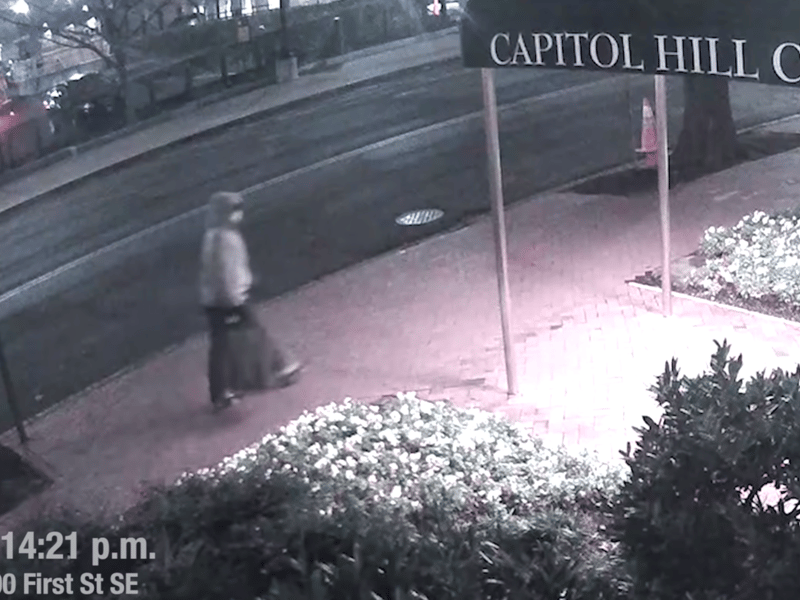
WASHINGTON (CN) — A federal judge Tuesday declined to decide whether the Virginia man suspected of placing two pipe bombs outside the Republican and Democratic National Committee headquarters on Jan. 5, 2021, should be held in detention before trial as he weighs the defense’s request he be released under strict conditions.
U.S. Magistrate Judge Matthew Sharbaugh heard arguments from Brian Cole Jr.’s defense attorney that the government failed to show Cole posed a danger to his community and could not be adequately monitored at his grandmother’s home. He indicated he would rule within the next day or two.
Mario Williams of HDR Law Firm, representing Cole Jr., argued that his client should be released because he lacked a prior criminal record, last purchased explosive materials in August 2022 that have gone untouched since, and has not shown any likelihood he would pose a danger to his community if released.
Williams highlighted the fact that the vast majority of Jan. 6 defendants were released on pretrial detention — outside of the most violent offenders and members of the Oath Keepers and Proud Boys — as the government could not show that strict release conditions were inadequate.
Williams suggested that Cole could be released to his grandmother, Loretta Cole Donnette, who would serve as a third-party custodian while Cole is under house arrest, along with GPS monitoring, weekly reporting and unannounced visits by pretrial services.
Donnette, who attended Tuesday’s hearing with Cole’s mother, took the stand to assure Sharbaugh that Cole would remain under her and her husband’s watchful eye, and if Cole violated any terms of his release conditions, she would immediately report it to the court.
Sharbaugh described the role as the court’s “eyes and ears” and said he doubted he could report his own child if he were in the same position.
“We know this is a high-profile case; we want him to make it through this case as easily as possible, but if he’s not doing something right, I have to let the court know,” Donnette said.
Justice Department attorney Charles Jones argued those conditions would merely return Cole to the circumstances he had been in as he planned and carried out his plot, warning that Cole had shown a pattern “of concerning and disturbing conduct” even after the August 2022 purchase.
Jones highlighted the fact that Cole had wiped his phone 943 times since December 2020 and was found with those remaining explosive materials in his room at his mother’s home and in his car.
Cole was arrested on Dec. 4 in Woodbridge, Virginia, just 35 miles from Washington. Federal prosecutors charged him with two counts of use of an explosive device.
Cole’s arrest brought a potential end to nearly five years of uncertainty surrounding the two improvised explosive devices discovered just an hour before a mob of rioters breached the U.S. Capitol on Jan. 6. Surveillance footage around the DNC and RNC had shown an individual placing the bombs at 7:54 p.m. and 8:16 p.m., respectively, on Jan. 5.
According to the Justice Department in a memorandum urging Cole’s pretrial detention, Cole provided a “detailed confession” to the crime and explained his motivation.
“By his own admission, the defendant committed these chilling acts because he was unhappy with the response of political leaders on both sides of the political aisle to questions raised about the results of the 2020 election, and ‘something just snapped,’” the Justice Department wrote.
According to the government, Cole spent months acquiring the necessary materials and learned how to assemble the pipe bombs by watching YouTube science videos and playing video games.
Cole specifically targeted the DNC and RNC and chose Jan. 5 in part because the 2020 election was set to be certified on Jan. 6.
Further, he said he was inspired to use pipe bombs because of the Troubles in Ireland, where the Provisional Irish Republican Army regularly targeted political officials and civilians through the ’60s and ’90s.
“In his own words, the defendant did so because he did not ‘like either party,’ but ‘they were in charge,’ and thus were, in defendant’s mind, an appropriate target for extreme acts of violence,” the Justice Department added.
Before Tuesday’s hearing, the Justice Department informed the court it had obtained an indictment from a grand jury at the D.C. Superior Court, raising questions about whether Sharbaugh could accept the indictment.
Sharbaugh noted there was very little precedent, with the only such case currently pending before the D.C. Circuit.
Chief U.S. District Judge James Boasberg determined in November that he could accept one such indictment in the case of Kevontae Stewart, who was charged with illegal firearm possession by a local grand jury after prosecutors failed to obtain an indictment from a federal one.
Boasberg’s decision was appealed and stayed by the D.C. Circuit. The appellate court has yet to rule, leaving the issue an open question for Cole’s case.
 Follow @Ryan_Knappy
Subscribe to our free newsletters
Our weekly newsletter Closing Arguments offers the latest about ongoing trials, major litigation and rulings in courthouses around the U.S. and the world, while the monthly Under the Lights dishes the legal dirt from Hollywood, sports, Big Tech and the arts.