
 Search Articles


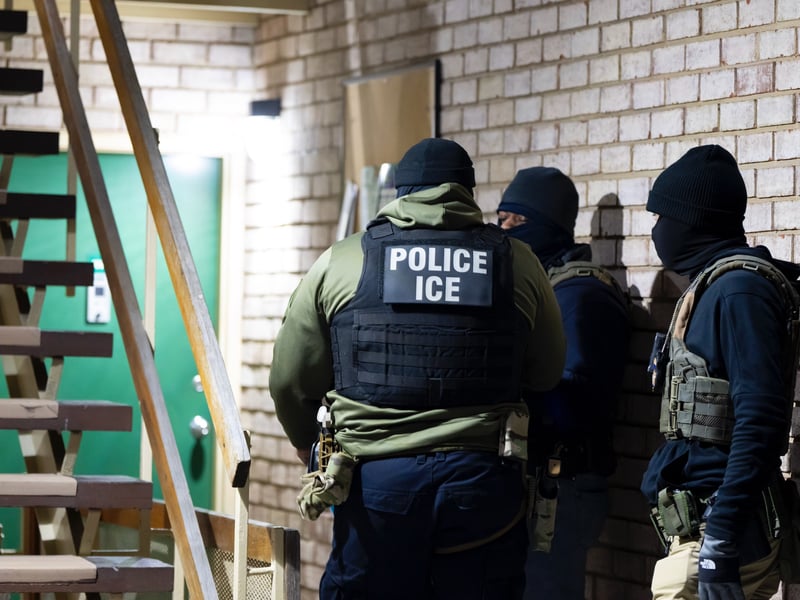
(CN) — A federal judge on Monday questioned government attorneys about the use of face masks on federal immigration agents, as higher education groups wrapped up their lawsuit against the Trump administration over its attempted deportations of pro-Palestinian student protesters.
“It would seem that the common sense inference is that that is to spread fear,” U.S. District Judge William Young of Massachusetts said of masked Immigration and Customs Enforcement agents arresting students.
Young, a Ronald Reagan appointee, spent the past two weeks presiding over the bench trial, in which groups including the American Association of University Professors and the Middle East Studies Association tried to prove that the arrests of students like Mahmoud Khalil and Rumeysa Ozturk were unconstitutional attempts from the government to chill pro-Palestinian speech on college campuses nationwide.
At closings on Monday, the government tried to justify its actions, citing case law and testimony that doesn’t necessarily greenlight their measures, but also doesn’t outright preclude them.
“As we heard from government agents, there’s no rule requiring that masks be worn in effectuating an arrest, and there’s no rule prohibiting it either,” said Justice Department attorney Ethan Kanter.
“Isn’t that strange?” the judge shot back. “I don’t know of a single law enforcement agency in the United States that permits their members, apparently at their option, to wear masks when carrying out their duty.”
The Trump administration says it gives ICE agents the option to wear face coverings to avoid being personally identifiable as they enforce the president’s controversial deportation agenda. But Young acknowledged the practice runs afoul of widely accepted strategies of good policing.
“Masks are an indicia that by its very nature spreads fear,” the judge said.
It’s a central argument for the plaintiffs, who argued throughout the trial that both students and educators were intimidated into silence by the arrests of their peers — Khalil’s being the first of several.
A lawful permanent resident with a green card, Khalil was arrested in New York City in March after the government said his role in pro-Palestinian protests at Columbia University was threatening to the United States’ foreign policy interests. He was recently released from custody after three months, but he is still fighting deportation.
Brown University international studies professor Nadje Al-Ali, one of the plaintiffs’ witnesses, reconsidered attending protests and international research trips after Khalil’s arrest.
“Following the arrest and the detention and the threat of deportation of several students … I felt that it was too risky for me to do research in the Middle East,” she told the court on July 7.
On Monday, the plaintiffs said that was by design, pointing the court to statements from government officials that egged on the arrests.
“The statements are to the effect of, ‘You saw what we did to Mr. Khalil, you could be next,’” said plaintiffs’ attorney Alexandra Conlon. “The public statements are designed by government officials to terrorize everyone else who shares the views of the people who they have arrested.”
The government’s removal policy, according to Conlon, is “exactly what the First Amendment was meant to prevent.
“It is intimidating and scaring students into silence to our collective detriment,” she said.
But the Trump administration argued that no such intimidation campaign is taking place, and that a combination of both speech and conduct justified the arrests of protesters like Khalil.
The government lawyers also claimed that non-citizens are not equally protected under the First Amendment.
“The answer to the question of whether aliens and citizens have equivalent rights under the First Amendment is no, they’re not equivalent,” Kanter said.
The plaintiffs are seeking an order from the judge that finds the Trump administration’s deportations of these pro-Palestinian students unconstitutional, though they’ll have to be patient. Young isn’t expected to rule in this case until September, as the government is fighting in a federal appeals court to block some of the evidence the judge admitted at trial.
 Follow @Uebey
 Follow @uebey.bsky.social
Subscribe to our free newsletters
Our weekly newsletter Closing Arguments offers the latest about ongoing trials, major litigation and rulings in courthouses around the U.S. and the world, while the monthly Under the Lights dishes the legal dirt from Hollywood, sports, Big Tech and the arts.