
 Search Articles


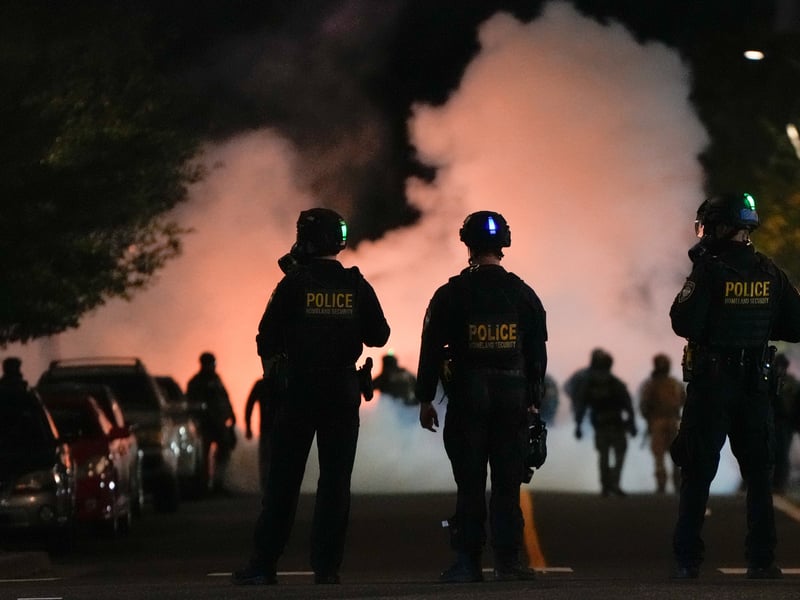
CHICAGO (CN) — A federal judge on Wednesday found that U.S. Immigration and Customs Enforcement agents repeatedly violated reporters’ and activists’ First and Fourth Amendment rights.
A group of journalists, religious leaders and community activists filed a class action against ICE, among other federal agencies and officials, on Monday. The class said ICE agents used a pattern of extreme brutality in an effort to silence the press and civilians, particularly at an immigration holding facility in Broadview.
The Broadview immigration facility has been a flashpoint of conflict since President Donald Trump announced his crackdown on immigration enforcement in Chicago, which he dubbed “Operation Midway Blitz.” Federal agents have shot rubber bullets and chemical agents at peaceful protesters, journalists and a priest who was trying to pray for the people inside the facility.
On Monday, the class asked U.S. District Judge Sara Ellis to grant them a temporary restraining order that would prevent ICE agents from using excessive force on reporters or protesters. Ellis denied an injunction at the initial hearing Monday afternoon, in part because she and the defendants’ counsel hadn’t read the filing in full.
She said she’d grant the injunction Wednesday but indicated that she wouldn’t file the actual order until Thursday morning.
“The TRO essentially directs agents and officers to follow the training that they’ve already received on use of force,” Ellis said. “[It’s] essentially directing them to follow their own rules, policies and regulations, the laws that apply to them and the behavior that the Constitution demands.”
Sean Skedzielewski, an attorney representing the government, asked Ellis if she’d limit the TRO to the Broadview facility since that’s from which a majority of plaintiffs’ evidence stems, and she declined.
“If I felt secure that this was only happening in Broadview, I’d be happy to limit it, but I don’t believe that is the case, and so I am not going to limit the TRO simply to Broadview,” she said.
Skedzielewski, who appeared remotely at Wednesday’s hearing, argued that the proposed relief was too broad, considering there is no way to tell who is a peaceful protester or a journalist.
He also noted that it’s already Department of Homeland Security policy to avoid lethal force unless absolutely necessary. He maintained that the restrictions the TRO placed on ICE agents would make it more difficult for them to do their jobs.
“Such restrictions improperly limit law enforcement’s ability to engage in legal enforcement operations, while increasing the potential for injuries to CBP agents, members of the public interfering with law enforcement operations, or arrested subjects,” he wrote in a reply brief.
In a similar vein, another federal judge on Wednesday extended a consent decree that requires ICE officers to document and report probable causes for immigration arrests. In September, the Supreme Court allowed federal agents in Los Angeles to stop people based on race, ethnicity, language and other factors, but the consent decree says officers must have probable cause that they’re in violation of immigration law and a flight risk.
U.S. District Judge Jeffrey Cummings cited warrantless arrests in his 52-page order, which extends the consent decree until February 2026. The consent decree, born out of a 2022 settlement called the Castanon Nava agreement, was set to sunset in March.
In particular, Cummings mentioned a recent South Shore apartment raid, during which federal agents propelled onto an apartment building, kicked in people’s doors in the middle of the night, and rounded up 37 people to arrest. Agents separated zip-tied children and put them in unmarked vans, and some of the people detained were U.S. citizens.
Cummings’ order could have sweeping impacts on immigration enforcement, both in Chicago and around the country.
The class action from journalists and activists isn’t the only legal challenge to Trump’s increased immigration enforcement efforts. The state of Illinois and the city of Chicago filed a lawsuit against the Trump administration on Monday after Trump announced that he’d send the National Guard into the city to help ICE agents. Recent reports indicate that National Guard troops could be deployed in the Chicago area as soon as Wednesday evening.
The complaint described Trump’s plan as “patently unlawful” and sought an injunction to block the deployment, which a federal judge denied on Monday. Further arguments are set to be heard on Thursday.
 Follow @RosenCaitlyn
Subscribe to our free newsletters
Our weekly newsletter Closing Arguments offers the latest about ongoing trials, major litigation and rulings in courthouses around the U.S. and the world, while the monthly Under the Lights dishes the legal dirt from Hollywood, sports, Big Tech and the arts.