
 Search Articles


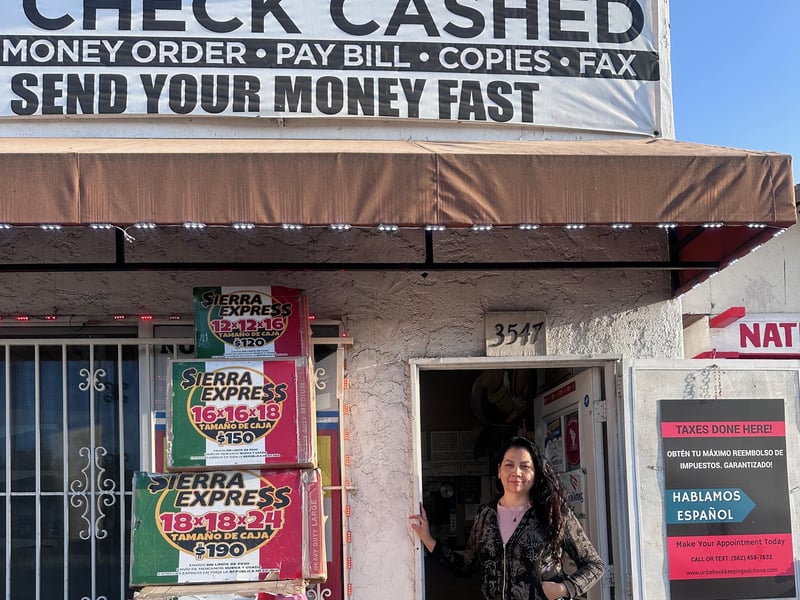
SAN DIEGO (CN) — A federal judge on Thursday ordered the government to stop enforcing a new requirement that check cashers, currency exchangers and other money service businesses along the Mexican border report all cash transactions over $200 to federal law enforcement while a lawsuit moves forward in California.
In March, the Treasury Department’s Financial Crimes Enforcement Network ordered businesses in 30 different ZIP codes across Texas and California to comply with the rule meant to uncover evidence of money laundering and other financial transactions by Mexican drug cartels.
But Esperanza Gomez, the owner of a small money transferring business in San Diego, filed a lawsuit in San Diego federal court in April claiming that the order will not only burden her and other similar business owners with mountains of unnecessary paperwork, but also force them to surveil their customers without the government providing any probable cause to suspect them of any wrongdoing.
U.S. District Judge Janis Sammartino, a George W. Bush appointee, ruled in favor of Gomez’s motion for preliminary injunction.
“I feel grateful because I don’t have to feel worried,” Gomez said. “It’s not just for me, it’s for the community too.”
However, Sammartino’s ruling only applies to counties that are under her jurisdiction within the Southern District of California, meaning all of San Diego and Imperial Counties in California.
Gomez’s attorneys are involved in a parallel suit in Texas federal court. Earlier this week, a judge ordered the Financial Crimes Enforcement Network to stop enforcing the rule against 10 small money services businesses that were parties to the lawsuit.
Robert Johnson, an attorney for the Texas plaintiffs and Gomez from the Institute for Justice, said there’s still work to be done to get complete relief to stop the government from enforcing the rule against all money services and other similar businesses in Texas.
The evidence of the rule’s damage to businesses in California prior to a temporary restraining order and its ongoing impact on businesses in Texas shows how harmful it is, Johnson said during the hearing.
While the rule was in effect for a week in California, Gomez saw a 50% to 60% drop in her customers and Western Union stopped providing cash transfers of any amount of money over $200, he said.
Johnson compared the rule to New York City’s attempt to require Airbnb to disclose the names and addresses of hosts as well as data on users, like the rental listing URL, the number of days the unit is rented and how much the platform collects in fees. In 2019, a federal judge blocked the law over concerns it could have violated the Fourth Amendment’s protection against unlawful search or seizure. The city later settled the suit and agreed to enact a much narrower data-sharing law.
The plaintiffs have hundreds of pages of administrative records discussing international money laundering by criminal organizations, none of which mentions those organizations using $200 money transfers or activity in the zip codes the government is targeting, Johnson said.
“This is the equivalent of a general warrant and unconstitutional under the Fourth Amendment,” he added.
The government tailored the rule to only last 180 days and only affect certain zip codes along the border where there’s a lot of financial transactions and activity, said Katherine Parker, an attorney with the Department of Justice representing the Financial Crimes Enforcement Network’s attorney.
“There is harm here, Your Honor. Has it been exaggerated? Yes. Could there be more efforts to reduce it? Yes. But the government is here because the statue — this is legitimate and legal,” Parker said.
The government made $200 the threshold for reporting “in order to sweep in almost everything,” she added.
When Sammartino asked why the government didn’t make the threshold zero dollars or $100 if they wanted to surveil every transaction along the border, Parker said she didn’t know.
Looking at a memo that the government used to set up a rationale for the order, Sammartino noted that it was submitted to the court without a date, meaning it could have been put out after the actual order was released.
“That’s troublesome. That doesn’t look good,” Sammartino said. “You’re a litigator, ma’am and you know it doesn’t look good.”
Subscribe to our free newsletters
Our weekly newsletter Closing Arguments offers the latest about ongoing trials, major litigation and rulings in courthouses around the U.S. and the world, while the monthly Under the Lights dishes the legal dirt from Hollywood, sports, Big Tech and the arts.