
 Search Articles


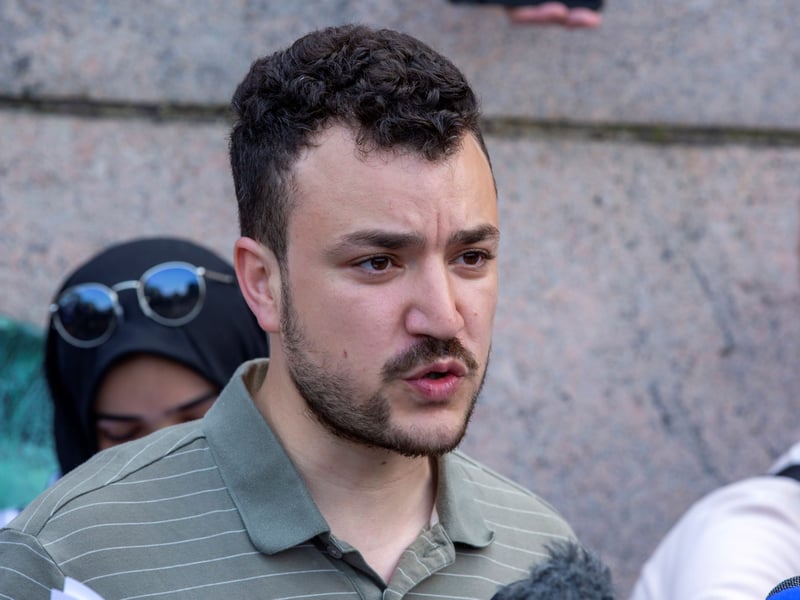
(CN) — A federal judge on Wednesday barred the Trump administration from continuing to detain Palestinian activist Mahmoud Khalil, finding that its treatment of the Columbia University graduate has irreparably harmed his reputation and chilled free speech.
U.S. District Judge Michael Farbiarz, a Joe Biden appointee in the District of New Jersey, granted a preliminary injunction in Khalil’s favor that bars the administration from continuing to keep Khalil locked up in a Louisiana immigration facility.
But he put a pause on his own order that prevents it from taking effect until 9:30 a.m. on Friday, giving the government about 40 hours to lodge an appeal that could keep Khalil behind bars.
Federal agents arrested Khalil, who is a Syrian citizen but a lawful U.S. resident and green card holder, on March 8 in the lobby of his Manhattan apartment building.
He claims the Trump administration is unlawfully trying to deport him for his leadership role in the highly publicized pro-Palestinian protests at Columbia last spring. Khalil served as a negotiator on behalf of students, and pushed the Ivy League college to divest from Israel.
Secretary of State Marco Rubio is seeking to remove Khalil from the country on a rarely used provision in immigration law that allows for a noncitizen’s deportation if their presence in the U.S. compromises foreign policy.
Farbiarz previously ruled that this is a “likely unconstitutionally vague” reason to detain Khalil. He doubled down on that finding Wednesday, ruling that that uncertainty surrounding Khalil’s detention makes it more likely that his speech could be curbed.
“There is a chilling effect on speech,” the judge said in a 14-page order that granted Khalil’s request for injunctive relief.
Injunctions like this are granted so that a party can avoid being harmed while legal battles are being waged. In order to win such an order, Khalil needed to prove that he was likely to succeed on his claim that his detention was unlawful and arbitrary.
“He has made this showing,” Farbiarz wrote.
Khalil also had to prove that, without this relief, he would suffer irreparable harm. Being detained more than 1,000 miles away from his wife in New York City, Khalil has already missed the birth of his first child due to his detention.
But Khalil claims his detention has also damaged his career prospects, ability to advocate and general reputation — none of which the Trump administration denies, according to Farbiarz.
Not helping the government’s case is Khalil’s lack of a criminal record. In fact, letters to the court from Khalil’s peers and professors paint him as a star student, a patient friend and an advocate for peace.
“The Secretary of State’s determination does not say that he has been involved in criminal activity or violence,” Farbiarz wrote in a footnote. “And the respondents have not put forward any evidence as to involvement by the petitioner in violence, destruction of property, or any other sort of criminal activity.”
The government isn’t just trying to deport Khalil for his potential impact on foreign policy, though. It also claims he omitted key details on his permanent residency application that make him subject to removal.
But even that wouldn’t justify his continued detention, Farbiarz said.
“The reason: the evidence is that lawful permanent residents are virtually never detained pending removal for the sort of alleged omissions in a lawful-permanent-resident application that the petitioner is charged with here,” he wrote.
Still, the government does have about two days to argue that these supposed omissions should keep Khalil locked up.
President Donald Trump acknowledged Khalil’s detention in March, promising that it was “the first arrest of many to come.” Since then, several other noncitizens have been arrested for their varying degrees of involvement with pro-Palestinian protests, in a trend that First Amendment experts have decried as an affront to free speech.
 Follow @Uebey
 Follow @uebey.bsky.social
Subscribe to our free newsletters
Our weekly newsletter Closing Arguments offers the latest about ongoing trials, major litigation and rulings in courthouses around the U.S. and the world, while the monthly Under the Lights dishes the legal dirt from Hollywood, sports, Big Tech and the arts.