Search Articles


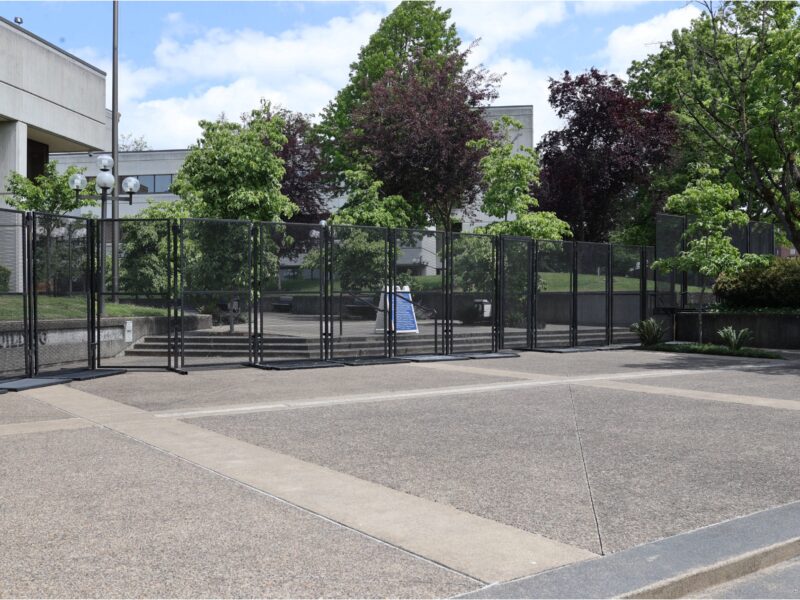
EUGENE, Ore. (CN) — A federal judge sided Monday with the free speech activists who challenged the government’s erection of a $270,000 fence around a federal building in an Oregon college town, blocking off a plaza traditionally used as a public meeting ground.
“The evidence is clear, convincing, really without any meaningful dispute, that for the time this place has existed, it has been a place where the community has assembled to express themselves,” said U.S. District Judge Mustafa Kasubhai, a Joe Biden appointee.
Kasubhai ruled from the bench following arguments Monday and an evidentiary hearing held last week and ordered the government to remove the fence within 48 hours.
Six plaintiffs with a history of participating in protests at the Eugene Federal Building sued the General Services Administration at the beginning of the month, accusing the agency of violating their First Amendment rights by blocking off access to the plaza.
The federal government installed fencing around the perimeter of the building in late April. The building houses U.S. Customs and Immigration Enforcement and other federal agencies. The move was publicly announced in February by Eugene Police Chief Skinner in response to protests that occurred in the plaza and courtyard in late January.
The General Services Administration told the city the fence was temporary and expected to be in place for approximately two years to protect the building and employees and to facilitate repairs to damage caused by the January protests. The agency also said it would provide a designated area for protesters to gather on a lower plaza.
The protesters rejected this rationale and argued the government intended to chill their free speech and described it as a ruse to put up a fence.
“Here we have extreme overkill,” said Marianne Dugan, attorney for the Civil Liberties Defence Center representing the plaintiffs.
The protesters also argued the designated area is too small, subjects protesters to “coal-rolling” and doesn’t allow for people using mobility aids to easily gather.
The federal government argued the fence is a necessary measure to adequately protect both the building and its employees.
“There was an ongoing security situation that began increasing in what’s called amplitude in and around September 2025,” said James Blum with the U.S. Attorney’s Office.
After a protest in January that drew a crowd of around 400 and was declared a riot by local police due to property damage, including graffiti, broken windows and a breach of the lobby, the agency sought emergency funding to install a security fence.
The government also argued the fencing doesn’t stop protests, contending that groups can apply for permits to meet in the plaza. However, the protesters noted the permit process takes multiple days and chills their right to spontaneous and anonymous protest.
In finding in favor of the protesters, Kasubhai noted it was troublesome that the federal government had changed its website to remove reference to the plaza as a longtime gathering place for free speech expression.
The website once stated the plaza played a “significant civil role in the early 1970s and during the Vietnam War. The plaza was and remains a favored venue as a stage for protests against the government’s policies.”
That passage has since been removed from the website.
“It raises significant concern for me that history is revised, erased really, by GSA’s removal of that same reference and acknowledgement of the forum in its current website,” Kasubhai said.
As for the remedy, Kasubhai determined the best resolution would not be to entirely remove the fence but rather push it closer to the buildings and open up the courtyard and plaza. Doing so would require more fencing and time, and the General Services Administration suggested it may take several months to move the fence.
“I’m not sure the First Amendment can wait that long,” Kasubhai said.
Since the government was unable to provide an adequate timeline as to how long it would take to alter the fence perimeter, Kasubhai resolved to order the government to return to the status quo and remove the fence entirely. The government may erect the fence again, so long as it does not obstruct access to the plaza.
Kasubhai said a written order will follow.
Subscribe to our free newsletters
Our weekly newsletter Closing Arguments offers the latest about ongoing trials, major litigation and rulings in courthouses around the U.S. and the world, while the monthly Under the Lights dishes the legal dirt from Hollywood, sports, Big Tech and the arts.