
 Search Articles


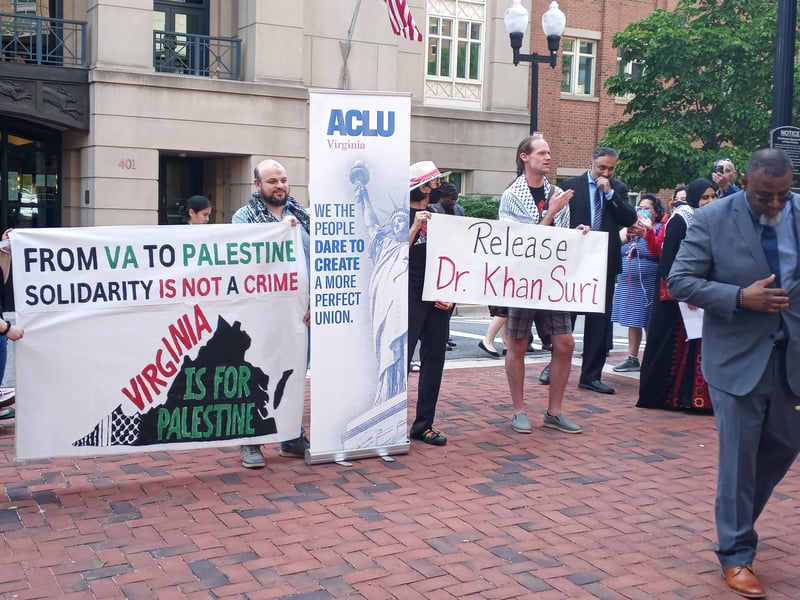
ALEXANDRIA, Va. (CN) — Badar Khan Suri, the Georgetown University professor detained by immigration officers and transported from his Virginia home to a Texas prison, must be released, a federal judge ruled Wednesday.
Khan Suri, an Indian national and postdoctoral fellow in the country on a J-1 visa, had not been accused of a crime — but of spreading Hamas propaganda. His legal team charged that his arrest was in retaliation for pro-Palestinian views and his family connections. Specifically, they are referring to his wife’s father, once a political advisor of the prime minister in Gaza.
In a ruling from the bench, U.S. District Judge Patricia Tolliver Giles, a Joe Biden appointee, found that Khan Suri’s First Amendment right to free speech and Fifth Amendment right to due process had been violated. Releasing him, she said, is “the only remedy that would disrupt the chilling effect” that his detention has had on political speech.
Shortly after his arrest, a government spokesman accused Khan Suri of “actively spreading Hamas propaganda and promoting antisemitism.” Beyond that, attorneys from the U.S. Department of Justice were given time to present court filings detailing the reasons Khan Suri was detained. They have not done so.
Department of Homeland Security officers arrested Khan Suri as he arrived home March 17, telling him that the government had revoked his visa. In short order, he was transferred first to a facility in Farmville, Virginia, then to Richmond, Louisiana, and finally Texas. While government attorneys have argued that the jurisdiction belonged in Texas, Giles ruled that jurisdiction remained with her court.
A scholar legally in the country, Khan Suri’s case has been championed by civil rights organizations, including the ACLU and the Center for Constitutional Rights. Soon after his arrest, his legal team filed a habeas corpus lawsuit naming President Donald Trump as the chief defendant. The president has threatened pro-Palestinian protesters with visa revocation. “We’ll get them off our college campuses,” Trump said at a 2023 rally, “out of our cities and get them the hell out of our country.”
Giles made note of this threat while making her ruling: “The court does not defer to the government’s reading of the First Amendment.”
Khan Suri can return to Virginia, where he will participate in court hearings. At the request of his lawyers, Giles added a provision that he cannot be detained again without giving the court 48 hours notice.
Khan Suri is a postdoctoral fellow at the Alwaleed Bin Talal Center for Muslim-Christian Understanding at Georgetown’s foreign service program. He completed his Ph.D. in peace and conflict studies from the Nelson Mandela Center for Peace and Conflict Resolution at Jamia Millia Islamia in New Delhi, India, in 2020. At Georgetown, an administrator noted that Khan Suri had not engaged in any illegal activity or posed a threat to campus security.
Rather, he was arrested, detained and charged with removability under a rarely used immigration law that allows deportation of an individual “whose presence or activities in the United States the Secretary of State has reasonable ground to believe would have potential serious adverse foreign policy consequences for the United States.”
Secretary of State Marco Rubio made the determination that Khan Suri should be removed based on the professor’s “actual or imputed protected speech, viewpoint, religion, national origin or protected associations,” as well as views expressed by his wife, according to court filings by Khan Suri’s attorneys.
At a press conference after the hearing, his wife Maphaz Ahmad Yousef, who also goes by Mapheze Saleh, thanked supporters and said that whatever she and her family had suffered was “a drop in the ocean” next to the suffering of Palestinians.
Subscribe to our free newsletters
Our weekly newsletter Closing Arguments offers the latest about ongoing trials, major litigation and rulings in courthouses around the U.S. and the world, while the monthly Under the Lights dishes the legal dirt from Hollywood, sports, Big Tech and the arts.