
 Search Articles


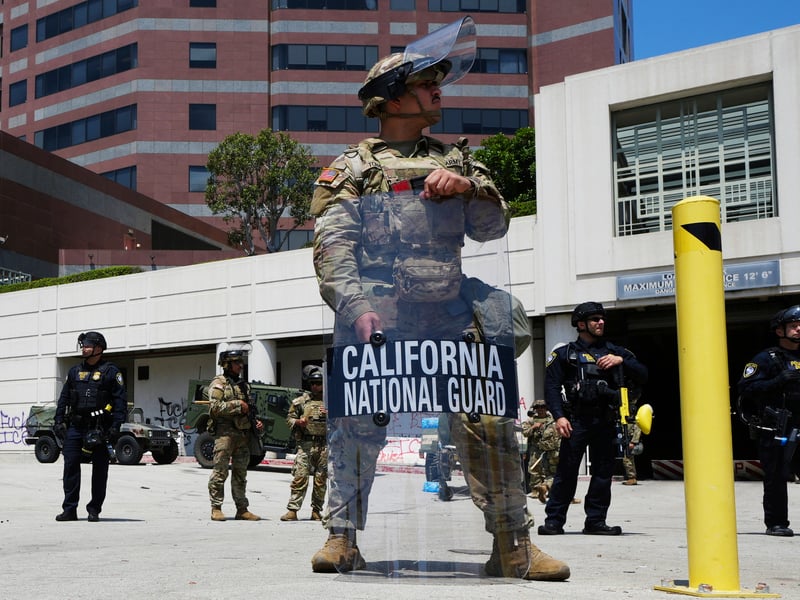
SAN FRANCISCO (CN) — Governor Gavin Newsom on Wednesday praised a federal judge’s order stopping President Donald Trump from federalizing the California National Guard in Los Angeles.
U.S. District Judge Charles Breyer in his ruling chided the federal government for federalizing the troops, saying the only system of checks and balances it wanted was a blank check. He noted that the White House has maintained control of some 300 Guard members for six months, though there’s no evidence federal law is impeded. Additionally, Trump sent California Guard members into other states, which has created a national police force.
Granting Newsom’s motion for a preliminary injunction, Breyer temporarily stopped the federal government from deploying the state’s National Guard in Los Angeles. It also must return control of those Guard members to Newsom.
However, the judge stated that his order won’t become effective until noon on Dec. 15.
“Today’s ruling is abundantly clear — the federalization of the National Guard in California is illegal and must end,” Newsom said in a statement. “The president deployed these brave men and women against their own communities, removing them from essential public safety operations. We look forward to all National Guard servicemembers being returned to state service.”
California Attorney General Rob Bonta in a statement said the judge had firmly rejected Trump’s attempts to make the Guard a traveling, national police force.
“For more than five months, the Trump administration has held California National Guard troops hostage as part of its political games,” Bonta said. “But the president is not king. And he cannot federalize the National Guard whenever, wherever, and for however long he wants, without justification.”
The legal struggle stems from Trump’s June deployment of the National Guard in Los Angeles. He pointed to “numerous incidents of violence and disorder” in the wake of federal immigration enforcement and called the protests a kind of rebellion.
California sued and Breyer returned control of the Guard to Newsom. After an appeal to the Ninth Circuit, the issue returned to the Breyer, a Bill Clinton appointee, who heard arguments on Friday.
In his Wednesday ruling, Breyer rejected Trump’s arguments, at one point referring to a bedrock of American law — the 1803 case of Marbury v. Madison.
“Defendants first argue that the Aug. 5 and Oct. 16 orders are not subject to judicial review,” Breyer wrote. “But ‘[i]t is emphatically the province and duty of the judicial department to say what the law is.’”
Breyer also cast aside Trump’s argument that Newsom was focused on the number of Guard members he’d federalized. The judge called an argument that the governor’s management of headcount wasn’t reviewable a “red herring.” Newsom challenged the federalization, not the appropriateness of how many were federalized.
According to Breyer, the instances when a president can federalize National Guard members include when the country faces danger of invasion by another nation, when there’s a rebellion or danger of one occurring, and when the president with regular forces can’t execute the law. Trump argued only one: the danger of a rebellion in Los Angeles.
“Defendants made the incredible argument at the motion hearing that there is a current danger of rebellion in Los Angeles,” Breyer said. “The evidence they offered was the protests six months ago and the fact that, on Dec. 1, 2025, a single individual — acting alone and having burned down his own apartment that morning — threw two unlit Molotov cocktails at a federal building, injuring no one.”
Concerning a president’s ability to execute the laws, Breyer said he shares Trump’s concerns about public safety. However, people have a core right to gather in protest, even if it causes inconvenience.
Protests carry a risk of violence, Breyer noted, but a potential protest doesn’t impede Trump’s ability to execute the laws.
Breyer also found fault with Trump’s argument that the federalization of the Guard was needed, as regular forces weren’t able.
“The risk that a handful of people could overtake a federal building, for example, looks different if there is just one guard, as opposed to many, protecting that building,” Breyer said. “Consequently, it defies the record — and common sense — to conclude that risks stemming from protests — in August, October, or even present day — could not have been sufficiently managed without resorting to the National Guard.”
A spokesperson for the U.S. Department of Justice declined comment.
Subscribe to our free newsletters
Our weekly newsletter Closing Arguments offers the latest about ongoing trials, major litigation and rulings in courthouses around the U.S. and the world, while the monthly Under the Lights dishes the legal dirt from Hollywood, sports, Big Tech and the arts.