
 Search Articles


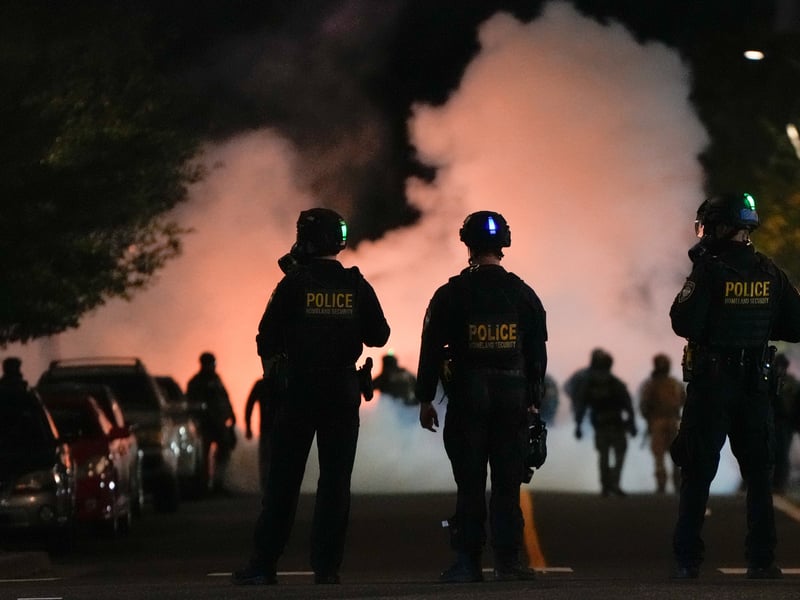
PORTLAND, Ore. (CN) — Protesters and journalists urged a federal judge Wednesday to extend restrictions on federal officers’ use of tear gas, pepper balls and other munitions outside of Portland’s ICE facility, which they argue have been deployed in retaliation for exercising their First Amendment rights.
On the final day of a three-day evidentiary hearing, U.S. District Judge Michael Simon, a Barack Obama appointee, seemed inclined to grant the class of protesters and journalists’ motion for a preliminary injunction.
Simon issued a temporary restraining order in early February blocking federal immigration officers from deploying chemical or projectiles. While Simon declined to rule from the bench on Wednesday, he said an opinion would be out by Monday and warned that it would be “very unwise” for federal agents to use munitions against crowds at the ICE facility in the time it takes for him to release his order.
“Unless they had a darn good reason for why they needed to do something like that, I think that would be very strong evidence of retaliatory animus used against them, even if they don’t have the risk of contempt hanging over them,” Simon said.
Over the course of the hearing, the federal defendants — President Donald Trump, the Department of Homeland Security and its Secretary Kristi Noem — have denied that federal agents have acted in retaliation against people protesting or reporting at the ICE building.
“If retaliation were the motive, one would expect retaliation on a regular basis,” argued Brad Rosenberg, Justice Department attorney.
Simon disagreed.
“It’s probably the height of foolishness for someone who wants to retaliate to retaliate every single day because it would be so obvious,” Simon said.
The federal government also argued that not only does DHS have policies instructing officers on the proper use of force and crowd control tactics, but it expressly forbids retaliatory conduct.
However, plaintiffs argued that there’s circumstantial evidence that the federal government intended to incite on-the-ground agents in Portland to curtail protest activity and discourage protected protest activity. They noted that federal officers weren’t trained on First Amendment protections when they were preparing to come to Portland for crowd control efforts.
The plaintiffs presented videos of officers launching munitions at protesters who were simply standing on public sidewalks and, in one case, lobbing a tear gas canister under the walker of an elderly man attempting to leave the site — evidence Simon referred to as disturbing.
“There’s been a pattern of retaliation here, and there’s been no explanation from the other side,” said plaintiffs’ attorney Matthew Borden, pointing out that the federal government failed to bring any officers to testify during the course of the hearing.
The federal government argued that an injunction would be unworkable for federal agents. Protesters have taken to blocking the driveway of the ICE facility. Local police can’t assist federal officers in clearing the driveway because Oregon’s sanctuary state laws restrict local police from assisting federal forces with immigration-related operations.
“That’s an untenable situation,” Rosenberg argued.
The federal defendants have pointed to this as a reason federal agents need to use “less lethal” forces like tear gas and other munitions to disperse those crowds. They asked that Simon issue an administrative stay if he issues a preliminary injunction to allow them to appeal the order.
However, Simon noted that there hasn’t been a problem clearing the driveway since he issued his first temporary restraining order in early February. He further told the government that if he issues a preliminary injunction, he “absolutely, positively” would not issue a stay for the course of the appeal, but may consider a weeklong stay.
“Things have been working fine for 28 days, what’s another seven days?” Simon asked. “Nothing bad has happened.”
The plaintiffs expressed optimism following the hearing.
“No one should be at risk of violence for peacefully protesting and making their voice heard,” Kim Hutchinson, attorney with the American Civil Liberties Union of Oregon, said after the hearing.
Jack Dickinson, one of the plaintiffs in the case — known as “the Portland Chicken” for donning a chicken costume while protesting — said he hopes Simon will halt federal agents’ “barbaric treatment” of protesters.
“I joined this case so people in our city could regain some feeling of safety expressing their First Amendment rights,” Dickinson said to the press following the hearing.
He also addressed the agents assigned to the ICE building, saying he’s heard them retching from inhaling the same chemicals he and other protesters have inhaled.
“Please understand, this administration does not care about you any more than they care about me,” Dickinson said. “I urge you to reexamine your role in suppressing the voice of the people to protect the whims of the powerful.”
Subscribe to our free newsletters
Our weekly newsletter Closing Arguments offers the latest about ongoing trials, major litigation and rulings in courthouses around the U.S. and the world, while the monthly Under the Lights dishes the legal dirt from Hollywood, sports, Big Tech and the arts.