
 Search Articles


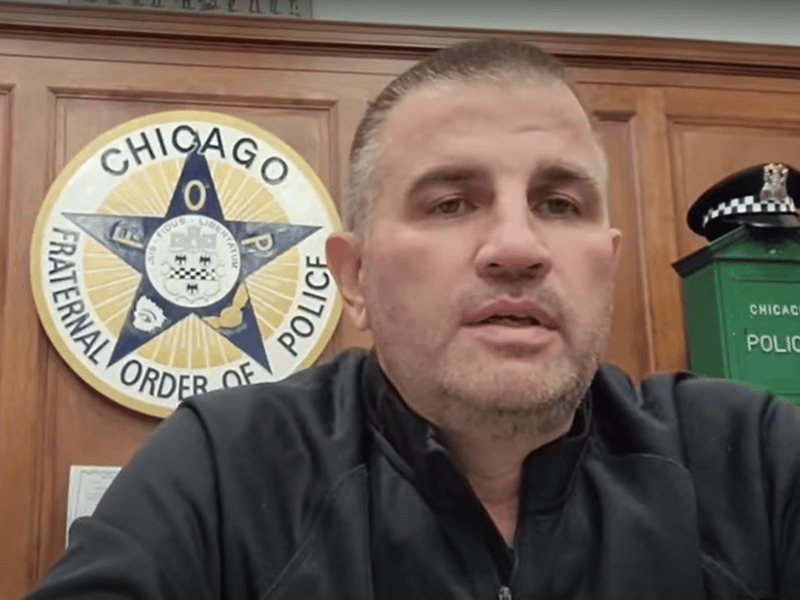
CHICAGO (CN) — The Chicago Fraternal Order of Police won a small victory in its fight against a city employee Covid-19 vaccine mandate on Monday when a county judge temporarily lifted the mandate’s requirement that all police be fully vaccinated or have a valid exemption by Dec. 31.
Cook County Judge Raymond Mitchell’s order still allows the city to put officers who refuse to report whether they are vaccinated on no-pay status, but it prevents the city from disciplining police who are not fully vaccinated or exempt by the end of the year.
The order also only applies to members of Chicago’s police unions. The Dec. 31 vaccination deadline remains in place for all other city employees. Mitchell’s order is set to last until Nov. 10, when another hearing in the case is scheduled, but it can be renewed.
In his written ruling, Mitchell wrote that he partially granted the FOP’s request for a temporary restraining order to protect the polices unions’ collective bargaining power and what he deemed the “arbitrability” of their grievances with the vaccine mandate. Both the city and the FOP agreed in court last week that the ongoing fight over the vaccine mandate would be best solved via arbitration.
“There is no serious dispute as to the arbitrability of the police unions’ grievances,” Mitchell wrote. “They squarely present disputes as to the interpretation and application of the collective bargaining agreements, and under those agreements, if such disputes cannot be resolved between the parties, they shall be arbitrated.”
Mitchell’s order is consistent with the FOP’s argument in court last Thursday that if police officers are forced to comply with the vaccine mandate, it would remove the police unions’ ability to effectively argue to an arbitrator that they shouldn’t have to comply with the vaccine mandate. Chicago’s four police unions operate under the FOP umbrella.
“Once you get a jab in your arm, you can’t get it out,” the FOP’s lead attorney in the case, Joel D’Alba, said Thursday.
D’Alba also contended that the vaccine mandate could violate police officers’ right to medical privacy, as part of the mandate requires city employees to report their vaccination status to an online database.
“Our officers are afraid that information is not confidential,” he said.
Mitchell was less sympathetic to this line of reasoning, noting that police officers are already regularly required to report medical information such as injuries and disabilities.
“Police are required to submit all kinds of medical information. There’s nothing unusual about this,” the judge said at last week’s hearing.
He also acknowledged, along with the city’s own attorneys, that vaccine mandates have become a political issue - one that conservative institutions like police departments are losing ground on nationwide.
“It’s fair to say, if you’re looking in other jurisdictions, the trend isn’t going in your direction,” Mitchell told D’Alba.
The city’s attorneys meanwhile argued that the FOP’s attempts to fight the vaccine mandate are both a risk to public health and a futile attempt to delay the inevitable. They pointed out that the majority of Chicago police officers have already complied with the mandate by entering their vaccination status in the city employee database. A majority of those that complied are also already vaccinated.
“What we’ve seen since Oct. 14, Oct. 15, is a steady stream of people coming into compliance,” one of City Hall’s attorneys, David Johnson, argued Thursday.
He also argued that getting a vaccine does not constitute irreparable harm, a standard by which a judge determines the worth of a request for an injunction or restraining order – the allegation that, should the order not be put into place, one party will suffer some form of permanent and intractable injury.
“How does vaccination constitute irreparable harm? I don’t see the harm,” Johnson said.
On this point Mitchell disagreed. He noted in court that arbitration can sometimes take weeks or even months, and wrote in his opinion Monday that compliance with the Dec. 31 deadline would render the police unions’ grievances moot.
“If every union member complied and was vaccinated by December 31 (or otherwise exempt), they would have no grievance to pursue and there would be no remedy an arbitrator could award,” the judge wrote.
In a competing case brought by Chicago against the FOP on Oct. 14, the city attempted to get its own restraining order against FOP President John Catanzara and other police union leaders. In the days leading up to the first hearing of that case on Oct. 15, Catanzara publicly told police to disobey orders from superior officers to comply with the vaccine mandate.
The city alleged that this amounted to a call for a strike, which is illegal under the police unions’ collective bargaining agreement. Sharing this concern, Cook County Judge Cecilia Horan granted a restraining order against Catanzara on Oct. 15 that prevented him from publicly speaking out against the mandate.
However, by Oct. 25, when a mass work stoppage failed to materialize and only 23 officers had been put on a no-pay status for not registering their vaccination status, Horan lifted that restraining order.
“Since the October 15th deadline, the city has had ten days to address its staffing needs and make a determination about whether or how it will implement its vaccination policy as it pertains to [FOP] members who are out of compliance,” Horan wrote in her Oct. 25 opinion denying an extension of Catanzara’s restraining order. “With very limited exception, the city has not implemented a no-pay status for those members who are not in compliance, and the threatened work-stoppage has not come to pass.”
The city’s next hearing for its case against the FOP is scheduled for Nov. 8.
 Follow @djbyrnes1
Subscribe to our free newsletters
Our weekly newsletter Closing Arguments offers the latest about ongoing trials, major litigation and rulings in courthouses around the U.S. and the world, while the monthly Under the Lights dishes the legal dirt from Hollywood, sports, Big Tech and the arts.