Search Articles


WASHINGTON, Va. (CN) — Just two days before implementation, a Virginia judge blocked the commonwealth from enforcing a newly passed assault weapons ban.
Granting a block on Monday, Washington County Circuit Judge Jeffrey Campbell held that the bans on the sale, purchase, manufacturing and transfer of high-capacity semi-automatic weapons and magazines holding more than 15 rounds violate a 1971 provision of the Virginia Constitution enshrining the right to keep and bear arms.
The injunction applies to Virginia State Police and the localities of Washington County, Chesterfield County, Frederick County, York County, Giles County and Chesapeake.
“Because the newly enacted firearms ban and magazine ban would likely run afoul of the protections of the Second Amendment with respect to the types of firearms and components the plaintiffs possess as enunciated in both Heller and Bruen, I find that the plaintiffs are likely to prevail on the merits of their claims,” Campbell wrote in the seven-page opinion.
Other Virginia courts have held the provision is co-extensive with the Second Amendment.
The injunction will remain in place until July 1, 2027, or until the court issues a final order. Virginia Attorney General Jay Jones said his office would appeal the ruling.
“We will continue fulfilling our responsibility to defend Virginia’s magazine capacity restrictions, the assault weapons ban and uphold laws designed to keep Virginians safe,” Jones said in a statement.
State Senator Bill Stanley, a Republican attorney who argued on behalf of the plaintiffs — the National Rifle Association, several firearm retailers, hobbyists and the Virginia Sports Association — called the opinion well-reasoned.
“We know that this is just the first step,” Stanley said in an interview. “This is a journey, not a sprint, but I’m confident that we have both the law and the facts on our side, and that this law will be ultimately deemed unconstitutional by the appellate courts.”
The NRA shared Stanley’s optimism.
“This is a major victory, but our work is not complete,” NRA Institute for Legislative Action Executive Director John Commerford said in a statement. “We will not rest until this unconstitutional measure is struck down in its entirety and added to the long list of gun control laws the NRA has removed from the books for good."
Campbell — who has previously served as a Republican in the House of Delegates — seemed empathetic to the law’s patrons who argued the bans are necessary to curb gun violence.
Still, Campbell ultimately quoted the Cistercian monk St. Bernard: “The pathway to Hell is often paved with good intentions."
Campbell also noted that courts generally accord legislatures deference in enacting laws, but said that the legislature’s power is not without limits.
“This court, indeed any court, should be reluctant to flippantly undertake an interference with these separate, but co-equal, functions, absent a clear and unequivocal showing of constitutional infirmity,” Campbell said. “But, upon a sufficient showing of the same, it is the court’s long-standing duty to lift the clouds of unconstitutionality from above the heads of our citizens."
Campbell analyzed the bans through the framework set out by the Supreme Court in its 2022 decision in N.Y. State Rifle & Pistol Ass’n v. Bruen. Bruen first requires courts to analyze whether the challenged conduct is protected under the Second Amendment and, if so, requires the government to demonstrate that the challenged gun regulation is rooted in the historical tradition of firearm regulations rather than engaging in interest-balancing or policy-laden analyses.
Campbell first rejected the commonwealth’s argument that the bans apply to military-style weaponry that the government has traditionally regulated. The Supreme Court held in Bruen that the Second Amendment only protects the carrying of weapons in common use. The Supreme Court also labeled the AR-15 the most popular semi-automatic rifle in the country in Heller v. District of Columbia.
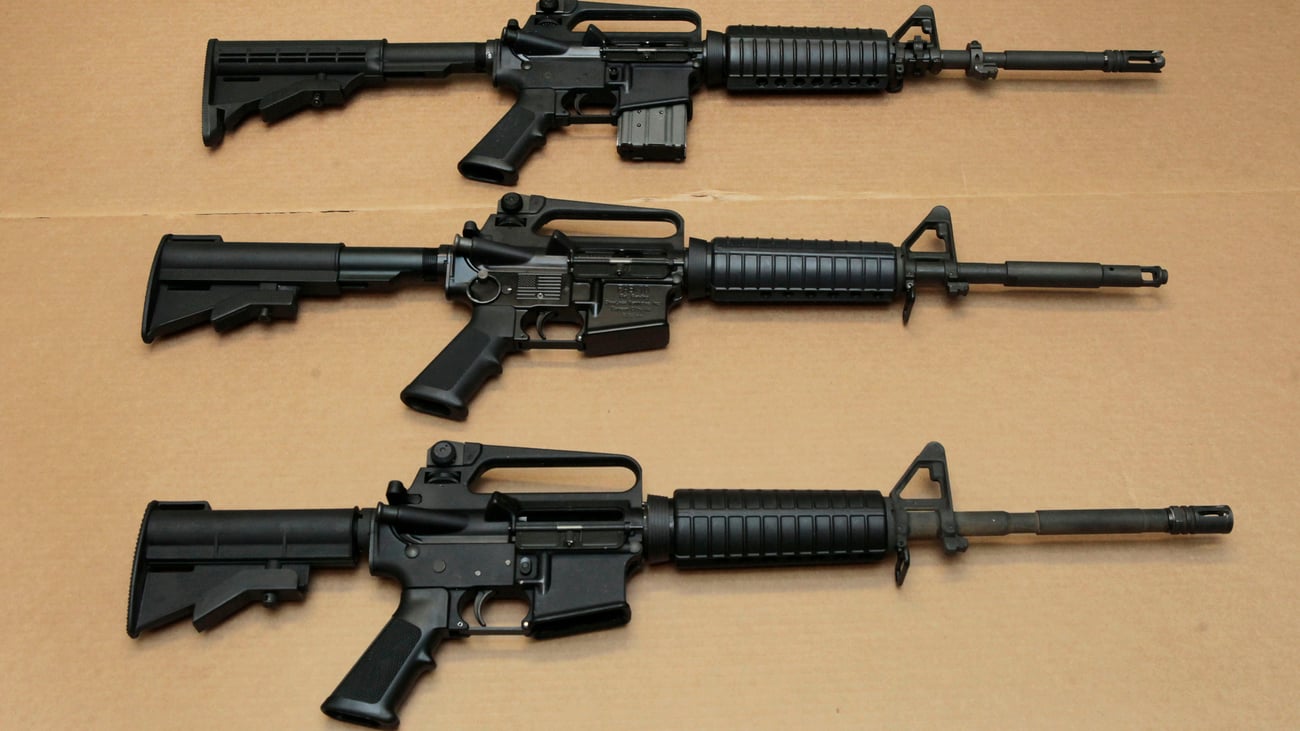
“The court makes note of the fact that the plain text of the enacted firearms ban would establish broad ranging prohibitions on the plaintiff dealers with respect to an entire class of firearms and, without question, in historical common usages, specifically that of semi-automatic centerfire rifles with a second hand grip, comprising virtually all semi-automatic centerfire rifles including the AR-15 style rifles and other that plaintiffs possess,” Campbell wrote.
The ban would apply to all firearms that are not designed to operate only with .22 caliber rimfire ammunition. The firearms must also have either a folding, telescoping or collapsible stock, a thumbhole stock or a pistol grip that protrudes conspicuously beneath the action of the rifle or a second handgrip.
Campbell next rejected the commonwealth’s attempts to point to historical analogs justifying the bans. The commonwealth cited a 1934 state law regulating automatic weapons.
“The court finds this analogy inapplicable in as much as the subject firearms herein are not defined as automatic weapons,” Campbell wrote.
The ruling comes four days after a judge in Lancaster County, Virginia, granted a preliminary injunction blocking Virginia State Police from enforcing the bans.
Minority Leader for the House of Delegates, Terry Kilgore, welcomed the ruling.
“This is no longer hypothetical,” Kilgore said. “Two courts have now looked at this law and found the same problem: you cannot ban arms commonly owned by law-abiding Virginians and call it constitutional."
Subscribe to our free newsletters
Our weekly newsletter Closing Arguments offers the latest about ongoing trials, major litigation and rulings in courthouses around the U.S. and the world, while the monthly Under the Lights dishes the legal dirt from Hollywood, sports, Big Tech and the arts.