
 Search Articles


CHICAGO (CN) — A federal judge lambasted Border Patrol Commander Greg Bovino in court Tuesday for tear gassing residential neighborhoods last week, demanding that he wear a body camera and provide her with daily use-of-force reports.
U.S. District Judge Sara Ellis’s directive came after a series of tense exchanges between federal law enforcement officers and protestors in Chicago. She ordered Bovino to testify after he was seen lobbing a canister of tear gas into a Little Village crowd on Oct. 23, which Ellis said violated her temporary restraining order. Bovino has maintained that he only deployed the tear gas because an unruly group of protestors threw something at his head.
In her temporary restraining order, the Barack Obama appointee blocked federal law enforcement from using excessive force or other nonlethal munitions against peaceful protestors or journalists. It was issued after a group of reporters, protestors and religious leaders sued U.S. Immigration and Customs Enforcement for using what they describe as a pattern of extreme brutality in an effort to silence them.
One of the big pieces of Ellis’s order was the requirement that ICE officers wear visible identification and body cameras. Ellis asked Bovino how he’d directed his officers to don their identification badges, and he responded that he tells them to wear them conspicuously, but leaves it to their discretion where exactly they put those badges.
Bovino testified that most ICE agents have body cameras, but not all of them. When Ellis asked him if he had a body camera, he said he did not. She ordered Bovino to get a body camera and complete its commensurate training by Friday. She also ordered him to present her with daily reports regarding use of force starting Wednesday up until the full preliminary injunction hearing next week.
Ellis noted that her order requires officers to give a clear warning to protestors before deploying nonlethal forces, which is something she said agents have not done thus far.
“A warning does not consist of saying get back, or get out of here. That’s not what this means," she said. Ellis continued that a clear warning also tells people what officers are going to do before they do it, which gives them time to comply.
Attorneys for the group of protestors, journalists and religious leaders filed a motion ahead of court Tuesday seeking to stop officers from deploying tear gas until the full preliminary injunction hearing on Nov. 5. Ellis denied the order, and said given her conversation with Bovino, she can’t see them deploying a whole lot of tear gas over the next week.
Ellis reiterated multiple times at the end of Tuesday’s proceedings that she is a reasonable person, and is only requiring Bovino to give her daily reports to ensure they’re all on the same page.
“I do not want to get violation reports from the plaintiffs that show that agents are out and about on Halloween where kids are present and tear gas is being deployed or pepper balls are being deployed,” she said. “Alright? I expect everybody to act reasonably.”
In court Tuesday, Ellis cited multiple incidents throughout the month of October where federal law enforcement used excessive force against protestors. She focused in particular on an incident in Old Irving Park over the weekend, in which federal agents deployed tear gas on a residential street just moments before a children’s costume parade was set to pass through.
“Kids dressed in Halloween costumes walking to a parade do not elicit an immediate threat to the safety of a law enforcement officer," she said. “They just don’t.”
At the start of Tuesday’s hearing, Ellis went over the oaths that both she and Bovino took when they started their jobs. “Even though the words of the oaths we each took are different, they’re fundamentally the same," she said.
Ellis said there are three possible circumstances that led to the TRO violations: either the language in the order was unclear, nobody ever read it, or people read it, understood it and chose not to abide by it. She said only the first circumstance made sense, given their respective oaths.
She then went through the order line by line with Bovino on the stand and expounded on what exactly it means, and when it warrants the use of force. Ellis gave Bovino some situations she described as hypotheticals, such as a man standing and filming officers, and asked whether federal agents would be in the right if they deployed force, such as tear gas, in those situations.
Bovino replied that he wasn’t sure, and he’d have to understand the full circumstances of the situation to give a clear answer. When Ellis pressed him further, he agreed that someone standing and filming officers doesn’t threaten law enforcement and as such doesn’t warrant tear gas or other nonlethal munitions.
Elllis reiterated that people have a right to film federal law enforcement or engage with them nonviolently without the fear of retribution from officers.
“They don’t have to like what you’re doing, and that’s okay,” she said. “That’s what democracy is.”
Seemingly shellshocked Justice Department attorneys objected to Bovino’s deposition and asked Ellis to stay her orders from Tuesday, which she denied.
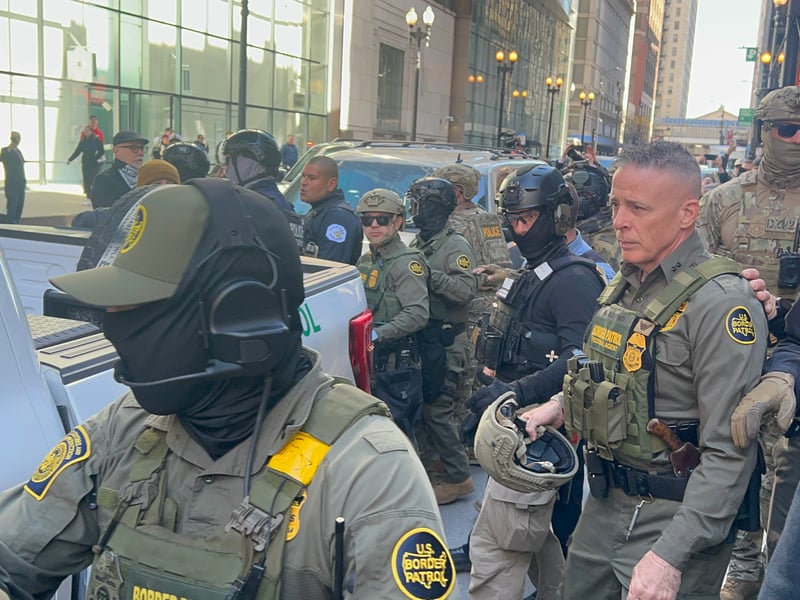
Bovino exited the Chicago courthouse Tuesday afternoon surrounded by a crowd of federal officers in military-style fatigues. Crowds of protestors jeered at him as he waved and gestured from his truck, which protestors then unsuccessfully attempted to block.
 Follow @RosenCaitlyn
Subscribe to our free newsletters
Our weekly newsletter Closing Arguments offers the latest about ongoing trials, major litigation and rulings in courthouses around the U.S. and the world, while the monthly Under the Lights dishes the legal dirt from Hollywood, sports, Big Tech and the arts.