
 Search Articles


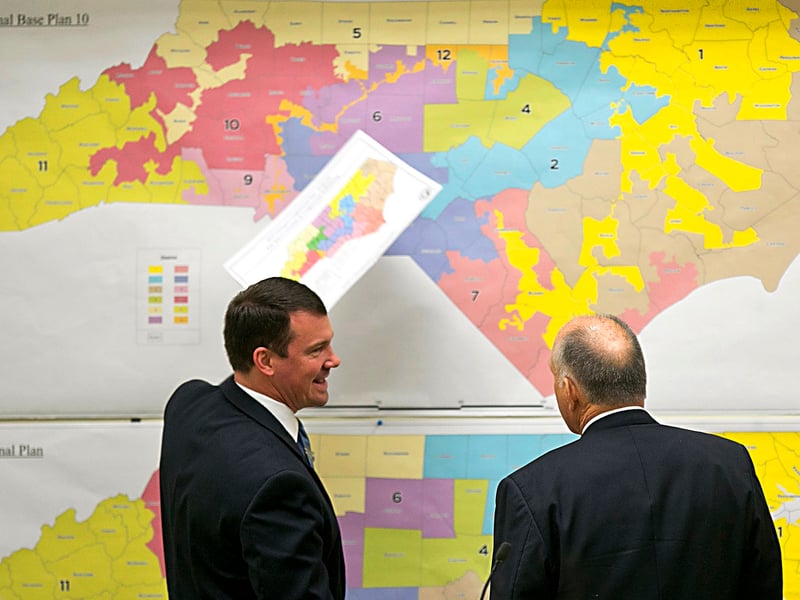
RALEIGH, N.C. (CN) — A federal judge dealt a massive blow Tuesday to North Carolina voters challenging a 2023 Senate election map, concluding that party preference, rather than race, drives voting in the state.
The plaintiffs, Rodney Pierce and Moses Matthews — two Black voters living in the state’s Black Belt area — filed suit in November 2023 after the General Assembly redrew election maps. They claim the new Senate map hurt their chances of electing their chosen candidates and split up a majority-minority district, in violation of Section 2 of the Voting Rights Act.
The General Assembly did not factor in a history of racially polarized voting when they drafted the new map, despite a history of race-based voter suppression, they say, and the Voting Rights Act requires a majority-Black Senate district in the state’s northeast.
U.S. District Judge James Dever squashed the plaintiffs’ case Tuesday, finding that racial animosity is absent even when the interests of racial groups diverge and that politics, not race, explains voting patterns.
“Throughout North Carolina, Black voters regularly join with their white counterparts to support common causes and candidates in local elections, state elections and federal elections,” he wrote in his 126-page order. “Plaintiffs ignore the progress that North Carolina has made over the past 60 years and seek to use section 2 to sort voters by race in order to squeeze one more Democratic Senate district into the map.”
“Here, plaintiffs seek to use Section 2 not to address vote dilution but to obtain ’the maximum possible’ political power,” he said. “The current redistricting plan in the Senate protects Black voters from ‘political famine.’ Section 2 does not entitle plaintiffs to a ‘political feast.’”
Democrats, who voted unanimously against the Senate map, have condemned the 2023 redistricting process for what they call racial gerrymandering. The map was used in the November 2024 elections after the Fourth Circuit quashed an attempt to freeze their implementation. The trial in the case ended in February.
Dever said the state’s legislature, the General Assembly, did not engage in race-based redistricting or sort voters based on race and noted racial data was not included when the Senate map was drawn. The plaintiff voters failed to prove the defendants violated the Voting Rights Act, he said.
The legislature’s redistricting criteria was legitimate, the George W. Bush appointee found, and the General Assembly was not required to draw a majority-Black district in the northeastern part of the state.
The case challenged Senate District 1, in the Tidewater region, and Senate District 2, which includes portions of the Piedmont and Tidewater areas. Both districts fall within an area referred to as the Black Belt. Both of the plaintiffs live in Senate District 2, and they lack standing to challenge Senate District 1, Dever said.
He criticized the plaintiffs’ presentation of Black citizen voting-age population data as “not accurate or reliable” compared to the area’s population, saying they chose between the two sets of numbers as it suited their needs. The voters’ alternative Senate district options were also not “reasonably configured” and “fail to respect political subdivisions,” Dever wrote.
“The court also finds that the success of minority-preferred candidates in crossover districts supports a finding that legally significant racially polarized voting does not exist in North Carolina, including in northeast North Carolina,” Dever said.
“It is not 1965 or 1982 in North Carolina,” he said. “It is 2025. Due in part to societal progress on race and due in part to the VRA, North Carolina is a very different state politically and socially than it was in 1965 or 1982. Black voters in northeast North Carolina and throughout North Carolina have elected candidates of their choice (both white and Black) with remarkable frequency and success for decades.”
Senate President Pro Tempore Phil Berger, a defendant in the case, called it a big win on X.
“The VRA can’t be weaponized to make up for the shortcomings of the Democratic Party,” he said. “I am glad this latest attempt by partisan interests to undo our fair and legal Senate districts was rejected by the court.”
Counsel for Pierce and Matthews did not immediately reply to a request for comment. A representative for Speaker of the House Destin Hall declined to comment.
 Follow @SKHaulenbeek
 Follow @shaulenbeek.bsky.social
Subscribe to our free newsletters
Our weekly newsletter Closing Arguments offers the latest about ongoing trials, major litigation and rulings in courthouses around the U.S. and the world, while the monthly Under the Lights dishes the legal dirt from Hollywood, sports, Big Tech and the arts.