
 Search Articles


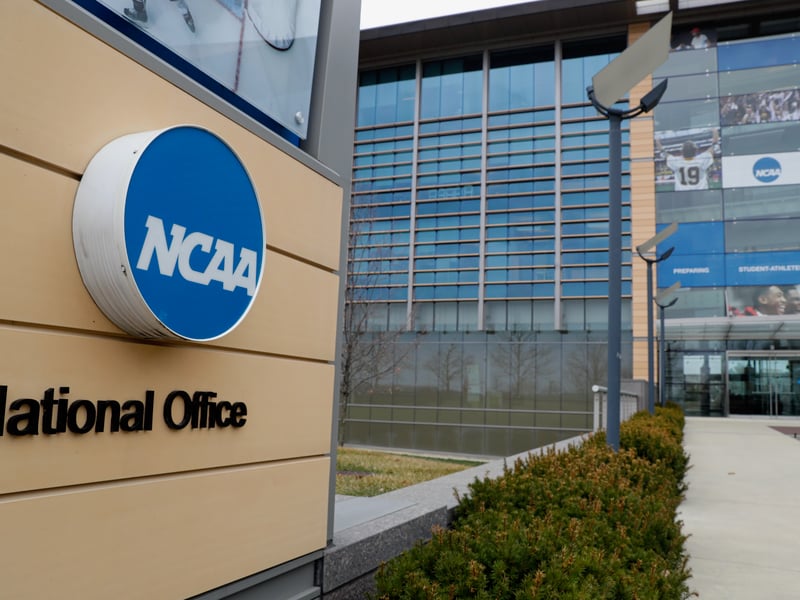
MANHATTAN (CN) — A federal judge on Monday dismissed a sweeping antitrust lawsuit brought by Mario Chalmers and other prolific college basketball players against the NCAA.
Chalmers, the former Kansas Jayhawk, filed the antitrust class action last year alongside 15 other former college hoopers, who claimed that the NCAA is unjustly enriching itself off the name, image and likeness (NIL) of its athletes to promote the annual March Madness basketball tournament.
But U.S. District Judge Paul Engelmayer, a Barack Obama appointee in the Southern District of New York, sided with the NCAA in dismissing Chalmers’ complaint Monday, finding it untimely.
As the NCAA’s attorneys emphasized in court earlier this year, Chalmers and the other suing ex-players haven’t been college athletes for years. Chalmers last played for Kansas in 2008; fellow plaintiffs Jason Terry and Alex Oriakhi last played for the University of Arizona in 1999 and the University of Missouri in 2013, respectively.
A four-year statute of limitations limits legal action for violations of federal antitrust law. Chalmers and the other plaintiffs contested that the law continues to be breached to this day by the NCAA using their likeness in promotional material, making their claims timely despite the four-year limit.
Engelmayer wasn’t persuaded.
“Plaintiffs’ theory … does not withstand the case law,” the judge wrote in a 34-page order. “Under it, the NCAA’s use today of a NIL acquired decades ago as the fruit of an antitrust violation does not constitute a new overt act restarting the limitations clock. Instead, as the NCAA argues, the contemporary use of a NIL reflects performance of an aged agreement: a contract between the student-athlete and the NCAA under which it acquired footage and images of the plaintiff.”
In their lawsuit, the plaintiffs honed in on Chalmers’ legendary game-tying 3-pointer in the 2008 NCAA national championship game against Memphis — widely considered to be one of the most iconic moments in college basketball — as a key example of the NCAA’s continued unjust use of players’ likeness.
The players claimed that the NCAA still profits off of Chalmers’ prolific shot through online highlight videos and advertisements for March Madness without Chalmers seeing a cent for his efforts. Chalmers and the other former stars sought back pay for the NCAA’s use of their vintage college performances.
At a court hearing in January, Engelmayer signaled that the statute of limitations would likely be a roadblock for the players to collect that cash. He told the plaintiffs’ attorney Elliot Abrams that his clients lost the property rights to the scrutinized footage “long, long ago” when they signed their college contracts, and would have had to bring their suit much sooner than they did in 2024 to contest that.
Engelmayer also implied at the time that past litigation like O’Bannon v. NCAA — a U.S. Supreme Court class action that similarly challenged the NCAA’s use of athletes’ likeness for commercial gain — didn’t help plaintiffs’ current case, since many of those same issues were already litigated.
The judge acknowledged that again in his Monday order, writing that “all named plaintiffs were members of the O’Bannon injunctive class.”
“The NCAA is pleased with the court’s dismissal of the entirety of the Chalmers case,” the organization said in a statement to Courthouse News. “The court definitively examined and dismissed the antitrust and unjust enrichment claims, finding they were untimely and precluded by prior cases. We are hopeful that several of the copycat cases will be similarly treated by other courts.”
Chalmers’ antitrust claim was one of several to crop up in recent years targeting the NCAA amid a shifting landscape for the NIL rights of college athletes. Former college football stars Reggie Bush and Terrelle Pryor each filed claims similar to Chalmers’ over the NCAA’s use of their likeness.
Engelmayer’s ruling is bad news for those other plaintiffs, according to Boise State sports law professor Sam Ehrlich.
“All of these are essentially the same lawsuit,” Ehrlich told Courthouse News on Monday. “All of them have been attacking the same issues by really similar plaintiffs.”
In 2021, the NCAA implemented a groundbreaking policy to allow student athletes to earn endorsement money using their own likeness for the first time in the organization’s history.
Ehrlich said that these lawsuits are a result of that policy change, as former college stars look to claim cash that wasn’t available to them while they were NCAA athletes.
Monday’s ruling greatly kneecaps their efforts to do so, according to Ehrlich.
“I can’t see any claims that would have a significantly longer statute of limitations or have a better base on the continuing violations doctrine than antitrust,” Ehrlich said. “I think this was kind of their one big chance.”
Attorneys for the plaintiffs didn’t immediately respond to requests for comment.
 Follow @Uebey
 Follow @uebey.bsky.social
Subscribe to our free newsletters
Our weekly newsletter Closing Arguments offers the latest about ongoing trials, major litigation and rulings in courthouses around the U.S. and the world, while the monthly Under the Lights dishes the legal dirt from Hollywood, sports, Big Tech and the arts.