
 Search Articles


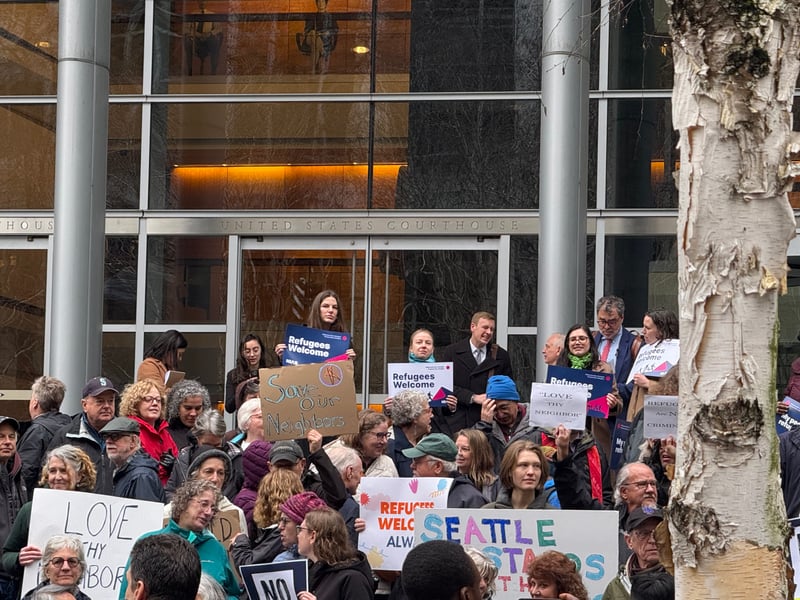
(CN) — Plaintiffs affected by President Donald J. Trump’s recent refugee ban earned a minor win in federal court on Wednesday when a judge denied the White House’s bid to dismiss a lawsuit against the president’s executive order.
In his 23-page order, U.S. District Judge Jamal Whitehead said the refugees plausibly claimed multiple violations of federal law by the president through his travel ban, including the Refugee Act, Immigration and Nationality Act and Administrative Procedure Act, as well as violations of the Fifth Amendment and separation of powers doctrine.
He also rejected the White House’s arguments that the court lacked authority to limit presidential action, stating that the “complete, indefinite suspension” of the U.S. Refugee Admission Program — a program by which the government fulfills its statutory duties under the Refugee Act — would override Congress’s intent and violate separation of powers.
“First, neither the President’s statutory authority under the INA nor his inherent authority under the Constitution permits him to subvert the express will of Congress,” the Joe Biden appointee said.
Notably, the judge also ruled that the case can proceed as a class action, marking a significant milestone in the refugees’ lawsuit.
The judge also disagreed with the government’s claims that its suspension of the program, which facilitates the resettlement of refugees in the United States, was recently supported by a decision in the Ninth Circuit Court of Appeals.
“At the start, the court notes that the Ninth Circuit’s partial stay does not, as the government represents, ‘clarif[y] . . . the President’s suspension of the USRAP was valid,’” Whitehead wrote.
Attorneys for the refugees celebrated the judge’s decision.
“Today’s orders ensure that this case will move forward on behalf of all people harmed by the Trump administration’s unlawful refugee ban. We will keep fighting to ensure they have their day in court," attorney Linda Evarts of the International Refugee Assistance Project, who represents the refugees, said in an email.
Attorneys for the government did not respond to an email seeking comment on the rulings.
The legal battle between the Trump administration and the refugees and aid groups who sued over the day-one shutdown of the U.S. Refugee Admissions Program has taken several turns as the court continues to grapple with the executive branch.
On Jan. 20, 2025, President Trump signed Executive Order No. 14163, titled “Realigning the United States Refugee Admissions Program,” suspending all “entry into the United States of refugees” under USRAP starting Jan. 27. The move dismantled the program’s infrastructure, halting admissions, stranding applicants mid-process and cutting off funding to resettlement groups.
One plaintiff, identified as “Pacito,” has drawn particular interest from both the district and appeals courts.
Pacito, an anonymous refugee from the Democratic Republic of the Congo, had previously been approved for resettlement in the U.S. before Trump’s order and was scheduled to travel to the U.S. with his family on Jan. 22. Along with his wife and infant son, he sold his belongings and gave up the lease on his home in Kenya.
However, on Jan. 21, after Trump signed the executive order targeting the admissions program, their travel was abruptly canceled, and Pacito was forced to shelter with his family in the parking lot of the U.S. embassy in Nairobi.
The refugees’ February lawsuit accuses the White House of violating multiple federal laws and asks the court to declare the executive order unlawful and unenforceable. It also seeks an injunction barring the government from applying the policy to all refugees covered under their proposed class certification.
Congress established the U.S. Refugee Admissions Program through the 1980 Refugee Act, which outlines the process for admitting and resettling refugees. The Act grants the president the authority to set the annual refugee cap, and in late 2024, former President Biden set the cap at 125,000 for fiscal year 2025.
In February, Whitehead issued a preliminary injunction preventing the government from enforcing its Jan. 20 refugee ban and later another ordering it to reinstate the thousands of federal contracts with resettlement agencies it terminated. However, after a series of appeals to the Ninth Circuit, the preliminary injunction was narrowed to cover only about half of the refugees who met specific circumstances.
This case was filed in the Western District of Washington.
Subscribe to our free newsletters
Our weekly newsletter Closing Arguments offers the latest about ongoing trials, major litigation and rulings in courthouses around the U.S. and the world, while the monthly Under the Lights dishes the legal dirt from Hollywood, sports, Big Tech and the arts.