
 Search Articles


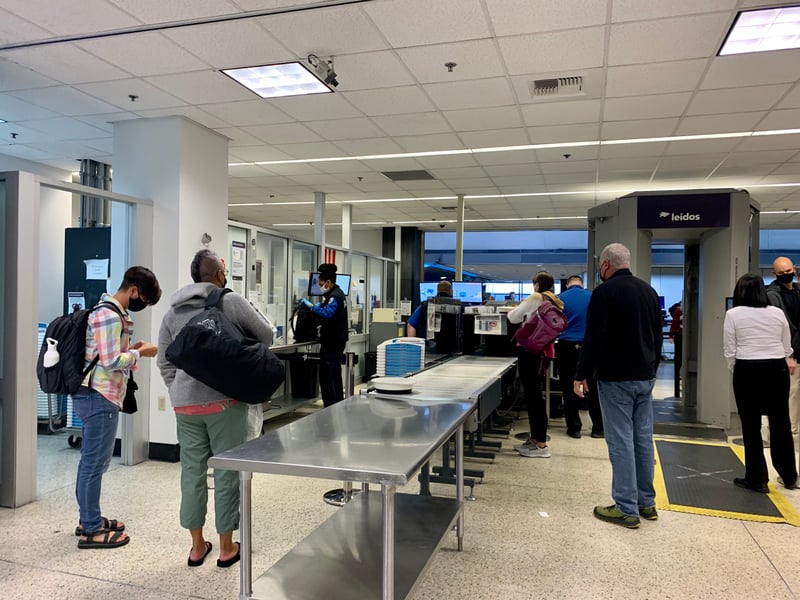
PORTLAND, Ore. (CN) — The Trump administration’s second attempt to cancel a collective bargaining agreement with the union representing tens of thousands of airport security workers failed Thursday as a federal judge clarified the move was blocked by an earlier court order.
“The question before the court is straightforward: Does defendants’ planned implementation of the September Noem determination violate the existing preliminary injunction? The answer is plainly yes,” U.S. District Judge Jamal Whitehead, a Joe Biden appointee, wrote in a brief order.
In March 2025, the American Federation of Government Employees sued the Department of Homeland Security and the Transportation Security Administration after Homeland Security Secretary Kristi Noem announced the end of the collective bargaining agreement with thousands of employees.
U.S. District Judge Marsha Pechman, a Bill Clinton appointee, issued a preliminary injunction in June 2025, blocking the government from ending the labor agreement covering around 47,000 TSA officers.
Despite an injunction requiring the Trump administration to preserve the collective bargaining agreement, the TSA informed the union last month that Noem had signed a memorandum in September terminating the collective bargaining agreement as of Sunday.
Whitehead, who took over the case from Pechman last October, rejected the government’s attempt to skirt the order, noting that it neglected to grapple with the terms of the injunction, which expressly prohibited the denial of rights.
“Rather than engage with the injunction’s plain language, defendants launch collateral attacks against the jurisdictional, legal, and factual bases for the injunction,” Whitehead wrote. “But a party subject to an injunction who believes compliance is no longer required must move to modify or dissolve the injunction — and that motion must be granted before the party may cease compliance.”
AFGE National President Everett Kelley celebrated the court’s ruling.
“On behalf of the 47,000 TSA officers our union represents, I thank the court for stepping in to prevent the administration from ripping up their union contract again,” Kelley said in a statement. “The administration’s repeated efforts to strip these workers of a voice in their working conditions should concern every person who steps foot in an airport.”
Norm Eisen, executive chair of Democracy Defenders Fund, likewise rebuked the government’s effort to get around the court order.
“It shouldn’t have been necessary to go to court once — much less twice — to stop the Trump administration’s illegitimate attack on the collective bargaining agreement between AFGE and TSA,” Eisen said in a statement. “It was plainly illegal the first time and even more so the second."
The collective bargaining agreement was signed in May 2024 and set to run through 2031. It provided workplace protections, grievance procedures and union representation for the officers, who historically receive lower pay and fewer protections than other federal employees.
When justifying the order to cancel the agreement, Noem framed the agreement as only benefiting the union while harming the security officers and the agency.
Whitehead noted the injunction specifically blocked the federal defendants from denying the union and its members any of their rights guaranteed in the collective bargaining agreement.
The government insisted that the injunction no longer applied because Noem rescinded the original order to cancel the collective bargaining agreement, but Whitehead said that argument “sidesteps the obvious.”
“The September Noem determination seeks the same result as its predecessor only with new reasoning,” Whitehead wrote. “Unless and until the injunction is modified, dissolved or stayed, defendants must make every effort to comply with its terms or risk the possibility of civil contempt.”
The federal government did not respond to a request for comment before press time.
Subscribe to our free newsletters
Our weekly newsletter Closing Arguments offers the latest about ongoing trials, major litigation and rulings in courthouses around the U.S. and the world, while the monthly Under the Lights dishes the legal dirt from Hollywood, sports, Big Tech and the arts.