
 Search Articles


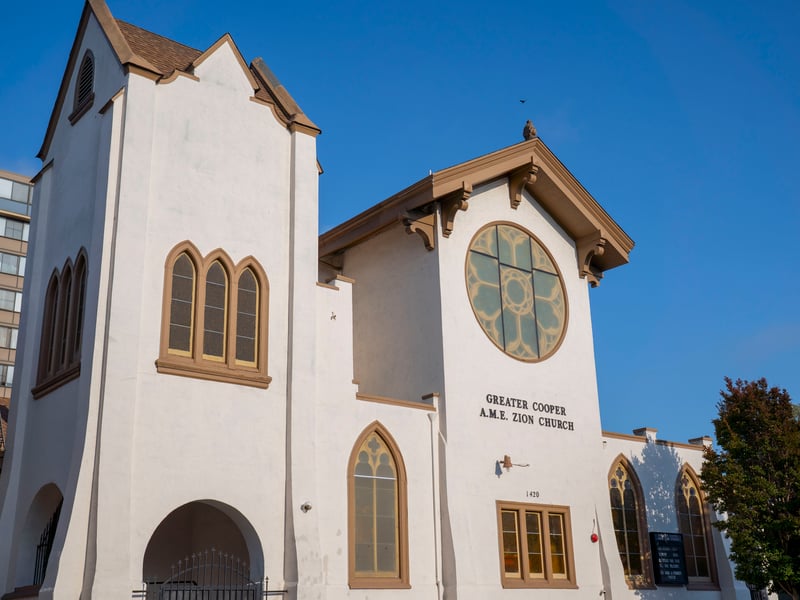
OAKLAND, Calif. (CN) — A judge heard arguments Tuesday over restitution in a high-profile criminal case against an ousted bishop who defrauded his flock of millions of dollars.
Former African Methodist Episcopal Zion Church Bishop Staccato Powell, 65, pleaded guilty to four felonies after diverting millions in loans obtained by fraudulently mortgaging church properties, using some for his personal benefit. His plea agreement allowed him to avoid jail time.
At the Tuesday restitution hearing, U.S. District Judge Jeffrey White said he was inclined to side with the government’s proposal of $10,000 monthly payments, totaling $12.4 million, but stopped short of declaring an order during the hearing.
“The court may impose what the government seeks, and Mr. Powell will accept it,” said Powell’s public defender John Reichmuth at the beginning of the hearing, to White’s surprise.
One of the stipulations of the plea agreement was Powell’s ongoing employment to pay restitution to several AME Zion churches and affiliates. During court proceedings for the case, which started in 2022, Powell created New Church Believers LLC to minister to followers online. Through the ministry, according to the government, he made $110,000 in the last year.
Assistant U.S. Attorney Jonathan Unruh Lee told the court that during a deposition, Powell said, “These are my people, and I want them to be whole,” but questioned why Powell wasn’t trying to make more money by writing a book, creating a podcast or through the ministry.
“The harm inflicted by this individual is massive,” Lee said, asserting it would take 30 years of $10,000 monthly payments to meet even the minimum amount of restitution the government seeks.
Lee noted that under the defense’s assessment of Powell’s earnings of $96,000 a year, around $3,000 a month was earmarked for “family support” and $500 for storage fees.
“That’s over $40,000 a year that is highly discretionary,” he said.
Reichmuth said that based on his current income, Powell could certainly make $1,000 monthly payments, but ordering more would set him up for failure.
“I think the government proposal is excessive,” said Reichmuth. “We should assume he is already earning as much as he can make.”
White, a George W. Bush appointee, said if Powell was unable to make the higher payments, it’s possible to modify the agreement through his probation officer. However, White questioned what tools the government may use if Powell is unable or decides not to make the higher payments.
“Where are the teeth in that?” asked White.
In September, White sentenced Powell to three years of supervised release for each felony charge, which included mail fraud, wire fraud and conspiracy to commit both, as well as 18 months of home confinement, with stipulations to forfeit the deeds to church properties, not open any new lines of credit and be subject to search at any time.
In the July plea agreement, prosecutors pushed for monetary restitution for AME Zion and its churches instead of jail time so that the victims could be made whole as soon as possible, Lee said during the September sentencing.
Reichmuth argued that if the church recovers any money through future bankruptcy proceedings, it should be taken off the restitution award.
Lee disagreed, saying there “was no recovery in the offing,” and asked the court “not to work off of conjecture.”
Shortly after being elected bishop in 2016, Powell formed a business operation called Western Episcopal District Inc., of which he was the CEO. In 2017, he began instructing his co-conspirators to execute loans to fund WED Inc., using the deeds of several church properties as collateral for the loans.
The properties — located in Oakland, San Jose, Palo Alto and Los Angeles, among other areas — were redeeded without their congregations’ knowledge.
Powell then diverted some of the funds borrowed by WED Inc. for his personal benefit, including the purchase of property in North Carolina for two of his children and a $14,000 payment for mortgage debt that he owed on a residence in North Carolina.
Justice Department officials said WED Inc. listed 11 churches in California, Arizona and Colorado among its assets when it filed for Chapter 11 bankruptcy in 2020, as well as a parsonage and Powell’s official residence, but that WED Inc.’s real property was worth over $26 million.
AME Zion Church traces its history to 1796 and has about 1.4 million members worldwide.
Subscribe to our free newsletters
Our weekly newsletter Closing Arguments offers the latest about ongoing trials, major litigation and rulings in courthouses around the U.S. and the world, while the monthly Under the Lights dishes the legal dirt from Hollywood, sports, Big Tech and the arts.