
 Search Articles


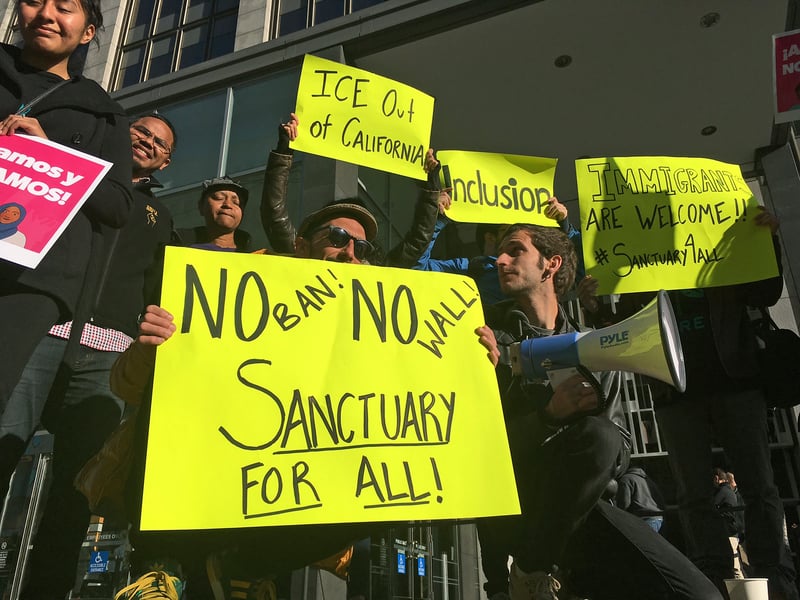
SAN FRANCISCO (CN) — A federal judge on Thursday blocked President Donald Trump’s executive orders that promise to defund sanctuary cities like San Francisco.
“In 2017, President Donald Trump issued Executive Order 13,768, titled ‘Enhancing Public Safety in the Interior of the United States,’ which was directed at so-called ‘sanctuary jurisdictions.’ The city and county of San Francisco and county of Santa Clara sued, arguing that Section 9 of EO 13,768 was unconstitutional. I found that they had pre-enforcement standing, that they were likely to succeed on the merits because Section 9(a) was unconstitutional, and that they faced irreparable harm absent an injunction. I enjoined Section 9(a). The Ninth Circuit affirmed,” U.S. District Judge William Orrick III wrote in a 6-page order issued Thursday.
“Here we are again.”
This time, the executive orders being challenged — Executive Order 14159 and Executive Order 14218, signed shortly after Trump took office in January — direct every federal agency to ensure that “federal payments” to localities do not, by design or effect, “abet so-called ‘sanctuary’ policies that seek to shield illegal aliens from deportation.”
“The clear and specific directive to ensure that sanctuary jurisdictions do not receive federal funds is unconstitutional,” San Francisco Deputy City Attorney Karun Tilak, representing the plaintiffs, said at a preliminary injunction hearing Wednesday.
The plaintiffs — San Francisco, Santa Clara County and 14 other cities and counties around the nation — sued in February, claiming that Trump was attempting to commandeer local law enforcement to help round up immigrants. San Francisco’s sanctuary city law was signed in 1989. The ordinance largely prohibits San Francisco police from using any city funds or resources to assist immigration agents unless it’s required by federal or state law.
Tilak asked Orrick, a Barack Obama appointee, for injunctive relief to pause the federal government from interfering with any sanctuary cities’ funding. If the funds were cut, Taluk argued, vital programs in sanctuary jurisdictions, such as health care programs, would need to be shuttered because the programs would face an existential crisis.
Tiluk said the language in the challenged executive orders is vague and that precedent is on the plaintiffs’ side.
“As this court and the Ninth Circuit has found, there is no congressional authorization for the broad-scale withholding of federal funding from sanctuary jurisdictions,” Tiluk argued, referring to Orrick’s blocking of a similar executive order from Trump that ordered sanctuary cities to be defunded during Trump’s first term in office. The judge’s ruling was upheld on appeal; the Ninth Circuit ruled the order unconstitutional.
Caroline McGuire from the Department of Justice said the plaintiffs’ claims were unripe because, at this point in the litigation, it is unclear what, if any, of the plaintiffs’ grants will be affected by the executive orders. McGuire also said that the executive orders merely call for an evaluation.
“In order for the plaintiffs to achieve the relief that they seek here, the contours of any alleged injury would need to be fleshed out, and that hasn’t been done at this stage in the litigation,” McGuire told Orrick.
“The distinction, though, that I think will be hard for you to get around is that the executive orders speak to all federal funds. It’s not speaking to a discrete grant, and so that becomes coercive to governments that rely on federal funding for health care and other things that are now at risk,” Orrick replied.
McGuire said that at this point, the plaintiffs have admitted they have not suffered an injury and that their harms are simply budget uncertainty. No money has been impacted yet, she said.
Lauren Fascett, McGuire’s co-counsel, told Orrick that the executive orders are going to ensure that federal grants are monitored and that the court should not issue injunctive relief and assume the federal government is going to violate the Constitution.
“We have a general plan to review federal funding and make sure that sanctuary jurisdictions are compliant with federal law,” she said. “Nothing in the memo or the executive orders suggest the government is trying to force the states to take specific action.”
Orrick replied that the plaintiffs may have a well-founded fear of budgetary uncertainty, even more so than they did during Trump’s first attempt at cutting funding to sanctuary cities during his first term.
On rebuttal, Tiluk said the government’s argument that the executive orders call for only an evaluation cannot be squared away with the plain language of the orders or the government’s statements or actions and again asked for injunctive relief.
“We don’t have to wait to suffer the injury to challenge the unconstitutional action,” Taluk said.
Orrick agreed, finding U.S. Attorney General Pam Bondi’s directive freezing Justice Department funds amounted to a final agency action and was arbitrary and capricious, and also unconstitutional.
“The cities and counties have also demonstrated a likelihood of irreparable harm. The threat to withhold funding causes them irreparable injury in the form of budgetary uncertainty, deprivation of constitutional rights, and undermining trust between the cities and counties and the communities they serve,” Orrick wrote, and barred the Trump administration from directly or indirectly withholding, freezing or conditioning any federal funding from the plaintiffs.
Subscribe to our free newsletters
Our weekly newsletter Closing Arguments offers the latest about ongoing trials, major litigation and rulings in courthouses around the U.S. and the world, while the monthly Under the Lights dishes the legal dirt from Hollywood, sports, Big Tech and the arts.