
 Search Articles


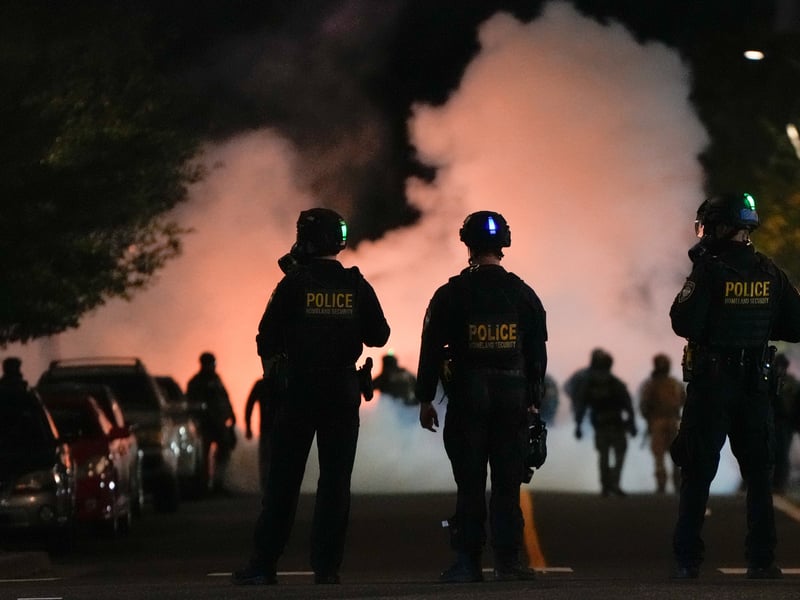
PORTLAND, Ore. (CN) — Federalized National Guard troops are permanently blocked from coming to Portland, U.S. District Judge Karin Immergut ruled on Friday.
“The president’s unlawful federalization of the National Guard violates the Tenth Amendment, which ‘reserves to the states’ any powers not expressly delegated to the federal government in the Constitution,” Immergut wrote in the 106-page opinion.
The decision from the Donald Trump-appointed judge comes just one week after the conclusion of a three-day trial over whether the Trump administration could deploy troops to protect “war ravaged” Portland and its Immigration and Customs Enforcement facility.
Immergut found that the evidence “demonstrates that these deployments, which were objected to by Oregon’s governor and not requested by the federal officials in charge of protection of the ICE building, exceeded the president’s authority.”
Under the order, the federal government is permanently blocked from federalizing and deploying members of the National Guard in Oregon to respond to the protests at the ICE building. Immergut issued a two-week stay on the portion of the order that blocks the federalization of the Oregon National Guard in order to preserve the status quo, as members had already been federalized, but those federalized troops may not be deployed.
Oregon leaders praised Immergut’s ruling, with Oregon Attorney General Dan Rayfield calling it a huge victory for Oregon.
“The courts are holding this administration accountable to the truth and the rule of law,” Rayfield said in a statement. “From the beginning, this case has been about making sure that facts, not political whims, guide how the law is applied. Today’s decision protects that principle.”
Portland Mayor Keith Wilson said the ruling vindicated the city’s position that zero federal troops are needed.
“Portland values the Constitutional right to free speech, and we will defend those rights,” Wilson said in a statement. “We will continue fighting in court and working with state and community partners to ensure public safety, protect civil rights, and stand up for our immigrant community."
Protest activity
The ICE facility in southwest Portland has been the site of ongoing protests since June. The city of Portland and the state of Oregon sued Trump and his administration in federal court after he announced that he directed the Department of Defense to federalize and deploy the Oregon National Guard. Immergut blocked that directive, and California joined the lawsuit the next day after Trump attempted to send already federalized California National Guard troops to Portland in lieu of Oregon troops.
Over the course of the trial, the city and states’ depiction of the situation at the ICE facility varied greatly from that presented by the federal government. Local law enforcement leaders testified that protests, which are often attended by protesters in inflatable costumes, had mostly been mild and “low energy” except for one night in June when the police declared a riot. The plaintiffs accused the federal government of “manufactur[ing] a crisis” to justify the deployment.
The city and states showed videos of federal agents deploying tear gas at crowds and tackling individual protesters. They also shared the number of protesters and federal agents at the site, noting that federal agents outnumbered protesters for five of the eight days leading up to Trump’s late September deployment announcement.
The federal government told the court that the protests were out of control and that federal intervention was necessary to protect the ICE facility and ICE agents. The facility temporarily closed for several weeks in the summer due to property damage from the protests.
Federal law enforcement testified that protesters blocked the driveway of the facility and taunted officers guarding the building. The government argued the protest activity constituted a danger of rebellion.
In Friday’s ruling, Immergut noted that the federal defendants presented inconsistent testimony as to whether the ICE facility had breached or if protesters had merely just attempted to breach it.
The only witness who testified to an actual breach was ICE Field Office Director Cammilla Wamsley and Immergut noted her testimony was “inconsistent with every other piece of evidence received on the subject” and that she presented a “general lack of reliability” on issues related to the protests.
She also noted that reporting from the Portland Police Bureau showed inconsistencies in the testimony of the federal government’s version of events. While there was evidence of isolated instances of threatened violence toward federal officers, that activity peaked in June and declined rapidly with only sporadic but manageable instances following, Immergut found.
“On a few occasions, federal personnel endured more serious acts of violence,” Immergut wrote. “But there is no indication that these acts, while unacceptable, ever resulted in serious injuries.”
Title 10, Section 12406 of the U.S. Code allows federal use of state National Guard troops when the president is unable to execute the laws of the United States with regular forces or during a “danger of rebellion.”
Immergut wasn’t convinced the federal government had proven such a rebellion had occurred.
“This court arrives at the necessary conclusion that there was neither ‘a rebellion or danger of a rebellion’ nor was the president ‘unable with the regular forces to execute the laws of the United States’ in Oregon when he ordered the federalization and deployment of the National Guard,” Immergut wrote.
Immergut noted that the ruling doesn’t mean the president can never deploy the National Guard to the state, but the conditions on the ground must justify that deployment.
White House spokesperson Abigail Jackson said the facts haven’t changed, despite the court’s ruling.
“Amidst ongoing violent riots and lawlessness, that local leaders have refused to step in to quell, President Trump has exercised his lawful authority to protect federal officers and assets,” Jackson said in a statement. “President Trump will not turn a blind eye to the lawlessness plaguing American cities and we expect to be vindicated by a higher court.”
Appeals and injunctions
The trial was combined with a preliminary inunction hearing, and Immergut on Sunday ruled in the state’s favor and blocked troops from deploying until she could release her final order.
In her order granting the preliminary injunction, Immergut noted the evidence in the record showed nothing more than “isolated and sporadic instances of violent conduct that resulted in no serious injuries to federal personnel.” Most of the violent incidents at the facility occurred between protesters and counter-protesters.
Immergut first blocked the federalization and deployment of the Oregon National Guard on Oct. 4. In disclosures before Immergut on the first two days of trial, Justice Department attorneys admitted that Oregon National Guard troops had been deployed to the ICE facility the morning of Oct. 4 and had remained on site for an unknown number of hours after Immergut issued that order.
Immergut issued a second temporary restraining order on Oct. 5, after the Trump administration announced it would send federalized National Guard troops from both Texas and California.
Following an appeal of the first order, a split three-member panel of the Ninth Circuit Court of Appeals ruled in favor of Trump on Oct. 20.
The order effectively cleared the way for the deployment of the National Guard, but a Ninth Circuit judge quickly called for a vote on whether to rehear the case en banc. Deployment stalled as Immergut’s second restraining order remained in effect — though the Ninth Circuit panel majority noted the two orders “rise or fall together.”
The Ninth Circuit voted to rehear the appeal en banc, but the expiration of the temporary restraining order, combined with Immergut’s preliminary injunction ruling, rendered it moot.
Subscribe to our free newsletters
Our weekly newsletter Closing Arguments offers the latest about ongoing trials, major litigation and rulings in courthouses around the U.S. and the world, while the monthly Under the Lights dishes the legal dirt from Hollywood, sports, Big Tech and the arts.