
 Search Articles


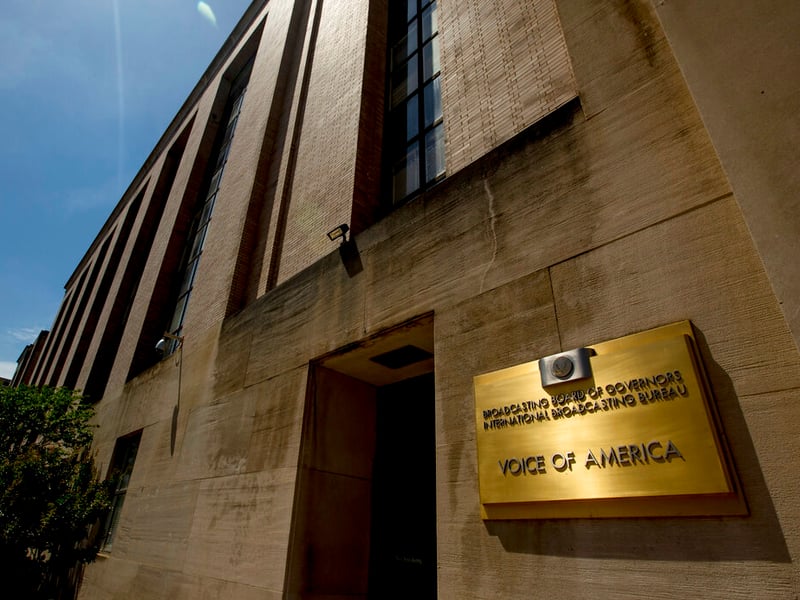
WASHINGTON (CN) — A federal judge ruled Thursday that Kari Lake, the head of the U.S. Agency for Global Media, cannot fire the Voice of America director as part of the administration’s wider effort to shut down the independent media outlet.
U.S. District Judge Royce Lamberth, in a 23-page ruling, granted a preliminary injunction to prevent the removal of Michael Abramowitz that was set to take effect on Aug. 31.
Lamberth, a Ronald Reagan appointee, ruled that the VOA director can only be removed by a majority vote of the International Broadcasting Advisory Board, which has been without quorum since January and has thus been inactive.
The seven-member board is made up of six presidential appointees — no more than three can be from the same party — with the seventh being the secretary of state.
Upon taking office, President Donald Trump fired six of the seven members, none of whom have since been replaced, leaving just Secretary of State Marco Rubio in charge.
Trump targeted VOA and the other media organizations in a March 14 executive order, “Continuing the Reduction of the Federal Bureaucracy,” and required its “non-statutory components and functions” to be eliminated to the “maximum extent.”
Lamberth also previously temporarily blocked the Trump administration’s effort to cut funding to Radio Free Europe on March 25, similarly finding that the government’s “one sentence of reasoning” was clearly arbitrary.
The VOA was created over 80 years ago to counter Nazi propaganda during World War II with pro-democracy programming and fact-driven journalism and has not shut down since. The organization has operated through government shutdowns as an essential service.
The Justice Department has argued that a provision in the statute creating the advisory board violates the separation of powers by “unduly interfering with the president’s authority to remove inferior officers” and called on Lamberth to strike down 22 USC Section 6205(e)(1).
That section specifically empowers the board with the removal of any head from the VOA, the Office of Cuba Broadcasting, Radio Free Europe, Radio Free Asia, the Middle East Broadcasting Networks and the Open Technology Fund.
Lamberth noted the statute allows the president to remove any of the board’s members without cause but that there’s no such language empowering the CEO of the global media agency.
“Though the board is not independent from the president, it does enjoy independence from the CEO of USAGM,” Lamberth wrote. “Congress has therefore empowered the board, when necessary, to serve as a check on the CEO.”
Lamberth recounted how, in June 2020, then-CEO Michael Pack’s unilateral moves to terminate several network heads sparked criticism from a bipartisan group of seven senators, including now-Secretary of State Rubio. He was joined in a letter to Pack by Senators Lindsey Graham, Jerry Moran, Susan Collins, Dick Durbin, Patrick Leahy and Chris Van Hollen.
“The senators stated that the ‘credibility and independence of these networks’ was ‘required by law,’” Lamberth wrote. “Consequently, Congress acted to shore up the statutory basis for such independence by curtailing the authority of the USAGM CEO to unilaterally fire network heads without the input of the board.”
The only role the CEO has in such removals is when a five-member majority of the board consults with them before unilaterally removing them.
In her effort to terminate him, Lake placed Abramowitz on administrative leave with 1,300 other employees on March 15 and reassigned his duties to another employee.
That action was quickly challenged, leading Lamberth in April to order Lake to restore the positions of all employees at VOA, Radio Free Asia and Middle East Broadcasting.
On July 8, Abramowitz was informed he would be reassigned to VOA’s transmitting station in Greenville, North Carolina, effective Sept. 6, and that if he did not accept by July 29, he’d be removed as VOA director. Abramowitz challenged the move on July 23.
On Aug. 1, Senior Adviser John Zadrozny sent Abramowitz a termination letter, indicating he’d be removed on Aug. 31, citing his refusal to accept reassignment as the reason and that Lake had made the decision.
In his conclusion, Lamberth wrote that if Lake truly wants to remove Abramowitz, there is a clear, legal solution.
“To the extent that the board’s current lack of quorum institutes a practical barrier to removing Abramowitz, the Broadcast Act gives the president a straightforward remedy: replacing the removed members,” Lamberth wrote.
The global media agency did not respond to a request for comment.
 Follow @Ryan_Knappy
Subscribe to our free newsletters
Our weekly newsletter Closing Arguments offers the latest about ongoing trials, major litigation and rulings in courthouses around the U.S. and the world, while the monthly Under the Lights dishes the legal dirt from Hollywood, sports, Big Tech and the arts.