
 Search Articles


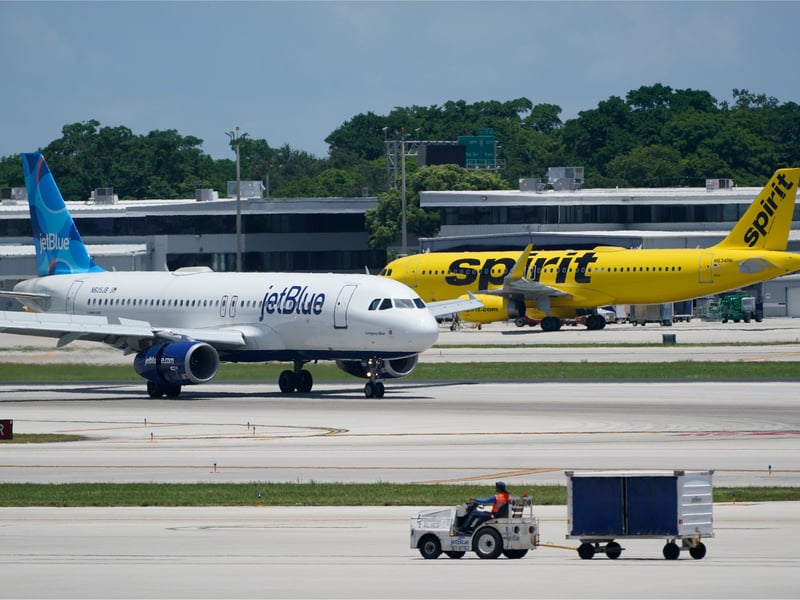
BOSTON (CN) — JetBlue Airways’ proposed $3.8 billion acquisition of Spirit Airlines was nixed by a federal judge Tuesday, marking the second time in eight months that JetBlue has lost an antitrust case brought by the Biden administration.
The proposed sale “does violence to the core principle of antitrust law: to protect the United States’ markets … from anticompetitive harm,” U.S. District Judge William Young wrote in a 110-page ruling.
Last May another federal judge in Boston ordered an end to JetBlue’s partnership with American Airlines at airports in Boston and New York.
The ruling caused Spirit’s stock to plunge more than 60%, from $15.36 a share to $5.86, before recovering slightly. JetBlue’s stock rose about 6%.
The Biden Justice Department has been concerned over the consolidation in the airline industry, where four carriers — United, American, Delta and Southwest — account for 80% of all U.S. air travel.
JetBlue’s proposed deal would have created the fifth largest U.S. airline with a 10% market share, allowing the company, which is currently sixth, to leapfrog Alaska Airlines.
The merger would have been good for competition in some ways, Young acknowledged, noting that the four principal carriers have an “oligopoly” and a combined JetBlue and Spirit “would likely place stronger competitive pressure on the larger airlines.”
JetBlue also argued that it would be difficult for it to grow organically to compete with the “big four” because of a shortage of available new aircraft, so acquiring aircraft by purchasing Spirit made sense.
“There are no ‘bad guys’ in this case,” Young commented.
But he went on to find that JetBlue is “a low-cost carrier” whereas Spirit is “an ultra-low-cost carrier … meaning that its offerings target budget-conscious passengers with low-cost, often unbundled flight options.”
Removing Spirit from the market would eliminate those options for consumers and force them to pay more to travel, he found.
The merger “would eliminate one of the airline industry’s few primary competitors that provides unique innovation and price discipline," Young said, and “would likely incentivize JetBlue further to abandon its roots as a maverick, low-cost carrier.”
The deal would also eliminate competition in routes currently served by both JetBlue and Spirit, Young went on, and it would be difficult for other ultra-low-cost carriers such as Allegiant and Frontier to step up and take over Spirit’s role.
Young, an octogenarian Reagan appointee, concluded his ruling by speaking directly to budget air travelers.
“Spirit is a small airline. But there are those who love it,” he wrote. “To those dedicated customers of Spirit, this one’s for you. Why? Because the Clayton Act, a 109-year-old statute requires this result — a statute that continues to deliver for the American people.”
Subscribe to our free newsletters
Our weekly newsletter Closing Arguments offers the latest about ongoing trials, major litigation and rulings in courthouses around the U.S. and the world, while the monthly Under the Lights dishes the legal dirt from Hollywood, sports, Big Tech and the arts.