
 Search Articles


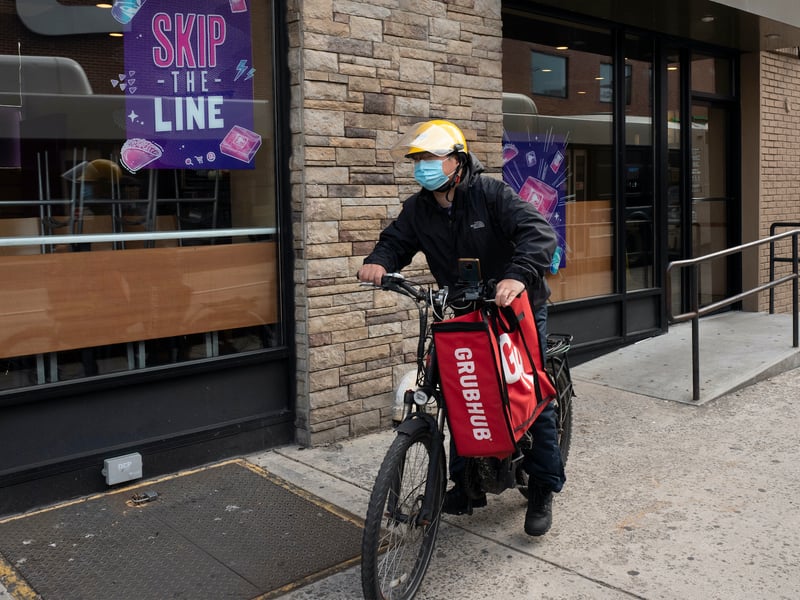
SAN FRANCISCO (CN) — A federal judge chastised attorneys Thursday over the proposed settlement of a class action involving food delivery app Grubhub over claims of driver misclassification.
Under the proposed terms, Grubhub would pay $24.7 million to an estimated settlement class of 60,000 Grubhub drivers, resolving a decadelong suit filed by then-Grubhub driver Raef Lawson. Lawson claims the company misclassified him as an independent contractor and failed to pay him minimum wage, overtime pay, or fully reimburse him for job-related expenses.
U.S. District Judge Jacqueline Scott Corley homed in on the terms of the deal, which would resolve claims through the present day. Previously, she found Lawson only had standing up to the enactment of Proposition 22, a ballot measure passed by California voters that exempts app-based ride-hail and delivery drivers from a state law requiring those workers to be treated as employees and given full employment benefits.
“I have one complaint in front of me, and the only plaintiff I have is Mr. Lawson, who I held only had standing up through the enactment of Prop 22. So how can I approve a settlement that pays claims through the present?” the Biden appointee asked.
Class attorney Shannon Liss-Riordan of Lichten & Liss-Riordan said there was an agreement to combine another case involving post-Proposition 22 drivers in this settlement, adding that Grubhub was not challenging the standing issue.
Corley noted she had to follow the Constitution.
“I am not approving a settlement just because of heated negotiation; I have an independent obligation,” she said. “What I am asking is how I can approve a settlement class based on a named plaintiff who does not have standing to assert those claims? I do not understand why the parties think standing is something that I can just say ‘Oh, never mind!’ I made a ruling. You are asking me to do something that is jeopardizing the entire settlement for everybody, and I don’t know why you would do that.”
Grubhub attorney Dhananjay Manthripragada of Gibson Dunn and Crutcher said they are trying to settle the entire time period, as the case has been going on a long time and they want to resolve the case.
Corley responded: “You are talking to me like standing is not a constitutional requirement, and I can throw the Constitution aside. I really don’t understand that.”
She directed the parties to file a stipulation to an amended complaint that adds a new named plaintiff with standing to assert claims after the enactment of Proposition 22.
Corley also took issue with the proposed settlement release, saying it was “untethered” to the claims and essentially includes “anything, any claim, that any class member has against the long list of released parties.”
Liss-Riordan said the release states more than once it’s related to claims of misclassification, but blamed Grubhub for the broad wording.
“That you then signed onto, this is a pox on both parties,” Corley shot back. “You agreed to it. It does not represent the class at all.”
She went on: “This is about three times longer than it needs to be, and it’s incomprehensible. I have an obligation to ensure that the language is clear, so a Grubhub driver that gets hired to work in the office and has some harassment claim, that Grubhub can’t pull this out and say ‘You released this claim.’”
Manthripragada also attempted to defend the release, explaining that the release language had been approved by other courts.
“That is not a good argument,” Corley said. “When I first started working here, judges just signed off on these things. Maybe some judge somewhere in the past or even recently signed off on it, but that is no comfort.”
The judge said she would not approve the settlement unless the release was rewritten.
In a statement, Liss-Riordan said the class will “respond to the further issues the court raised today and look forward to moving forward to getting payments made to class members from this long-running case.”
Representatives for the defense did not immediately respond to a request for comment.
Lawson drove for Grubhub from October 2015 to February 2016, and sued the delivery giant during his tenure there.
In 2018, after a bench trial, Corley ruled Lawson was not an employee, but on remand from the Ninth Circuit, reversed course in 2021 and found Lawson was legally a Grubhub employee during his four months at the company, not an independent contractor. He was awarded $65.11 for his minimum wage claims in March 2023.
Lawson also brought an action under California’s Private Attorneys General Act, a law that allows private citizens to act in the place of the state attorney general to recover penalties for labor violations.
In 2023, Corley denied Grubhub’s motion for partial summary judgment, finding she had already ruled that Lawson suffered from minimum wage violations and is therefore an “aggrieved employee” who is allowed to bring a lawsuit to collect civil penalties under PAGA “on behalf of himself or herself and other current or former employees” regardless of what time period he was employed as a driver for Grubhub.
 Follow @mhattridge_
Subscribe to our free newsletters
Our weekly newsletter Closing Arguments offers the latest about ongoing trials, major litigation and rulings in courthouses around the U.S. and the world, while the monthly Under the Lights dishes the legal dirt from Hollywood, sports, Big Tech and the arts.