
 Search Articles


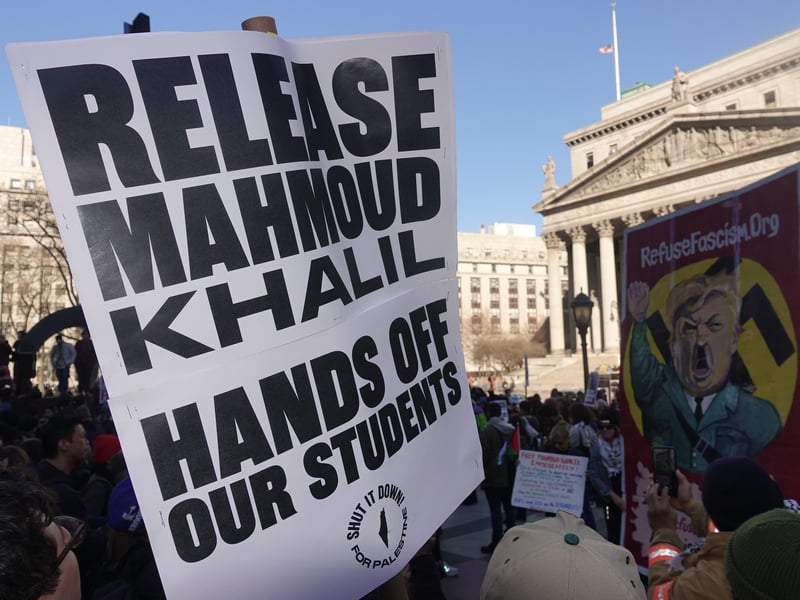
(CN) — A federal judge has expressed palpable frustrations with the government during a two-week bench trial over the administration’s attempts to arrest and deport pro-Palestine student protesters, but tensions reached a boiling point when government lawyers tried to claim that key evidence is off-limits for the court.
Justice Department attorneys claimed to U.S. District Judge William Young Tuesday that the police report of international student activist Mahmoud Khalil’s March arrest is privileged.
“Your honor, we would assert law enforcement privilege over this document,” said Justice Department attorney Nancy Safavi, referencing a privilege type that protects against divulging information about an ongoing investigation.
“Law enforcement privilege for something that’s happened?” Young, a Ronald Reagan appointee, shot back. Khalil was detained over four months ago and has since been released after more than 100 days in captivity.
The judge rejected Safavi’s claim that the records would reveal the methods and techniques leading up to the arrest, noting “if the privilege were that broad, no police report could ever be produced if the government decided not to produce it.”
“That’s what has baffled me from the outset here,” the judge continued. “This has no forward-looking aspect.”
Privilege has been a sensitive topic throughout the trial, in which a group of higher education groups are seeking to stop the Trump administration from deporting college students protesting Israel’s bombing campaign in the Gaza strip. The issue has already delayed the trial by at least a day after the government appealed an earlier ruling from Young that made certain documents available to the case’s plaintiffs.
That appeal left trial dark on Monday, with neither side able to call witnesses while awaiting direction from the First Circuit.
And last week, Young appeared similarly flummoxed when the government again claimed privilege when a witness was being questioned about meetings with the Homeland Security Council about the student deportations.
Justice Department attorney Jessica Strokus claimed that not only the meetings’ content, but also the names of those on the council were confidential, per “presidential communications privilege.”
“What?” asked the judge. “You’re asserting the executive privilege of the President of the United States with respect to these meetings? … And [the council’s] membership is secret?”
“I would not say that it is secret, your honor,” Strokus said. “I would say that it is privileged.”
Attorneys for the plaintiffs later noted that there is a list of the council’s attendees on the White House’s own website; members include the Vice President, the Secretary of State, the Secretary of Homeland Security and the Homeland Security Advisor.
The bombshell trial kicked off last week in federal court in Boston, Massachusetts. So far, several college professors and researchers have testified that the arrests of students like Khalil and Tufts University’s Rumeysa Ozturk have chilled free speech on campus.
One witness, Brown University international studies professor Nadje Al-Ali, said that Khalil’s arrest made her rethink attending a “No Kings Day” protest in Providence, Rhode Island, against the Trump administration and its policies.
“I would have liked to participate … but I was worried that my identity would be captured as part of the protest and that I would be risking increasing my vulnerability in terms of being targeted,” she said.
It’s precisely the point that the case’s plaintiffs, which include groups like the American Association of University Professors and the Middle East Studies Association, are trying to prove. The groups claimed in their March complaint that the Trump administration’s targeting of pro-Palestinian students is “terrorizing” university students and faculty merely for exercising their First Amendemnt rights.
They’re seeking an order from Young that bars the administration from targeting lawful residents like Khalil and Ozturk for deportation based on their constitutionally-protected speech.
Young has ruled against the Trump administration in other cases, recently lambasting it for “palpable” discrimination in the slashing of public health funding in another lawsuit.
 Follow @Uebey
 Follow @uebey.bsky.social
Subscribe to our free newsletters
Our weekly newsletter Closing Arguments offers the latest about ongoing trials, major litigation and rulings in courthouses around the U.S. and the world, while the monthly Under the Lights dishes the legal dirt from Hollywood, sports, Big Tech and the arts.