
 Search Articles


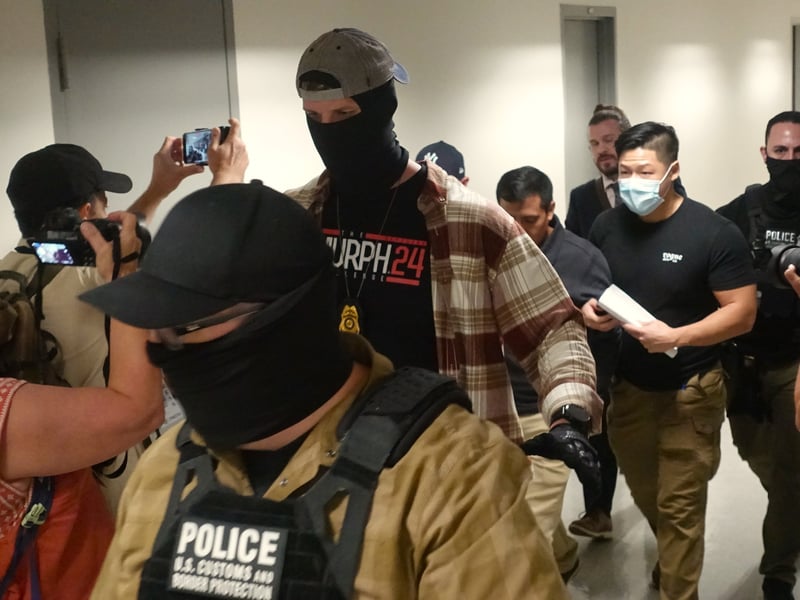
(CN) — Carmen Sequen faced a dilemma familiar to thousands of immigrants across the country: appear for her hearing and risk arrest by ICE agents or stay away and lose her chance to make a legal case to remain in the United States.
On Monday, U.S. District Court Judge P. Casey Pitts of the Northern District of California ruled that such concerns warrant judicial examination. He rejected the government’s motion to dismiss a lawsuit challenging policy change implemented by U.S. Immigration and Customs Enforcement and the Justice Department’s immigration court system.
The decision allows Sequen and two other plaintiffs to continue their challenge against policies they say have fundamentally altered immigration enforcement. This includes Yulisa Alvarado Ambrocio and Ligia Garcia.
“In general, there is a strong presumption that Congress intends judicial review of administrative action,” Pitts, a Joe Biden nominee wrote in his order.
In May, ICE issued final guidance allowing its agents to make civil immigration arrests in or near courthouses on a case-by-case basis whenever they believe a noncitizen will be present, easing earlier restrictions that generally limited such arrests to national security threats, imminent danger or other exceptional circumstances.
The plaintiffs say the policy shift has led to more absences at immigration hearings as they weigh the risk of arrest against appearing for their cases. Pitts found that the plaintiffs had reasonably argued that the government didn’t provide sufficient justification for the changes.
“Plaintiffs plausibly allege that each of the challenged policies is arbitrary and capricious,” he wrote.
The plaintiffs also challenge ICE’s elimination of a longstanding 12-hour limit on detention in short-term holding facilities. The agency now permits detention in these facilities for up to 72 hours or longer under what it terms exceptional circumstances.
In their lawsuit, the plaintiffs describe conditions at ICE’s San Francisco field office that include overcrowded rooms with open toilets, limited access to hygiene products and showers, and inadequate sleeping arrangements.
Pitts expressed concern about the policy’s internal contradictions.
“Providing for overnight or multi-night detention in hold rooms while preserving a prohibition on ‘sleeping apparatus’ is not just likely but certain to lead to violations of noncitizens’ due process rights to be free from punitive conditions of confinement,” he wrote.
The government had argued that the plaintiffs should pursue other legal avenues, including habeas corpus petitions, to challenge their treatment. Pitts rejected that argument, explaining that such petitions have limited scope.
“Habeas petitioners may challenge only the fact or duration of particular detainees’ confinement,” he wrote. “Plaintiffs could not use habeas to challenge ICE’s failure to provide a reasoned basis for its overall policy of permitting detention longer than 12 hours in short-term hold rooms.”
Pitts granted the government’s motion to dismiss claims brought by Martin Hernandez Torres, who was removed to Mexico and no longer faces the prospect of detention by ICE.
“The ‘inherently transitory’ exception thus no longer applies to Mr. Hernandez Torres, rendering his claims moot,” the judge wrote.
The decision allows claims by Sequen, Ambrocio and Garcia to move forward. The court has already issued preliminary orders staying the courthouse arrest policies within ICE’s San Francisco area of responsibility, which covers Northern California, Hawaii, Guam and Saipan, in the Northern Mariana Islands, and requiring ICE to address conditions at its holding facility on Sansome Street.
Representatives for the plaintiffs, ICE and the Justice Department’s Executive Office for Immigration Review did not immediately respond to requests for comment.
 Follow @JeremyYurow
Subscribe to our free newsletters
Our weekly newsletter Closing Arguments offers the latest about ongoing trials, major litigation and rulings in courthouses around the U.S. and the world, while the monthly Under the Lights dishes the legal dirt from Hollywood, sports, Big Tech and the arts.