
 Search Articles


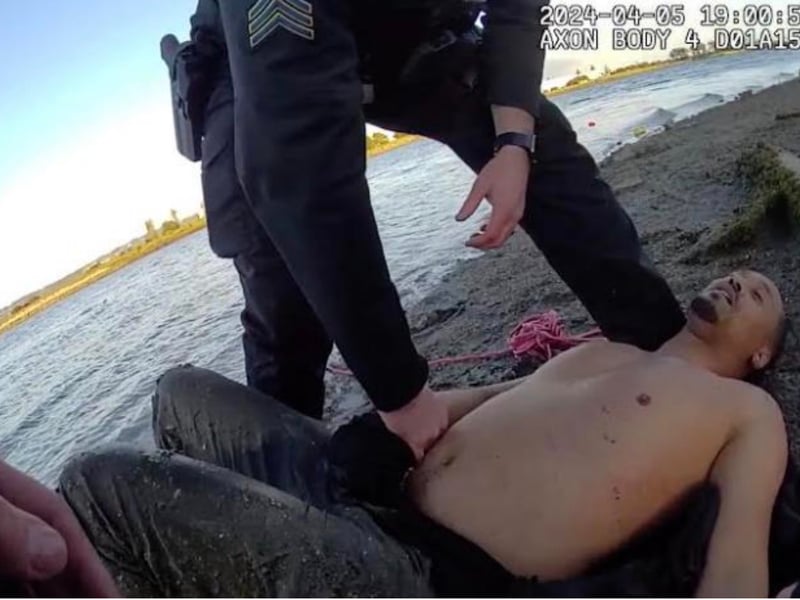
SAN FRANCISCO (CN) — The last day Deontae Charles Faison was awake, he was chased into San Leandro Bay, tased at least twice by police and left in the frigid water for 40 minutes before officers dragged him onto dry land. He’s been in a coma ever since.
A federal judge on Thursday allowed Faison’s family to sue the East Bay Regional Park District, finding its failure to train officers was so obvious it could amount to deliberate policy.
“He was tased in the water, in the estuary, in violation of policy, including the TASER company’s, and then was left there without aid for 40 minutes. That seems to me to support an inference of a need for training that is so obvious,” U.S. District Judge Jacqueline Scott Corley said.
Faison’s family argues that officers violated training and district policy by using tasers on him while he was in water, a potentially lethal combination. At the hearing, the judge rejected the district’s claim that it couldn’t be held liable since no official policy explicitly condoned the officers’ actions.
Instead, Corley said that this was the “rare case” where claims against the district could survive, citing Supreme Court cases like City of Canton, Ohio v. Harris.
The judge also impressed upon the district’s lawyers how serious the family’s claims were, after the attorneys suggested otherwise.
“I want to make sure we’re all on the same page, and that the East Bay is not taking the position that we don’t have a very serious injury here,” the judge said. “One that resulted from no known crime being committed.”
The judge called the facts of the case “troubling,” but the district was quick to push back.
“There are troubling facts from 30,000 feet, but when you get on the ground and get into the weeds … anyway, I don’t need to argue the case,” said Patrick Moriarty, attorney for the East Bay Regional Park District.
The district also said it would be filing some of the officers’ body cam footage for the court to see, claiming the video would “blatantly contradict” the facts claimed by Faison’s family.
The Joe Biden appointee said she would issue an order shortly denying the district’s motion to dismiss the case.
On April 5, 2024, Faison set out to enjoy a day at Martin Luther King Jr. Regional Shoreline Park with a friend when he was approached by police officer Jonathan Knea, who activated his vehicle’s lights and instructed them to sit on the car’s bumper.
According to the lawsuit, Knea said the car next to Faison had expired tags, and that it belonged to him, despite never seeing Faison drive it.
Although his friend is white, Faison is an African American man in a county and district with a history of discriminating against Black people.
When asked his name, Faison provided Knea with an alias. After running his name through the district system without any matches, Knea called for back-up.
After 20 minutes, Faison attempted to leave the area, and Knea drew a gun on him. Faison ran toward the Bay, and Knea deployed his taser, hitting Faison in the back a few feet from the water.
Faison collapsed but got back up and walked into the water. There, his family claims that officers re-applied the taser to him multiple times, against the district and taser manufacturer’s orders, at one point stating, “he is not going to make it.”
The officers watched him yell for help for nearly 40 minutes until he lost consciousness, and they dragged him out of the water. At no point did the officers render CPR to Faison, the lawsuit claims.
Faison has been in a coma and on life support since that day, now for over a year.
Faison’s family is seeking punitive and statutory damages against the officers and the district for assault, violations of his constitutional rights, negligence, false imprisonment, and misrepresenting the harm he endured to medical staff.
Faison’s family filed the lawsuit in August 2024. The park district moved to dismiss in March.
The East Bay Regional Park District is a special district that operates within Alameda and Contra Costa counties in the East Bay region of the San Francisco Bay Area. It maintains its own police and fire departments, separate from the county.
This case was filed in the Northern District of California and heard online via Zoom Workplace.
Subscribe to our free newsletters
Our weekly newsletter Closing Arguments offers the latest about ongoing trials, major litigation and rulings in courthouses around the U.S. and the world, while the monthly Under the Lights dishes the legal dirt from Hollywood, sports, Big Tech and the arts.