
 Search Articles


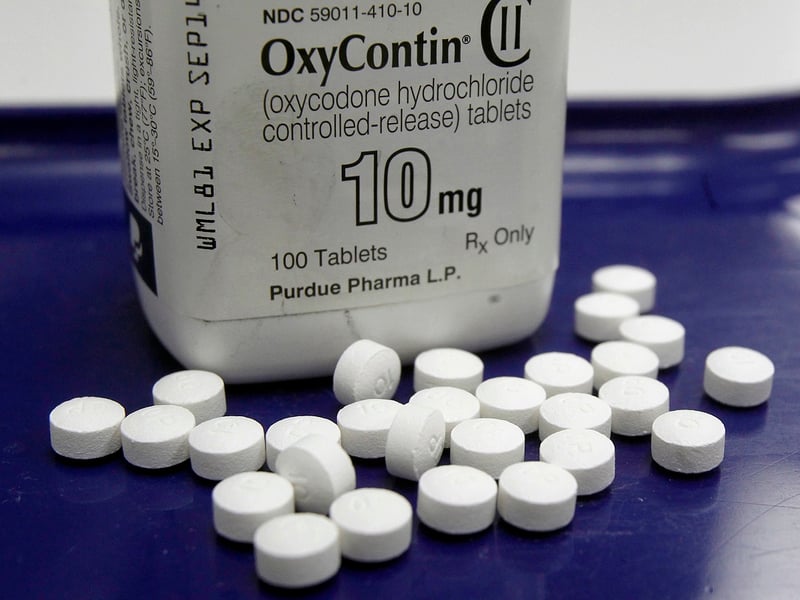
LOS ANGELES (CN) — A public nuisance lawsuit filed by Los Angeles County against two pharmacy benefit managers — middlemen in the chain between drug makers and insurance companies — cleared its first major legal hurdle on Tuesday, when a Los Angeles Superior Court judge declined to dismiss the complaint.
Los Angeles County sued two dominant pharmacy benefit managers — Express Scripts and OptumRx — in August of last year, accusing the companies of operating behind the scenes to fuel the opioid crisis, which has claimed the lives of more than 650,000 Americans since 1999.
According to the county, the pharmacy benefit managers, or PBMs, colluded with drugmakers, like the embattled Purdue Pharma, by placing certain opioids on their formularies, or lists of approved drugs, giving them preferred status and declining to impose limits on their approval in exchange for rebate payments — which the county calls “kickbacks.”
At a hearing on Tuesday for their request to dismiss, attorneys for the PBMs argued that even if the facts in the complaint were true, they still hadn’t done anything wrong.
“Collusion alone cannot cause a public health crisis,” said Express Scripts attorney Sage Vanden Heuvel of Quinn Emanuel. “There has to be some wrong or illegal act, like spilling noxious fumes. What is the wrongful act here?”
“It’s a little more than collusion if you look at the complaint,” Superior Court Judge David Cunningham said. “Allowing Purdue Pharma to edit medical guidance — that certainly triggers potential liability from the court’s perspective, assuming it’s true.”
The county claims in its complaint that Express Scripts allowed Purdue Pharma to make key changes to its clinical guidance on the use of opioids to one of its worker’s compensation clients, removing the sentence: “Opioids appear to be no more effective than safer analgesics.”
Vanden Heuvel pressed on, noting that the county is not trying to remove opioids from formularies.
“Collusion, for it to be wrongful, has to have some kind of wrongful result. Here, collusion resulted in opioids on formulas,” the attorney said.
“Half a million died,” Cunningham replied. “That’s a fairly significant, I’d say almost mind-blowing result.”
Vanden Heuvel also argued that drug formularies are sent to state and federal regulators for approval, which he said gave the PBMs a “safe harbor” from liability. In other words: the government can’t sue over something the government is tasked with regulating.
But Mimi Liu, an attorney with Motley Rice representing LA County, said that regulators weren’t approving the contents of the formularies.
“It is incorrect to say that anyone in the state reviewed and approved the substance of the formularies and agreed that certain opioids needed to be in a preferred status or higher tier, with no limitations on its use,” Liu said. “They were looking at the format of formularies. They were reviewing, ‘is there a table of contents?’ None of it was a substantive review.”
Besides, Liu argued, the regulators weren’t getting the full picture. Liu said the PBMs had deceived their employers and insurance companies, and that they had “kept their collusion with Purdue confidential from their clients … When clients took those formularies to regulators, of course that deception was passed down to regulators.”
“Reviewing and approving formularies is different than giving PBMs permission to collude with manufacturers … in return for kickbacks,” Liu said. “There was no approval of the fact that PBMs imposed no limitations on the use of Oxycontin.”
Cunningham overruled most of the PBM’s dismissal motion but agreed with the safe harbor argument — to a certain extent. The judge effectively ordered a rewrite, telling the county to amend their complaint, for a third time, to include more details on how state and federal regulators were deceived by the PBMs.
“The extent of the deception — what information was or was not disclosed to the regulators — is a factual question,” Cunningham wrote in his tentative ruling, later made permanent. “But, first, plaintiff needs to amend to actually plead that the deception occurred. The court believes the amendment would suffice to overcome defendants’ safe-harbor defense.”
Cities, states and individual plaintiffs have filed innumerable lawsuits against prescription drug manufacturers like Purdue Pharma, maker of Oxycontin, as well as pharmacies like CVS and Rite Aid, over their role in fomenting and fueling the opioid epidemic.
But PBMs — which are hired by insurance companies and employees to negotiate with pharmaceutical companies, and come up with lists of drugs that the insurers will pay for — have received far less scrutiny.
In theory, they are meant to control the costs of prescription drugs. But the companies have been accused of anticompetitive practices by the Federal Trade Commission, including the charge that they received kickbacks from drug makers like Purdue.
According to the county’s complaint, Express Scripts and OptumRx amassed a trove of data on what kind of patients were taking which drugs, data which they then misused.
“Through that data, Defendants could effectively track the opioid epidemic, pill-by-pill, as it unfolded over decades and chronicle the opioid epidemic in real time,” the county says in its complaint. “However, instead of using their data to guard against diversion and public harm, or to report suspicious prescribers, defendants used it to further their own profits. This included offering services, in exchange for lucrative ‘administrative fees’ ostensibly associated with administering benefits or contracts, to Purdue and other manufacturers of opioids to help them plan their marketing efforts and boost their sales.”
 Follow @hillelaron
Subscribe to our free newsletters
Our weekly newsletter Closing Arguments offers the latest about ongoing trials, major litigation and rulings in courthouses around the U.S. and the world, while the monthly Under the Lights dishes the legal dirt from Hollywood, sports, Big Tech and the arts.