
 Search Articles


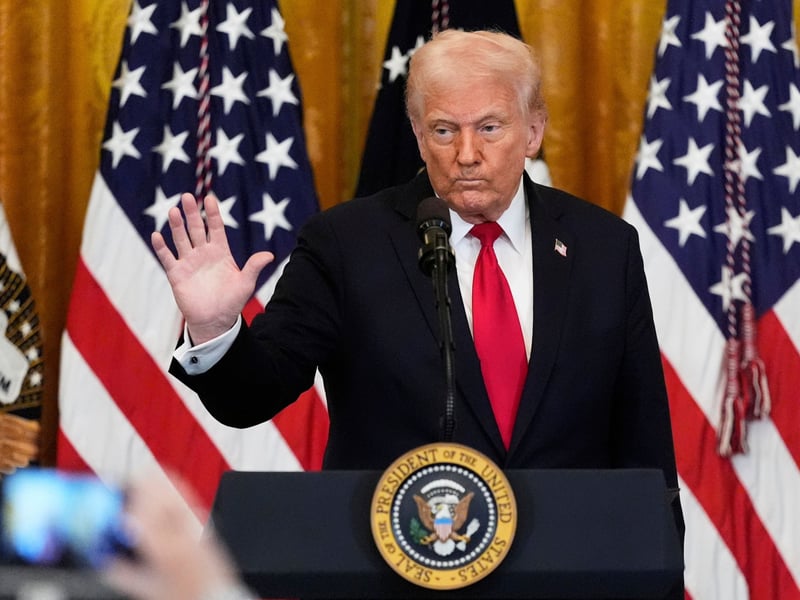
WASHINGTON (CN) — A pair of law firms sued the Trump administration Friday challenging a slew of executive orders targeting them for employing attorneys who represented the president’s legal opponents.
Washington firms Jenner Block and WilmerHale filed their separate suits in the U.S. District Court for the District of Columbia, where another federal judge temporarily blocked a similar executive order earlier this month that targeted firm Perkins Coie.
Since Feb. 25, President Donald Trump has signed several executive orders and presidential memorandums against so-called “Big Law” firms — also including Paul Weiss and Covington Burling — directing agency heads to review attorneys’ security clearances and any government contracts as well as barring attorneys from government buildings.
Trump signed the order “Addressing Risks for WilmerHale" on Thursday, citing its employment of certain attorneys who worked on the Justice Department’s investigation of the 2016 election, in particular former special counsel Robert Mueller, James Quarles and Aaron Zebley. Mueller and Quarles are retired partners at the firm.
The firm has also recently represented the Democratic National Committee, the Joe Biden and Kamala Harris campaigns and eight inspectors general who were suddenly terminated by Trump.
Trump said that WilmerHale engaged in conduct “detrimental to critical American interests” that “threaten public safety and national security, limit constitutional freedoms, degrade the quality of American elections, or undermine bedrock American principles.”
WilmerHale said that the right to counsel has long been a cornerstone of the nation’s democracy dating back to the colonial days, when John Adams defended eight British soldiers in the Boston Massacre trial.
The British monarchy’s practice of punishing attorneys for representing unpopular causes helped inspire the Bill of Rights, the firm said.
“In an unprecedented assault on that bedrock principle, the president has issued multiple executive orders in recent weeks targeting law firms and their employees as an undisguised form of retaliation for representing clients and causes he disfavors or employing lawyers he dislikes,” WilmerHale wrote.
They pointed to U.S. District Judge Beryl Howell’s decision to grant a temporary restraining order against Trump’s order targeting Perkins Coie, where she determined the order likely violated the First Amendment by improperly chilling the firm and the “entire legal system.”
Justice Department chief of staff Chad Mizelle defended the order during the March 12 hearing before Howell, arguing that the president has the sole constitutional authority to determined whether an individual or entity poses a national security risk.
Mizelle pushed back against Howell’s concern that the order amounted to viewpoint discrimination. He argued the order was based on Perkins Coie’s conduct, not its views, and that the president had the prerogative to deem an entity “untrustworthy” to handle the nation’s secrets.
Trump targeted Jenner Block in a Tuesday order, “Addressing Risks from Jenner Block,” citing the firm’s employment of Andrew Weissmann and its pro bono practices, which he asserted are used for “destructive cause.”
Jenner Block has been repeatedly ranked as the top firm providing pro bono services, where lawyers volunteer often on behalf of low-income clients who would otherwise be unable to pay for legal counsel.
“[The order] is intended to hamper the ability of individuals and businesses to have the lawyers of their choice zealously represent them,” Jenner Block wrote. “And it is intended to coerce law firms and lawyers into renouncing the administration’s critics and ceasing certain representations averse to the government.”
Several law firms have surrendered to the administration’s pressure, such as Skadden Arps, which announced on Friday that it would provide at least $100 million in pro bono legal services to the federal government.
Trump announced the agreement in a Truth Social post and said the firm would create a “pro bono committee” to provide free legal services assisting veterans and public servants like law enforcement and government officials, “ensure fairness in our justice system” and combat antisemitism.
On March 21, Trump rescinded his executive order targeting Paul Weiss after it agreed to similarly provide pro bono legal work for causes Trump supports.
WilmerHale and Jenner Block’s suits were originally assigned to Howell due to the apparent similarities in the cases, but Howell issued minute orders clarifying that certain differences in the three cases’ facts warranted reassignment to two separate judges.
She wrote that the punitive measures imposed on Perkins Coie arose solely from its representation of clients Trump disliked, while the measures imposed on WilmerHale and Jenner Block’s arose from similar representation as well as work performed at the Justice Department by current WilmerHale employees and a former Jenner Block employee.
WilmerHale’s case was reassigned to U.S. District Judge Richard Leon, a George W. Bush appointee, while Jenner Block’s was assigned to U.S. District Judge John Bates, another Bush appointee.
 Follow @Ryan_Knappy
Subscribe to our free newsletters
Our weekly newsletter Closing Arguments offers the latest about ongoing trials, major litigation and rulings in courthouses around the U.S. and the world, while the monthly Under the Lights dishes the legal dirt from Hollywood, sports, Big Tech and the arts.