
 Search Articles


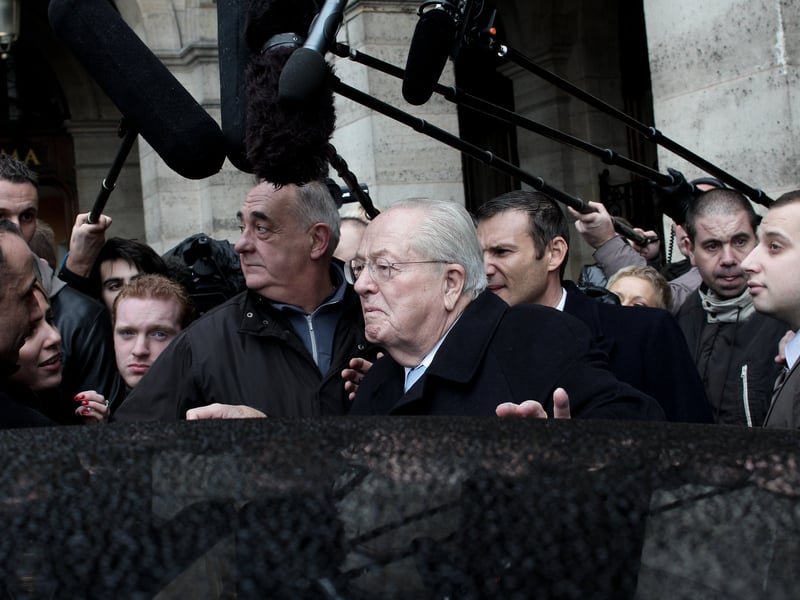
MARSEILLE, France (CN) — France’s extreme-right National Front founder Jean-Marie Le Pen, nicknamed by many as the “Devil of the Republic,” died Tuesday at 96 years old. Le Pen, who had been in a care facility for several weeks, died “surrounded by his loved ones,” his family said in a statement.
Since launching the National Front in 1972, Le Pen became a reference point in the French imagination. His antisemitic and xenophobic rhetoric set the foundations for his platform and ultimately contributed to him losing control. His daughter Marine Le Pen took over the party in 2011 and renamed it the National Rally, aiming to distance the party’s association from the scandals tied to her father.
The elder Le Pen has famously said that gas chambers used in the Holocaust were a “detail” of history, and has been charged with inciting racial hatred and embezzling public funds.
Nonetheless, he built the foundations for a party that has now become mainstream during a political career that spanned decades. It peaked in a run for president against Jacques Chirac in 2002, when Le Pen finished second.
Le Pen leaves behind a controversial but lasting legacy in France.
Born in 1928 in La Trinité-sur-Mer, a town with fewer than 2,000 inhabitants on the coast of Brittany, Le Pen had a fisherman father who was killed when his ship was blown up by a mine in 1942. His mother was a seamstress.
Le Pen studied law at the University of Paris before entering the military. He joined the French Foreign Legion and served in Algeria and French Indochina.
Le Pen’s time in Algeria sparked decades of inquiry and speculation about claims he committed acts of torture, including electrocutions, rape and waterboarding. Investigators have been collecting testimony, documents and victims’ accounts since the 1950s, but he was never charged.
In 2024, Fabrice Riceputi — a researcher and author specializing in the French colonial era and post-colonialism — released “Le Pen et la torture. Alger 1957, l’histoire contre l’oubli,” or “Le Pen and Torture. Algiers 1957, History Against Oblivion,” which unites the incriminating documents including police reports, archival documents, investigations and testimony.
“It was in Indochina that he probably learned methods of torture that were already practiced massively by the French army,” Riceputi told Courthouse News. “So the police in Algeria carried out torture regularly … . It is about a system, a system of terror of which torture is a part.”
In 1956 — just before arriving in Algiers — Le Pen was elected France’s youngest member of Parliament through the Poujadism movement, a new far-right group largely formed to protect small business owners. This gave him an important stature in the army, according to Riceputi, and launched his political career.
After over a decade working in politics — both running for positions and working in roles like campaign management — Le Pen launched the National Front in 1972.
The party was created alongside former leaders of hardline far-right movements like the New Order, and was inspired by Italian neo-fascism, according to Luc Rouban, a senior research fellow at Sciences Po Paris.
“It’s a small group that would bring together people who are nostalgic for French Algeria, nostalgic also for the fascist or Nazi regime,” Rouban told Courthouse News. “There was a form of desire to rally all the far-right forces that had not been politically represented since 1945 in France … with basically the idea that the Gaullist system was insufficient.”
Throughout the 1960s, France’s colonies became independent. Rouban says this fueled a resentment toward Charles de Gaulle, the founder of France’s modern republic.
For decades, the right-wing movement didn’t gain much traction, beyond a few deputies elected to France’s National Assembly, the second chamber of Parliament. In 1974, Le Pen won 190,000 votes in the presidential election.
This changed in 2002, when Le Pen faced off against Chirac in the second and final round of presidential elections and won roughly 17% of the vote — the highest for the far right at the time.
“From there, you have a real take-off,” Rouban said. “We’re seeing the reappearance of a political movement reviving far-right positions that are considered anti-republican, racist, xenophobic, too close to what we knew in France during the Vichy regime, and also very linked to the intellectual far right of the prewar period.”
Though Le Pen enjoyed a few years of relative popularity after his presidential run, Rouban said that faded around 2008.
Le Pen was notorious for blatant antisemitism, including his remark that gas chambers were a “detail” of history. In France, Holocaust denial is a crime. Before his run for president, he was fined the equivalent of roughly $200,000 for inciting racial hatred over such comments.
In 2011, Marine Le Pen took over and began a yearslong effort to rebrand away from the extreme racism associated with her father, who was expelled from the party. She has made numerous public statements to make the distinction clear, which has worked in her favor.
She ran against current French President Emmanuel Macron in the country’s 2017 and 2022 presidential elections, winning 21.3% and 41.5%, respectively. The growth in her popularity mirrors the RN’s growing normalization in France, where the party continues to gain momentum.
In 2024, the RN won an unprecedented 31.5% of the European elections vote, which prompted Macron to immediately dissolve France’s government and call for snap elections. Although the RN fell flat in the results — coming in third behind the left-wing New Popular Front coalition and Macron’s Ensemble group, despite early expectations for a landslide victory — the groundwork had already been set. Marine Le Pen is positioning herself for another presidential run in 2027.
Despite Marine Le Pen’s successful attempts at distancing the RN from her father, Jean-Marie Le Pen’s legacy has made a lasting impact on France’s political landscape.
Rouban argues that Le Pen ushered in a third partner to what had been a bipolar division between moderate right-wing parties and the left: the extreme right.
“So he has introduced a new, more complex political game which we see today, because today you have three blocs — you have a roughly left bloc, a center and right bloc and then you have the National Rally,” he said. “So it has nevertheless transformed the French political landscape in a significant way.”
 Follow @lilyradz
Subscribe to our free newsletters
Our weekly newsletter Closing Arguments offers the latest about ongoing trials, major litigation and rulings in courthouses around the U.S. and the world, while the monthly Under the Lights dishes the legal dirt from Hollywood, sports, Big Tech and the arts.