
 Search Articles



RIO DE JANEIRO (CN) — On May 20, José Tondello, an agronomist from Antônio Prado — a town of about 13,000 in southern Brazil that proudly calls itself the country’s most Italian city — lost his voice acting as a translator during celebrations marking 150 years of Italian immigration to the region.
Fluent in Talian, a dialect blending Italian and Portuguese that is taught in the town’s public schools, the 57-year-old helped local officials communicate with visiting Italian dignitaries.
But behind the festivities, he felt a growing sense of frustration. That same day, Italy’s Parliament passed a new law drastically curbing citizenship by descent — limiting recognition to children and grandchildren of Italians who never acquired another nationality.
The rule, which took effect on May 24, directly impacts Brazilians like Tondello — descendants of immigrants who, for generations, have preserved the language, traditions and memory of their ancestral homeland.
“They tell young people to board a plane to discover their roots,” Tondello said. “Because if your roots are strong, your leaves and fruit will be too. What this law is doing, in a way, is effectively cutting off those roots.”

A descendant of two of the 156 Italians who migrated to Brazil between 1886 and 1887 to found Antônio Prado, Tondello said he visited his great-grandparents’ hometown last year and tried to apply for citizenship through the administrative process — in vain. Under the new law, he now no longer qualifies. Only those who formally initiated their application by March 27, 2025 — the date the decree took provisional effect — will be eligible.
Italy was one of the most flexible European countries regarding citizenship by descent. Since 1992, it applied the principle of jus sanguinis — citizenship by blood — with no generational limit. Applicants only needed to document a direct line to an Italian citizen and prove no ancestor had renounced their citizenship before passing it on. This allowed even Brazilians with great-great-grandparents born in Italy to obtain an EU passport.
Brazil is home to the largest community of Italian descendants outside Europe, with an estimated 30 million people of Italian descent. Most immigrants arrived between 1887 and 1888, during the abolition of slavery in Brazil, according to Henrique Trindade, a historian and researcher at the São Paulo State Immigration Museum. “There was interest in replacing enslaved labor with contracted workers, and we can’t ignore the racial whitening policy of that era,” he said.
By offering benefits like train and ship fares and land grants, Brazil attracted mostly northern Italians fleeing rural unemployment, disease, hunger, floods and avalanches. The large influx of Italians gave Italian immigrants early social and political influence in Brazil.
“They were among the first to reach the middle class, form clubs, publish newspapers, organize in factories, create unions and lead the labor movement,” Trindade said, adding that this helped entrench Italian cultural influence in the country.
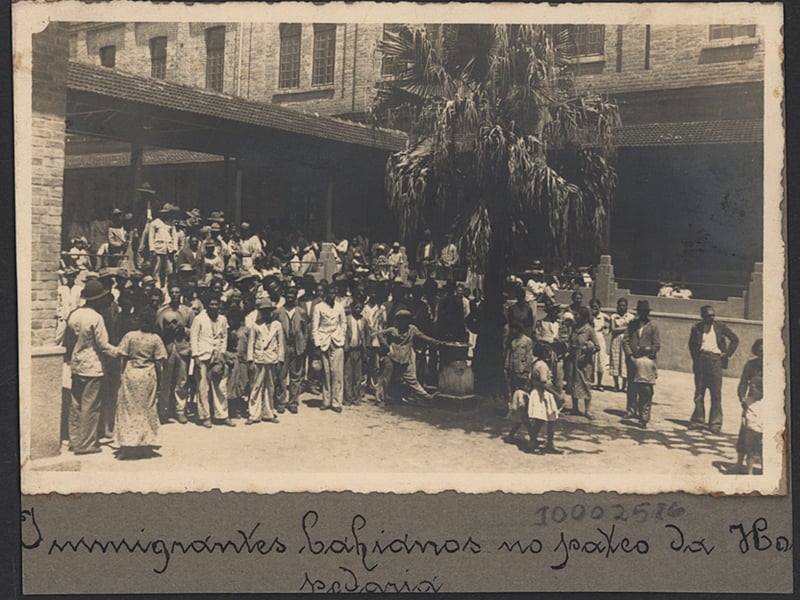
This legacy fueled a surge in citizenship applications by Brazilians, especially since the 2000s. Limited to consular appointments with long waits, many began seeking citizenship recognition directly in Italy — either by temporarily relocating to small towns or by filing lawsuits.
These legal claims typically ask a judge to confirm citizenship status based on presented documents, bypassing delays at consulates. Most are filed in regions where applicants’ ancestors were born, and the process involves verifying lineage and the uninterrupted transmission of citizenship rights.
In recent years, this trend fed into the narrative of a “passport industry,” which Prime Minister Giorgia Meloni’s government cited as justification for tightening the rules. According to Fabio Gioppo, a lawyer specializing in Italian citizenship, the problem isn’t the number of applicants but the state’s inefficiency. “The law says consular processes should take no more than two years, but we’re seeing delays of up to 10. People get fed up and turn to the courts,” he said.
The Italian government defends the new measure as a way to ensure genuine connections to Italy and prevent abuse. In a public statement, Foreign Minister Antonio Tajani said citizenship “should be a serious matter” and criticized what he called the “commercialization” of Italian passports, with companies profiting from helping people trace distant ancestors and overwhelming municipal offices with document requests.
Under the old rules, the Foreign Ministry estimated that up to 80 million people worldwide could be eligible for Italian citizenship. Between 2023 and 2024 alone, recognized applications rose from 20,000 to 30,000 in Argentina and from 14,000 in 2022 to 20,000 in 2024 in Brazil. Tajani said the principle of jus sanguinis remains, but with limits to prevent abuse.

Renata Bueno, an Italo-Brazilian lawyer and former member of the Italian Parliament, pointed to other influences behind the law — including efforts by the European Union to limit citizenship passed down through ancestry. A more controversial explanation, she said, involves pressure from U.S. President Donald Trump’s administration, which reportedly urged Italy to limit Latin Americans’ access to EU passports since many were using them as a backdoor into the United States.
While Bueno sees little political will to reverse the measure, she predicts a wave of appeals in Italian courts and possibly the European Court of Justice. Milan-based lawyer Valerio Piccolo explained that EU citizenship is protected under Article 20 of the Treaty on the Functioning of the European Union. “If someone loses Italian citizenship, they also lose EU citizenship — and that status is protected. The EU should never accept such a loss,” he said.
Piccolo warned that the decree should alarm not only descendants abroad but all Italians. “It’s very serious. We’ve become a country where someone can strip you of your citizenship,” he said. “That’s the kind of thing fascist dictators do. You can’t revoke the citizenship of someone born Italian.”
Gioppo said lawyers are working together to submit stronger petitions in the hope that one will reach Italy’s Supreme Court and set a precedent. They also aim to challenge the law in the Constitutional Court, arguing it violates the Italian Constitution.
Gioppo argues the law violates the principle of acquired rights, which the decree paradoxically claims to uphold. “They say: ‘We’ll honor acquired rights, so those who expressed intent by March 27 are fine, others not.’ But a right is acquired at a certain moment in time. So when is citizenship acquired? At birth. If someone is born into an Italian family, that right is already theirs,” the citizenship lawyer said.
Even those who filed judicial claims before the cutoff date remain uneasy. Vinicius Belatto, a 33-year-old engineer from Chapecó, applied in August 2024 with his father and siblings. His grandmother was born in Trentino, in northern Italy. “The process is already delayed, and it should be relatively simple — just validating documents the court sends to our town of origin,” he said. “It doesn’t make much sense to annul it. I just don’t know if it’ll take more or less time now.”
While he recognizes that Italian citizenship offers opportunities beyond Brazil’s reality, Belatto said it means more than that. For someone who grew up eating traditional sweets like grostolis, hearing the occasional “porco dio” and learning to speak with his hands, he said “it’s almost like official paperwork for something I’ve always lived.”
Tondello shares that feeling. Even without formal recognition, he doesn’t hesitate: “Without a doubt, we are Italians.”

Subscribe to our free newsletters
Our weekly newsletter Closing Arguments offers the latest about ongoing trials, major litigation and rulings in courthouses around the U.S. and the world, while the monthly Under the Lights dishes the legal dirt from Hollywood, sports, Big Tech and the arts.