
 Search Articles


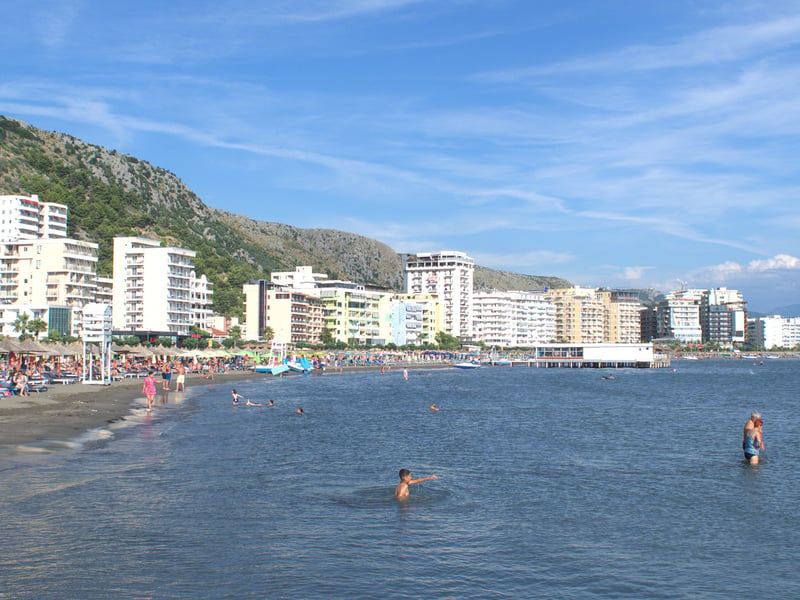
SHËNGJIN, Albania (CN) — In what may become a model for other European nations, Italy on Wednesday transferred its first group of migrants picked up in the Mediterranean Sea and brought them to this seaside town in northern Albania for processing.
On Monday, Italy’s interior ministry activated a controversial and expensive scheme to ship adult male migrants to Italian-run centers in Albania with the goal of deporting them home unless they are deemed eligible for asylum in Italy.
Far-right Italian Prime Minister Giorgia Meloni has touted the scheme as an innovative method to deter migrant crossings from North Africa, but critics say her project violates international humanitarian laws by setting up an inhumane detention system outside Italy where asylum seekers won’t get the legal aid they have a right to.
A court in Rome is expected to determine the system’s legality by Friday. Legal uncertainties swirl around this “offshoring” of asylum claims, but there is growing interest among European leaders to follow Italy’s example.
In Europe, backlash against the arrival of large numbers of migrants from Asia and Africa is growing and fueling the rise of far-right political parties. In response, governments are taking tougher steps to stop migrants, including the resumption of border checks between EU countries — a move that undermines the bloc’s core principle of free movement.
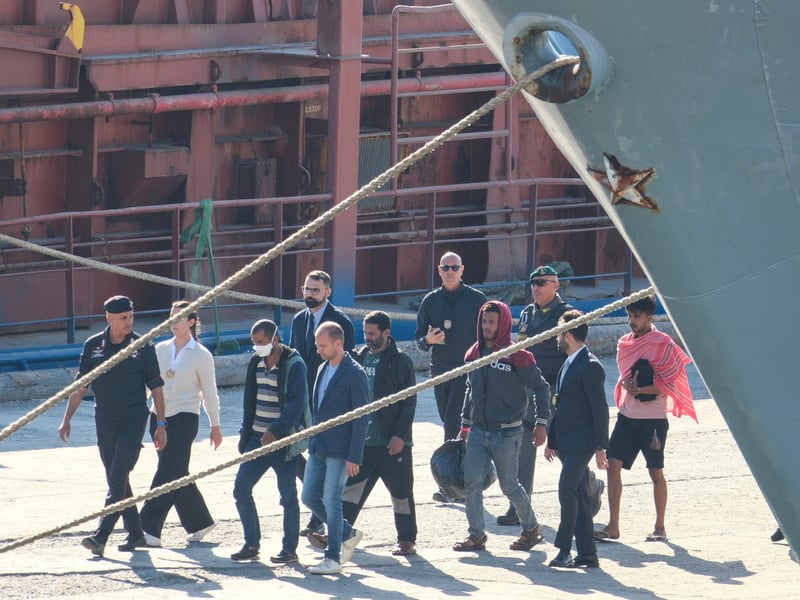
On Wednesday morning, an Italian navy vessel carried a first group of 16 migrants from Bangladesh and Egypt to a processing center erected inside the port at Shëngjin.
Italy hopes to transfer many more migrants along this route to Albania. But it can legally transfer to Albania only adult male migrants picked up in international waters. Children, women and people deemed vulnerable are to be sent to Italy and processed at migrant centers there.
For the past decade, Italy has struggled with a steady flow of migrants from war-torn and impoverished African and Asian countries who cross the Mediterranean in unseaworthy vessels from North Africa. In just the past two days, about 1,000 migrants have landed on the Sicilian island of Lampedusa, which lies off the coasts of Libya and Tunisia.
Luca Masera, a law professor at the University of Brescia and an expert on migration, said judges in Rome may very well determine the Albania scheme illegal because it undermines the right to a fair trial and breaks the law in other aspects.
“These individuals will never see a lawyer,” Masera said in a telephone interview. “They won’t have direct contact with judges because all the hearings, all the communication, will be done at a distance, they’ll all be done via computers.”
Under such conditions, he said judges and lawyers will not be able to see the migrants in person.
“This is very serious,” he said. A judge “must be able to see for example whether someone has been physically injured or been subjected to pressure.”
He said the courts also may find the Albanian centers amount to unlawful detention centers and that Italy’s parameters to determine who can be sent back to their home countries may be struck down. He cited a ruling this month by the European Court of Justice, the European Union’s high court, that found a country cannot be deemed safe when a portion of its territory is a conflict zone.
For example, Italy has listed Bangladesh and Egypt — the places the 16 migrants taken to Albania were reportedly from — as “safe countries” to deport people to.
But Masera said the Court of Justice ruling puts Italy’s definition into doubt.
“I think it will be difficult to say that Egypt and Bangladesh are entirely safe countries,” he said. “It’s very probable that a judge will say they are not safe countries.”
It is possible the Court of Justice may wind up examining the legality of Italy’s scheme.
Last November, Meloni signed the migrant deal with Albanian Prime Minister Edi Rama. Under the deal, two Italian-run processing centers will handle up to 36,000 asylum claims a year in the small Balkan nation. Italy is not giving Albania money for allowing it to operate the centers on its territory, but Meloni has promised to back Albania’s bid to join the EU. There are some economic benefits for Albania with hundreds of Italian personnel running the centers lodging there.
The project is costly with Italy expecting to spend about 670 million euros (about $727 million) on it by the end of 2028, including about $103 million spent so far. Critics contend the project will cost more than $1 billion.
Meloni’s right-wing government has put stopping illegal immigration at the center of its agenda and hopes the Albania scheme will deter migrant crossings. Other European leaders, including British Prime Minister Keir Starmer, say they are interested in outsourcing the processing of asylum claims too.
But human rights groups and Italian opposition parties have denounced the Albania deal.
“We are faced with an ugly, cynical and expensive operation,” said Piefrancesco Majorino, a member of the center-left Democratic Party, the main opposition force in Italy.
In a statement, he called the Albanian project “a laboratory for all the things not to do.”
“Human rights will be violated, transparency will be limited,” he said, adding that it was a colossal waste of money.
Italian authorities say Italian and EU laws will be adhered to in the processing of claims in Albania. They’ve dismissed accusations that the centers are more like prisons where asylum seekers will be treated harshly and unfairly deported.
“There is no barbed wire, there is above all assistance,” said Matteo Piantedosi, the interior minister, in a recent interview with Il Foglio, a right-wing newspaper. “They are centers where anyone is given the opportunity to apply for international protection, to see their situation resolved in one way or another in the space of a few days.”
On Tuesday, Meloni defended the Albania deal before the Italian parliament.
“By now, the migratory policies of the Italian government have become the migratory policies of the European Union,” Meloni said in response to attacks from opposition parties.
She said the money spent on the Albania scheme amounted to only 7.5% of what Italy spends a year on handling tens of thousands of migrants in Italy.
“Whether migrants are in Lampedusa or in Albania, it nonetheless is a cost for the Italian system of hosting migrants,” she said. “This is an important tool for deterrence that can also become a way to rein in the costs” of handling migrants.
Under the Albania arrangement, migrants are taken first to a center inside the port of Shëngjin for an initial health check and processing before they are transported 12 miles to a larger inland center in Gjadër, where they will await their fate. Hundreds of Italian police and functionaries will run both centers. The larger center has space for 880 people while the smaller one in the port has places for about 140 people.
Migrants will be sent to a country deemed safe if their asylum claims are rejected or they will be transferred to Italy if they qualify for protection.
People in Shëngjin expressed mixed feelings about the use of their town as a migrant center to a Courthouse News reporter during a recent visit.
“No one here likes this project,” said Ergys Popaj, 34, who runs a small grocery store near the port.
He worried opening the center in Shëngjin, a popular beachfront tourist destination, will tarnish the town’s reputation and not provide work to locals.
“It isn’t going to give anything back to people here,” he said. “This is a tourist town, not a town for migrants.”
Not everyone felt the same way.
Another Albanian man, who worked as a security officer in the port, said he was not opposed to the project. He declined to give his name because he worked at the port.
“We were emigrants too in the past and so they are like us,” he said, referring to the waves of Albanians who fled the country following the end of the country’s Stalinist dictatorship under the decadeslong rule of Enver Hodxa.
He expressed empathy for people fleeing troubled countries in Asia and Africa.
“We don’t know who they are; what they are doing; for what reasons they are coming,” he said.
Courthouse News reporter Cain Burdeau is based in the European Union.
 Follow @cainburdeau
Subscribe to our free newsletters
Our weekly newsletter Closing Arguments offers the latest about ongoing trials, major litigation and rulings in courthouses around the U.S. and the world, while the monthly Under the Lights dishes the legal dirt from Hollywood, sports, Big Tech and the arts.