
 Search Articles


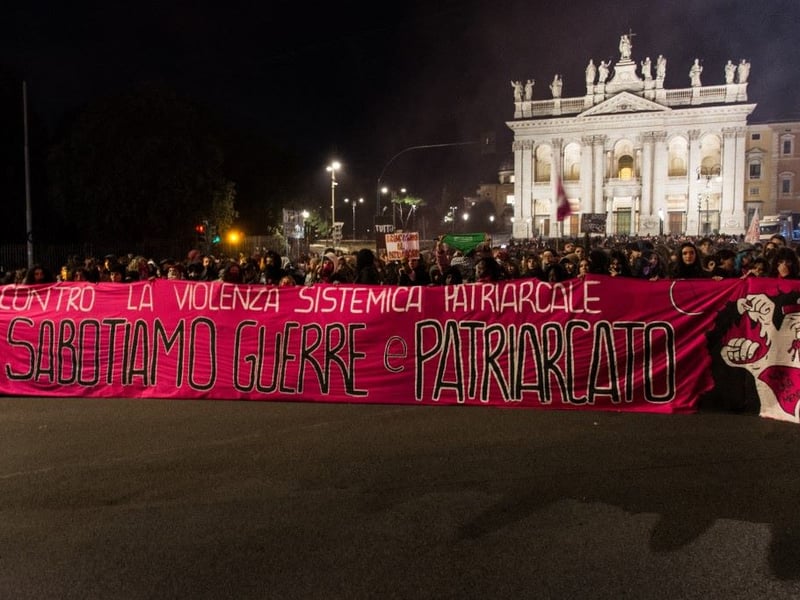
PALERMO, Sicily (CN) — Amid public outrage and national shame over the high number of women killed every year in Italy, the parliament in Rome on Tuesday unanimously passed legislation introducing femicide as a distinct crime punishable by life imprisonment.
The law’s passage came on the International Day for the Elimination of Violence Against Women, which falls every Nov. 25 as a means to raise awareness around the world about crimes against women.
In Italy, this date has turned into a solemn moment on the public calendar when schoolchildren dress in red, government buildings are lit up in orange, piazzas are turned into protest stages and politicians vow to do more to protect women from violence.
By passing the law, Italy joined a growing number of nations around the world — but one of Europe’s few — to adopt femicide as a specific crime. The United Nations defines femicide as an intentional killing with a gender-related motivation. While the term feminicide is often used interchangeably, including by the UN, it focuses on the broader link of such killings to human rights violations and a climate of impunity created by state inaction.
Italy is in the midst of a unique political moment with the country’s first female prime minister, Giorgia Meloni, leader of the far-right Brothers of Italy, and Elly Schlein, the 40-year-old Swiss-American-Italian secretary of the center-left Democratic Party, as opposition leader.
Despite their ideological differences, both women campaigned to get femicide included in the criminal code as a tool to combat the gruesome reality that Italy is beset by disturbing levels of gender-based violence.
In recent years, Italy’s consciousness has been shocked by daily news accounts of women getting murdered, raped, knifed and beaten by men in what has become a deep scar for a Roman Catholic nation that supposedly reveres the idea of womanhood and motherhood.
On Tuesday, Istat, the national statistics agency, reported that 106 women were killed last year in what was deemed a femicide, which amounts to nearly one woman murdered every three days.
Istat said gender-based homicides accounted for 91.4% of the 116 murders in which women were victims last year. In most cases, they were killed by Italian men from within the circle of their closest relations, with the most at risk being elderly women in the 75-85 age group. So far this year, Italian authorities say 75 femicides have taken place.
“This intolerable phenomenon continues to strike and must be fought relentlessly,” Meloni said in a statement.
To combat the scourge of violence against women, she cited her government’s efforts to stiffen penalties, toughen law enforcement, raise awareness and increase funding for anti-violence centers and shelters.
“These are concrete steps forward, but we shall not stop here,” she vowed. “We must keep doing more and more, every day… To build an Italy in which no woman ever has to feel alone, threatened or disbelieved again.”
The unanimous vote was a rare moment of political unity in Rome, where Meloni and Schlein are in a heated contest over the country’s direction.
Meloni’s right-wing coalition government suffered losses in regional elections on Tuesday, signaling a rise in popularity for Schlein and potential problems ahead for Meloni and her far-right coalition partner, the League and its leader, Matteo Salvini, a deputy prime minister.
Indeed, the show of unity over the femicide bill was short-lived, with Schlein’s center-left opposition pulling out atthe last moment from moving ahead with legislation in the Senate to rewrite the definition of rape to require explicit consent.
The origins of the International Day for the Elimination of Violence Against Women go back to the Nov. 25, 1960, assassination of the three Mirabal sisters, political activists opposed to the Dominican Republic’s dictator, Rafael Trujillo.
By the early 1980s, Latin American and Caribbean feminist activists began marking Nov. 25 as a day to speak out against violence against women, and in 2000, the United Nations dedicated this day in November to their cause.
Europe lags far behind Latin America in adopting femicide laws. Mexico introduced the world’s first standalone femicide law in 2012. Today, 17 of the 29 countries with femicide legislation are in Latin America and the Caribbean.
Before Italy’s move, only Cyprus, Malta, and Croatia had codified femicide in their criminal codes, with Belgium adopting related legislation in 2023. Major European states, including France, Spain, Portugal, and the United Kingdom, still rely on aggravated homicide provisions rather than standalone laws.
Italy’s penalty — life imprisonment — is among the harshest globally, comparable only to the upper end of punishments in countries such as Chile or Mexico.
For Italy, the new law represents a major departure from a legal culture long shaped by patriarchal norms. Until 1981, the Italian penal code provided leniency for “honor killings,” allowing drastically reduced sentences — sometimes as little as three years — for men who killed female relatives caught in “illicit” sexual conduct.
The concept of delitto d’onore remained embedded in court practice until the late 20th century, and only in 2007 did the Supreme Court rule that “honor” had no place as a mitigating factor.
This historical backdrop underscores the magnitude of the current change.
Although comprehensive national data for Italy does not exist for the entire 20th century, forensic studies reveal a striking consistency: Femicide has remained alarmingly stable in Italy for more than 70 years.
A University of Bologna study covering 1950–2019 found that rates of female homicide hovered between 0.22 and 0.37 per 100,000 inhabitants — remarkably stable over seven decades despite enormous social and legal change.
A recent nationwide forensic analysis of 1,238 homicides from 1950–2023 identified 410 femicides, most driven by jealousy, rejection or inability to accept separation. Across all available data, over 90% of cases involved intimate partners or family members.
Italy’s overall homicide rate has plummeted by more than 80% since the early 1990s, largely due to the decline of mafia-related killings. But femicide has not fallen in parallel. Women now make up 34% of homicide victims — up from 24% in 2007 — and the proportion continues to rise.
Recent studies show that from 2020–2023, 83% of homicides of women were femicides, and 94% of victims were killed by partners or relatives. The phenomenon spans all ages and regions, showing no significant variation between north and south.
Courthouse News reporter Cain Burdeau is based in the European Union.
 Follow @cainburdeau
Subscribe to our free newsletters
Our weekly newsletter Closing Arguments offers the latest about ongoing trials, major litigation and rulings in courthouses around the U.S. and the world, while the monthly Under the Lights dishes the legal dirt from Hollywood, sports, Big Tech and the arts.