
 Search Articles


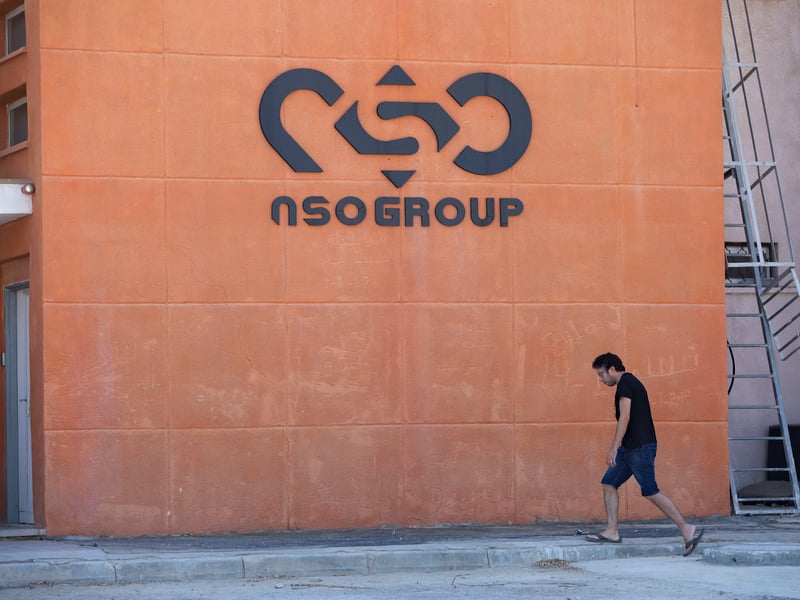
OAKLAND, Calif. (CN) — NSO Group CEO Yaron Shohat sparred with lawyers from Meta as he took the stand Thursday in a damages trial with the tech giant. Although the Israeli executive accepted legal responsibility for his company’s 2019 attacks using WhatsApp’s servers, he also denied that his company was responsible for any spying attempts.
“Don’t accuse me of spying. I never spied on anyone. And my company never spied on anyone,” he said sternly, leaning into the microphone.
During a confrontational cross-examination with Meta’s attorneys, Shohat distanced himself and his company from what their foreign government customers did with Pegasus, a powerful piece of proprietary spyware that can remotely access a phone’s microphone, listen to phone calls and download everything but the operating system, all without its owner’s knowledge.
“You say ‘I did it.’ I cannot do it. Our government customers can do it,” Shohat said.
Meta’s lawyers pressed Shohat on the subject, making a point to humanize the cyber-intelligence company’s targets in front of the jury.
“You call it ‘intelligence,’ but at the end of the day, it’s still people’s text messages,” Greg Andres of Davis Polk, who represented Meta, told him on cross-examination.
“Certain people’s text messages,” Shohat said. He later clarified what he meant.
“I think you try to imply they are regular people. I do not think that they are regular people,” he said.
NSO claims it only sells its spyware to legitimate government law enforcement and intelligence agencies vetted by Israel’s Defense Ministry for use against terrorists and criminals, but Meta is suing the company after a 2019 incident where Pegasus compromised the privacy of 1,400 activists, journalists and diplomats by covertly transferring the program to their phones via WhatsApp servers.
In 2020, the malware was found on the phones of six Palestinian human rights activists. Dubai’s ruler used Pegasus to hack his ex-wife’s phone during a court battle over their children in 2021.
Earlier, Shohat experienced a relatively endearing direct examination where he described his company as a generous but struggling tech company headquartered in Herzliya, Israel.
“We are government contractors. We develop cyber intelligence tools for governments and government agencies,” he told the jury.
He also rejected characterizations of NSO as a “hacking” or “spyware” company, saying such terms had a negative connotation.
To illustrate their unstable fiscal situation, Shohat guided jurors through his company’s usually secretive financial documents, which revealed that the powerful intelligence company has spent the last two years effectively in the red.
Documents furnished by NSO at trial showed that in terms of income before taxes, NSO had a deficit of nearly $9 million in 2023 and over $12.6 million in 2024.
A separate one for its parent company, Q Cyber, showed modest profits of $310,000 for 2023 and just under $360,000 in 2024.
Shohat also disclosed that NSO has operational costs of $10 million each month, part of which includes employee salaries.
Shohat also claimed that although their documents showed more than $158 million in debt owed to NSO by other companies in its organizational structure of last year, that money isn’t as liquid as the accounting sheets make it out to be.
“We don’t expect to receive any of that money,” Shohat said. “The companies who owe us that money don’t have any means to pay it.”
The CEO added that the only reason these companies were borrowing from NSO is that they already owe the bank substantial sums.
When asked about how his company would pay any punitive damages from the trial, the executive’s outlook was bleak.
“To be honest, I don’t think we would be able to pay anything. We are struggling to keep our heads above water,” Shohat said.
Shohat said he harbored no ill will toward Meta for its lawsuit and also claimed to accept the court’s previous summary judgment ruling against his company, which was decided in December 2024.
“I understand we were found to be liable, and I accept that and respect that,” Shohat said.
The current trial is only being used to determine how much NSO owes Meta in damages.
However, Meta pressed Shohat on these same topics on cross-examination, to explosive results.
The tech giant started by questioning the validity of the documents, noting that they were internally prepared and never verified by a third-party auditor.
Meta also pointed out that despite claiming financial hardships, the company spent $52 million on R&D in 2023, at least part of which went to developing Pegasus.
“If NSO didn’t spend $52 million on R&D, it might have a larger operating income, right?” Andres asked.
“If we didn’t develop Pegasus, the revenue downstream wouldn’t be there,” Shohat said.
“If you didn’t keep spying on people’s phones, you would have had more money left,” Andres said.
At this point, Shohat raised his voice in his microphone and made remarks about not wanting to be called a spy.
Interestingly, Shohat’s time on the stand almost stopped before it took off. At the beginning of the CEO’s testimony, the judge had to send the jury into another room to hash out accusations that NSO was once again violating court orders by addressing topics previously restricted by the judge.
Meta objected to a question posed by NSO to Shohat, asking if his company intended to cause any harm to WhatsApp’s servers. The tech giant said that such questions around NSO’s intent were not only restricted by the court but also falsely implied to the jury what their instructions were.
“I don’t want the jury to think that they had to harm us to get compensatory damages, because that’s clearly not the case,” Andres said.
NSO argued that the subject was still fair game because “malice” was one of the components examined in determining punitive damages.
“The intent to cause harm — that’s the definition of malice, your honor,” Joe Akrotirianakis of King and Spalding, lead counsel for NSO, said.
This resulted in both parties’ lawyers trading borderline personal attacks at times as over five years of litigation took its toll.
Akrotirianakis accused Andres of “sandbagging,” while Andres fired back with claims that he “crossed the line” and “misstated the law” to the jury.
“He can call me whining, complaining, whatever. I made legal objections, your honor, and you sustained them,” Andres told the judge.
U.S. District Judge Phyllis J. Hamilton said that NSO was trying to paint a picture that what it did was lawful and that it could save those kinds of arguments for appeal.
“I don’t care if it’s lawful in Israel or Saudi Arabia or something else. This is America,” the Bill Clinton appointee said.
The court also ruled that NSO’s attempts to portray Meta’s efforts to extract the Pegasus malware during its 2019 attack as “stealing” were “outlandish,” adding that she wouldn’t allow the Israeli company to use that word in the trial going forward.
The trial day ended on a cliffhanger, just before Meta tried to impeach Shohat by playing a video of his deposition.
A verdict is expected by May 5, 2025.
Meta is currently asking for over $440,000 in compensatory damages to remedy the costs of investigating malicious code on its servers, as well as unspecified punitive damages.
Originally designed as a tool for government law enforcement and intelligence agencies, Pegasus is NSO’s flagship product and is licensed to governments around the world.
To embed the spyware into someone’s phone, Pegasus clients send a text message that then invades devices through a malicious code lurking in these messages sent via WhatsApp, Telegram or other messaging services.
Pegasus can also infect users through missed phone calls and “zero-click” attacks, which do not require any action from the phone’s owner to succeed.
Once implanted, Pegasus can control a phone’s microphones and cameras while extracting the personal and location data of its owner — for example, by scraping browser history and contacts, grabbing screenshots and infiltrating communications.
This case was filed in the Northern District of California and heard at the Ron V. Dellums Federal Courthouse in Oakland, California. The trial was held before U.S. District Judge Phyllis J. Hamilton, a Bill Clinton appointee.
Subscribe to our free newsletters
Our weekly newsletter Closing Arguments offers the latest about ongoing trials, major litigation and rulings in courthouses around the U.S. and the world, while the monthly Under the Lights dishes the legal dirt from Hollywood, sports, Big Tech and the arts.