
 Search Articles


JERUSALEM (AFP) — Israel’s Prime Minister Benjamin Netanyahu threatened Hamas on Monday with unimaginable consequences if it did not return hostages held in Gaza, while the Palestinian group accused his government of sabotaging the truce.
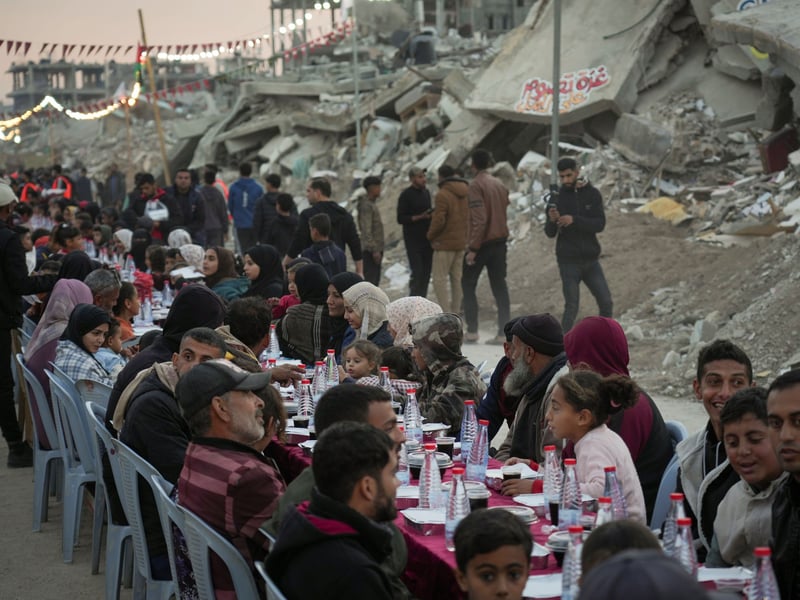
The first phase of the fragile ceasefire ended over the weekend but talks over its future have hit an impasse after six weeks of relative calm in the Gaza Strip that included exchanges of Israeli hostages for Palestinian prisoners and an influx of badly needed aid into the devastated territory.
While Israel announced early on Sunday it backed an extension of the first phase until mid-April, Hamas has insisted on a transition to the second phase, which should lead to a permanent end to the war.
Netanyahu, speaking Monday in the Israeli parliament, warned Hamas “there will be consequences that you cannot imagine” if the dozens of hostages held by militants were not released.
As the truce’s first phase came to a close, Netanyahu’s office had announced Israel was halting “all entry of goods and supplies into the Gaza Strip” and that Hamas would face “other consequences” if it did not accept the truce extension.
Israeli public broadcaster Kan reported that the measures the government was considering include displacing Gazans from the territory’s north and halting electricity supply.
A senior Hamas official, Osama Hamdan, accused Israel of actively sabotaging the ceasefire, calling its push for an extension “a blatant attempt to … avoid entering into negotiations for the second phase.”
Israel “was interested in the collapse of the agreement and worked hard to achieve that”, Hamdan said in a video statement.
Both Israel and Hamas have accused each other of violating the terms of the truce, which has largely held since it began on Jan. 19.
The move to block aid drew criticism from key truce mediators Egypt and Qatar, with both calling it a violation of the ceasefire deal.
Other governments in the region as well as the United Nations and some of Israel’s Western allies have spoken against the Israeli decision.
Stabbing
Germany’s foreign ministry said that denying humanitarian access “is not a legitimate means of pressure in negotiations,” while Britain said aid “must not be blocked.”
The European Union, the Red Cross and U.N. chief Antonio Guterres have all called on Israel to restore the flow of aid into war-battered Gaza.
The war has destroyed or damaged most buildings in Gaza, displaced almost the entire population and triggered widespread hunger, according to the U.N.
The fighting was triggered by Hamas’ Oct. 7, 2023, attack on Israel that resulted in the deaths of more than 1,200 people, most of them civilians, while Israel’s military retaliation in Gaza has killed nearly 48,400 people, also mostly civilians, data from both sides show.
Of the 251 captives taken during the attack, 58 remain in Gaza including 34 the Israeli military has confirmed are dead.
In the first fatal attack in Israel since the truce began in January, authorities said a stabbing spree Monday in the northern city of Haifa killed one person, wounded four others and ended with the assailant — a member of Israel’s Arabic-speaking Druze community — dead.
The stabbings took place at a bus and train station in the port city, home to a mixed Jewish and Arab population.
Police identified the assailant as a member of the Druze minority, generally considered supportive of the Israeli state, but did not specify a motive.
In Gaza, the Israeli military said it had struck a “suspicious motorized vessel” off the coast of Khan Younis in the south, and in a separate incident, opened fire on two suspects who had approached troops.
Reconstruction plan
Arab foreign ministers gathered in Cairo on Monday, a day before a leaders’ summit that is expected to discuss an alternative Gaza reconstruction plan to the one floated by U.S. President Donald Trump — under which the territory’s 2.4 million residents would be moved elsewhere.
The Arab ministers held a “preparatory and consultative” session centered on a plan to rebuild the territory without displacing Palestinians, a source at the Arab League told AFP on condition of anonymity.
In his remarks on Monday, Netanyahu hailed Trump’s “visionary and innovative” plan to forcibly remove Gazans, saying it was “time to give them the freedom to leave.”
The Gaza Strip has been under a crippling Israeli-led blockade since Hamas took power there in 2007.
Under the first phase of the truce, Gaza militants handed over 25 living hostages and eight bodies in exchange for the release of about 1,800 Palestinians in Israeli custody. Five Thai hostages were released from Gaza outside the scope of the deal.
Netanyahu has faced pressure from critics in Israel who have regularly blamed him for delays throughout the months of truce negotiations.
Dani Elgarat, speaking at the Monday funeral of his brother Itzik whose remains have been returned from Gaza, said the Israeli government had failed him.
The state “did not fulfill its duty … while your life was in danger. It abandoned you to die in the hands of Hamas,” said Elgarat.
—
By ALICE CHANCELLOR Agence France-Presse
Subscribe to our free newsletters
Our weekly newsletter Closing Arguments offers the latest about ongoing trials, major litigation and rulings in courthouses around the U.S. and the world, while the monthly Under the Lights dishes the legal dirt from Hollywood, sports, Big Tech and the arts.