
 Search Articles


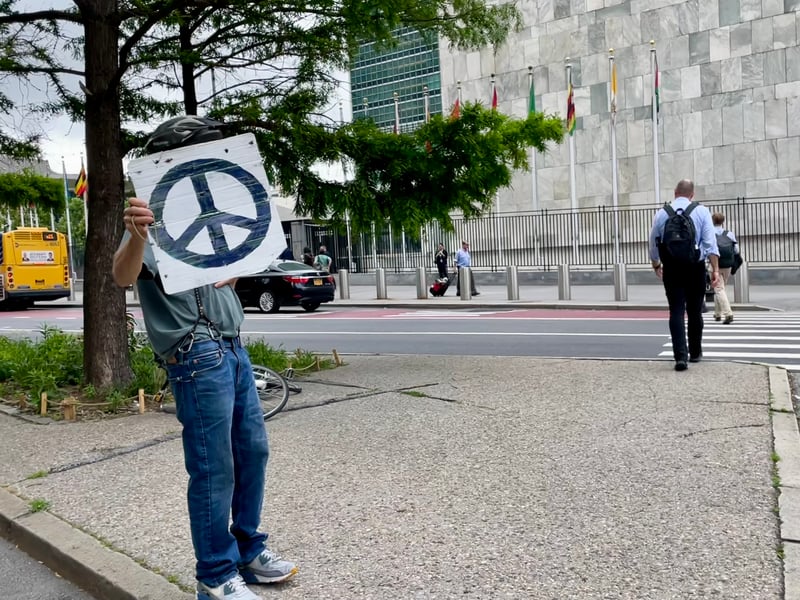
MANHATTAN (CN) — Remarking on unprecedented pressures mounting on the International Criminal Court, members of the court’s oversight group gathered Monday to review how the tribunal prosecutes the crime of aggression.
Representatives from the Assembly of States Parties to the Rome Statute, the ICC’s founding treaty, spoke about the urgency of unified support of the court’s jurisdiction at a time the world’s only permanent court for atrocity crimes is under attack — including by the U.S., which doesn’t recognize the court.
On the table is a proposal to amend the 1998 Rome Statute, the ICC’s founding treaty, which tasked the Netherlands-based court with prosecuting war crimes, genocide, crimes against humanity and the crime of aggression. Diplomats are expected to delve into lessons learned from a previous set of amendments adopted in 2010 in Kampala, Uganda, where states agreed on a definition of the latter crime.
Prosecuting the crime, however, is uniquely challenging: The court only has jurisdiction to charge the crime of aggression against countries that recognize its authority.
There are 125 countries that recognize the ICC, which is legally separate from the UN — unlike the UN’s International Court of Justice, which was established after World War II to settle disputes between nations. Both courts are based in The Hague.
Along with the U.S., six other countries voted against the Rome Statute: China, Israel, Iraq, Libya, Qatar and Yemen.
“In practice and unlike for other crimes, the court seemingly can exercise jurisdiction over the crime of aggression in only certain limited circumstances,” said Judge Tomoko Akane, president of the ICC, during prerecorded remarks Monday.
Akane continued: “The ICC is currently facing unprecedented measures that attempt to undermine the independence of an international judicial institution, which operates under the mandate from 125 state parties from all corners of the globe. These measures also show that international justice is not merely symbolic, but that it matters.”
In early June, the Trump administration imposed sanctions on four ICC judges, accusing them of “transgressions” by approving cases against the United States and Israel. Trump imposed sanctions against the court during his first presidency too, which President Joe Biden lifted.
Weeks after that, the ICC was hit by a “sophisticated” cyberattack, which the court said had been contained without elaborating on the impact or motive.
Akane encouraged more states to ratify the Kampala amendments “without delay,” noting that only 48 states have done so.
“This is insufficient for the effective use of the provision to strengthen the Rome Statute system,” she said.
Arguing in favor of the proposal at hand, which would bring the ICC’s ability to prosecute the crime of aggression in line with the other three crimes in its jurisdiction, some representatives argued that it’s a crucial move to seal the holes in the existing version.
“We see a glaring accountability gap,” said Tania Freiin von Uslar-Gleichen, a German representative speaking on behalf of the Group of Friends for the Review of the Rome Statute. The group also includes the Netherlands, Portugal, Palestine, Sweden, Switzerland and Ukraine, among others.
Even after Kampala, the states knew the Rome Statute would need further amendments, Von Uslar-Gleichen said — but “they did not imagine the level of force that would be used in 2025.”
She suggested the lack of ratification is a sign that the previous version did not go far enough.
“Some might draw the conclusion that at this juncture we should lower our ambition; the chances of reducing the accountability gap are slim. We beg to differ,” Von Uslar-Gleichen said. “These limitations seem to be one of the reasons for non-ratifications.”
Sally Langrish, a legal adviser at the United Kingdom’s Foreign, Commonwealth and Development Office, argued that there isn’t any evidence for that. While she expressed support for the ICC, Langrish said the lack of support for the Kampala amendments — which the U.K. has not ratified — will be a barrier.
“We are concerned that the amendment creates more legal and practical uncertainty than it would resolve,” Langrish said. She called for another conference to continue discussing amendments to the Rome Statute, and cautioned against discussions that are “divorced from the reality” facing the ICC’s oversight group.
In November the ICC issued arrest warrants for Israeli Prime Minister Benjamin Netanyahu and his former defense minister, Yoav Gallant, over Israel’s devastating bombing campaign in Gaza against Hamas, as well as a warrant against a senior Hamas official, citing war crimes and crimes against humanity.
In 2022, a Dutch intelligence agency said it foiled a plot by a Russian spy using a false Brazilian identity to work as an intern at the court, which is also investigating purported Russian war crimes in Ukraine and has issued a war crimes arrest warrant for President Vladimir Putin, accusing him of personal responsibility for the abductions of children from Ukraine.
Akane reminded delegates to keep in mind the mission behind the ICC as she opened Monday’s meeting.
“At this very moment, countless civilians live in ruins, subject to treatment contrary to international law,” Akane said. “The court was created precisely to be a glimmer of hope for these victims. It is our collective duty to cherish this precious project created by the wisdom of mankind.”
The special session is scheduled to continue through Wednesday.
 Follow @NinaPullano
Subscribe to our free newsletters
Our weekly newsletter Closing Arguments offers the latest about ongoing trials, major litigation and rulings in courthouses around the U.S. and the world, while the monthly Under the Lights dishes the legal dirt from Hollywood, sports, Big Tech and the arts.