
 Search Articles


(CN) — The Iowa Legislature met in special session Tuesday to pass a bill that bans abortions at six weeks, the point in a pregnancy during which a woman would have just missed her first period.
Two Republican representatives of the House joined every Democratic member who voted no, sending the bill through shortly after 9 p.m. in a 56-34 vote.
The Senate followed suit an hour later, passing the bill 32-17, with one Republican senator joining Democrats.
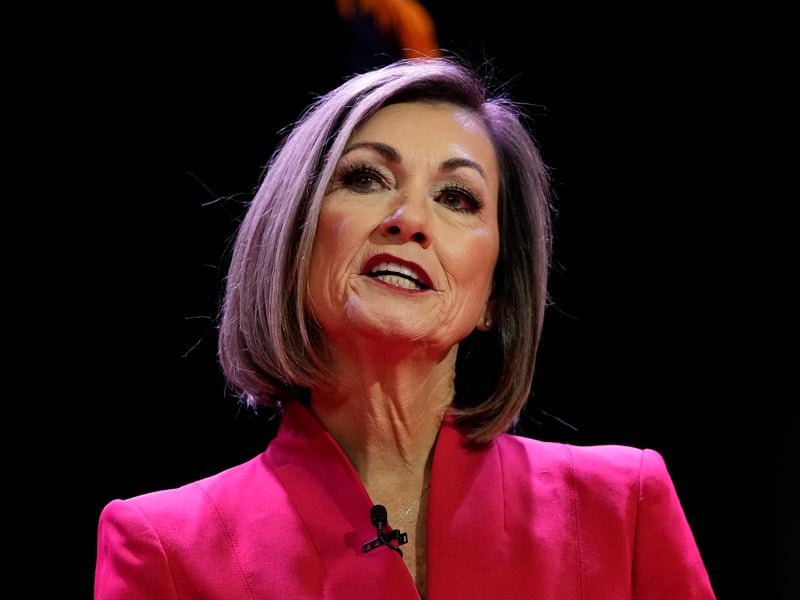
Once Governor Kim Reynolds signs it, the bill will take effect immediately. Reynolds, a Republican, has long advocated for the measure and called the Legislature into special session to consider it.
The legislation hinges on six weeks as that is the point when an ultrasound test can detect cardiac activity an embryo.
While medical professionals say cardiac activity is not the same as a heartbeat, and that an embryo is not yet a fetus, the more loaded term “fetal heartbeat" appears throughout the bill.
“Where there is a heartbeat, there is life,” House member Shannon Lundgren, a Republican from Dubuque County, told House members during Tuesday’s floor debate.
The bill makes exceptions to permit abortions in cases of rape, incest and fetal abnormality. Rather than imposing civil or criminal penalties for women who undergo abortions, the legislation would be enforced against doctors by the Iowa Board of Medicine.
“This law will save 2,000 babies lives every year,” Republican Senator Amy Sinclair of Wayne County said.
She asserted that it “does not put a single woman’s life in danger.”
House Democrat Beth Wessel-Kroeschell of Story County meanwhile quoted an OB-GYN as telling her otherwise. The physician said, “if this bill becomes law, women will die,” according to Wessel-Kroeschell, and that it will breach the boundary between doctors and patients.
Several legislators raised concerns about what the bill will mean for victims of incest or rape as young as age 10.
“A child should not have to carry a child,” Democratic Representative Timi Brown-Powers of Black Hawk County said.
Planned Parenthood of the Heartland, along other Iowa abortion providers, are expected to challenge the constitutionality of the new law in state court. The American Civil Liberties Union of Iowa has represented Planned Parenthood in previous abortion cases and criticized the effort, saying Governor Reynolds “believes that one of the most personal decisions a woman can make should be made by politicians."
“This is wrong,” the group said in a statement this week. “Individuals, not the government, should decide if and when they start a family.”
After a state judge enjoined a nearly identical version of the bill from 2018, the Iowa Supreme Court deadlocked last month when considering whether to lift the injunction.
While three members of the state’s seven-member high court wrote on June 16 that they would leave the injunction in place, three other justices disagreed, saying they would have lifted it. A seventh justice recused herself entirely.
Because there was no controlling decision, the injunction remains in place. The so-called fetal heartbeat bill from 2018 could not be enforced, and Iowa’s existing abortion law, which allows for abortions up to the first 20 weeks of pregnancy, remained on the books.
Governor Reynolds quickly intervened with a July 5 proclamation that called the General Assembly into special session Tuesday to reconsider the issue. Reynolds urged lawmakers to again pass legislation that would ban abortions “when it has been determined that the unborn child has a detectable fetal heartbeat.”
“I believe the pro-life movement is the most important human rights cause of our time,” Reynolds said in a statement accompanying her proclamation. “Not only will I continue to fight against the inhumanity of abortion, but I will also remain committed to supporting women in planning for motherhood, promoting fatherhood and parenting, and continuing policies that encourage strong families.”
A key question in any future legal challenge to an abortion ban in Iowa is what standard the justices should use in assessing the bill’s constitutionality. Three justices on the state’s high court indicated in their June 16 opinion they would rely on the undue-burden standard initially set by the U.S. Supreme Court in 1992.
Three Iowa justices supported the more lenient rational-basis standard, which the U.S. Supreme Court set in last year’s Dobbs decision, making it easier to enact abortion bans. The deciding vote may have to come from the seventh member of the court, who did not participate in the earlier case.
 Follow @roxalaird16
Subscribe to our free newsletters
Our weekly newsletter Closing Arguments offers the latest about ongoing trials, major litigation and rulings in courthouses around the U.S. and the world, while the monthly Under the Lights dishes the legal dirt from Hollywood, sports, Big Tech and the arts.