
 Search Articles


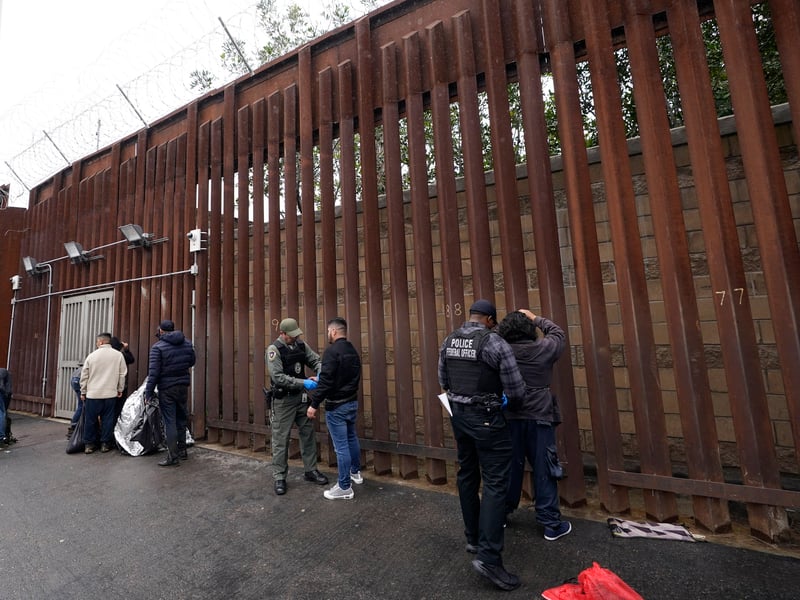
(CN) — Iowa may not enforce a 2024 state law that makes it a crime for a person who was previously deported to enter the state, a federal appeals court ruled Friday.
A three-judge panel of the St. Louis-based Eighth Circuit Court of Appeals held that Iowa’s statute is likely preempted by federal immigration law, because enforcement of Iowa’s law would invade the U.S. government’s interest in enforcing federal immigration law.
Iowa’s statute, Senate File 2340, makes it a misdemeanor punishable by up to two years in prison for a person who was previously deported or removed from this country to be present within the state’s boundaries. Those convicted of violating the statute must return to the nation from which they illegally entered.
The U.S. Department of Justice sued in 2024 to block enforcement of Iowa’s statute, which had been scheduled to go into effect this last July. The U.S. District Court for the Southern District of Iowa issued a preliminary injunction blocking enforcement. That decision was affirmed by the Eighth Circuit panel on Friday.
“The United States has clearly shown that its facial challenge is likely to succeed on the merits because every application of the Act stands as an obstacle to the accomplishment and execution of the full purposes and objectives of Congress,” Circuit Appeals Judge William Benton, a George W. Bush appointee, wrote for the panel. He was joined by Circuit Appeals Judge Jonathan Kobes, a Donald Trump appointee, and Senior Circuit Appeals Judge Morris Arnold, a George H.W. Bush appointee.
An Iowa immigrant advocacy group had filed a similar action against the state. The circuit court dismissed it as moot in light of Friday’s ruling.
Every section of the Iowa statute is likely in conflict with federal immigration law, the federal appeals court found — noting that the U.S. Supreme Court has “long recognized the preeminent role of the Federal Government with respect to the regulation of aliens within our borders.”
In response to the state’s argument that its statute is not a removal regulation but an exercise of traditional state power to exclude certain persons, the appeals court said that even if Iowa had that power, its law violates the U.S. Constitution’s supremacy clause if it clearly conflicts with federal law.
One such conflict, the court noted, is that unlike the federal law barring illegal entry, which makes some exceptions, Iowa’s law makes none.
“Federal officials might choose to prioritize the arrest of an alien who commits a serious crime, rather than pursue enforcement against an alien who ‘has children born in the United States, long ties to the community, or a record of distinguished military service,’” Appellate Judge Benton wrote, quoting the U.S. Supreme Court’s 2012 decision in Arizona v. United States . “Some discretionary decisions involve policy choices that bear on this Nation’s international relations.”
Iowa’s statute would allow the state to achieve its own immigration policy, the appeals court said, which is “precisely the result the Supreme Court in Arizona found barred by conflict preemption.”
The appeals court also said Iowa’s law interferes with federal officials’ discretion by requiring a state court to proceed with prosecution of a state immigration violation even if a federal prosecution is pending or will be initiated.
“Even if federal officials are considering an alien’s case, Iowa may arrest the alien, prosecute the alien, obtain an order to return, and transport the alien to a port of entry,” Federal Appeals Court Judge Benton wrote. “By prohibiting abatement of the state prosecution, [Iowa’s statute] undermines federal officials’ discretion to decide if, when, and how to address the case of an individual alien.”
Iowa Attorney General Brenna Bird, a Republican, said in a statement Friday that the Eight Circuit’s decislon is not the final word.
“Iowa stood strong against the Biden-Harris border invasion that made every state a border state,” Bird said. “Despite today’s court ruling, the battle is far from over. As President Trump works nationally to fix the mess Biden and Harris created on the southern border, we will continue fighting in Iowa to defend our laws and keep families safe.”
American Civil Liberties Union of Iowa Legal Director Rita Bettis Austen, a lawyer representing plaintiff Iowa Migrant Movement for Justice, praised the ruling in a statement Friday. “This extremely harmful law has exposed people with lawful status, and even children, to serious harm — arrest, detention, deportation, family separation, and incarceration, by the state,” Bettis Austen said, adding that Friday’s decision by the Eighth Circuit means that, for the time being, Iowa’s law “remains blocked and Iowans do not have to fear being subject to this unconstitutional law.”
 Follow @roxalaird16
Subscribe to our free newsletters
Our weekly newsletter Closing Arguments offers the latest about ongoing trials, major litigation and rulings in courthouses around the U.S. and the world, while the monthly Under the Lights dishes the legal dirt from Hollywood, sports, Big Tech and the arts.