
 Search Articles


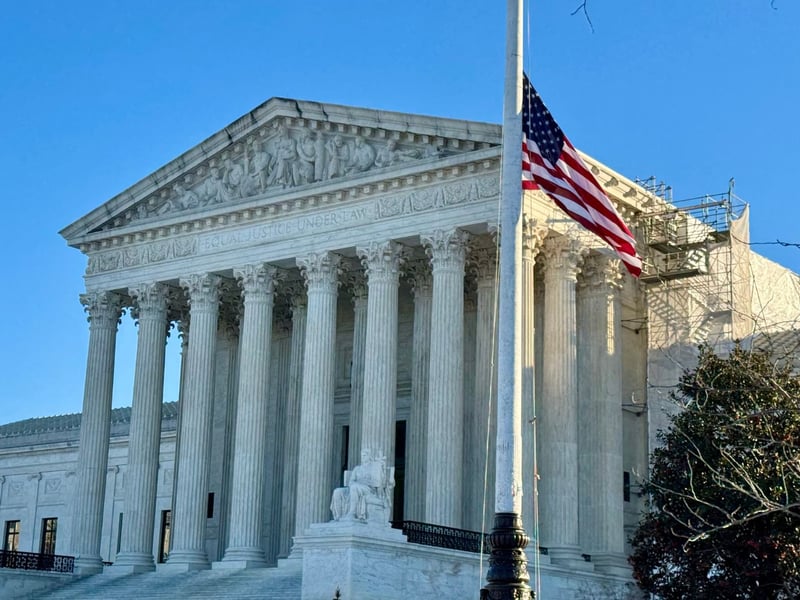
WASHINGTON (CN) — A Virginia prisoner can’t sue prison officers and officials over an Eighth Amendment excessive force claim, the Supreme Court said Monday.
The court’s decision reverses a Fourth Circuit order that allowed Andrew Fields III’s claims against prison guards to proceed. Fields claims the officers physically abused him while he was in solitary confinement, then denied him access to forms to file a grievance through the Federal Bureau of Prisons Administrative Remedy Program.
Prisoners can’t make a claim for monetary damages under the Eighth Amendment, the justices held Monday. The decision sends Fields’ case back to the Fourth Circuit for further proceedings.
At the crux of Fields’ argument is the 1971 ruling in Bivens v. Six Unknown Named Agents , which recognizes that federal officers can be sued for damages over violations of the Fourth Amendment. The court later upheld two other instances of Bivens claims. But since 1980, the Supreme Court has denied expanding Bivens to cover other constitutional violations on more than 10 occasions.
“For the past 45 years, this court has consistently declined to extend Bivens to new contexts,” the justices said in an unsigned opinion. “We do the same here.”
To determine if a Bivens claim can continue, the court applies a two step test, to determine if the argument presents a new context that hasn’t been recognized in a previous remedy, and if there are special factors that make the judiciary less equipped than Congress to weigh the merits of the case.
Congress has legislated over prisoner litigation but has not created a case of action for monetary damages. Extending Bivens to allow an excessive force claim could also have negative consequences for prison officials tackling the “difficult undertaking” of running a prison, the justices said, and federal prisoners have alternatives to air their grievances, through the administrative remedy program and by filing for injunctive relief in federal court.
The existence of alternative remedies warns against expanding Bivens suits, even if their success is less effective than seeking individual damages, the justices said. They reversed the Fourth Circuit’s judgment and remanded the case for further proceedings.
Fields filed a pro se lawsuit against the Bureau of Prisons, the prison warden, and prison officials for damages in 2022, claiming that certain prison officials used excessive force against him in violation of the Eighth Amendment.
Prison officials put him in solitary confinement and physically abused him, Fields said, including ramming his head into a concrete cell wall while he was in restraints. Fields said he attempted to use an administrative grievance procedure through the court system but staff denied him the forms. He argues that his case establishes a new context under Bivens , which he said should be extended to allow him to seek damages against the prison staff.
The U.S. District Court for the Western District of Virginia dismissed Fields’ complaint, saying that he did not assert a constitutional violation and had no remedy for money damages under Bivens .
Fields appealed, and the Fourth Circuit allowed him to maintain his Eighth Amendment claim against prison officers, while acknowledging that “the tide has turned against Bivens ” and the Supreme Court had not indicated a desire to expand the application of the Bivens remedy to a new context.
Fields’ case creates a rare context, U.S. Circuit Judge Roger Gregory wrote in the majority opinion, as the officers’ abuse was combined with a denial of administrative remedies. The Fourth Circuit panel dismissed Fields’ claim against supervisory prison officials who were not personally involved in conduct but allowed his excessive force claim to continue against the officers that Fields said abused him.
“Though this court has declined to extend Bivens to cases brought by federal inmates in the past, it has done so on the theory that inmates have access to alternative remedies. But that reasoning does not apply here — Fields lacked access to alternative remedies because prison officials deliberately thwarted his access to them,” the majority said.
U.S. Circuit Judge Julius Richardson dissented, pointing to the Supreme Court’s history of rebuffing requests to expand actions against federal officials for money damages. The majority on the panel made a conclusion that misreads precedent, he warned, and would encourage prisoners to bring excessive force lawsuits.
Prison officials facing liability filed a petition for a writ of certiorari following the panel’s order, asking the Supreme Court to take up the arguments. They asked the court to “reconsider the premise” of Bivens entirely, pointing to the court’s unwillingness to infer new Bivens claims.
The Supreme Court last weighed Bivens in 2022, reining in civil liability against federal officers over a retaliation claim. The case’s precedent has been weakened in recent years, notably after a Mexican family was barred from suing a U.S. border patrol agent who shot across the border and killed their 15-year-old son in Mexico.
 Follow @SKHaulenbeek
 Follow @shaulenbeek.bsky.social
Subscribe to our free newsletters
Our weekly newsletter Closing Arguments offers the latest about ongoing trials, major litigation and rulings in courthouses around the U.S. and the world, while the monthly Under the Lights dishes the legal dirt from Hollywood, sports, Big Tech and the arts.