
 Search Articles


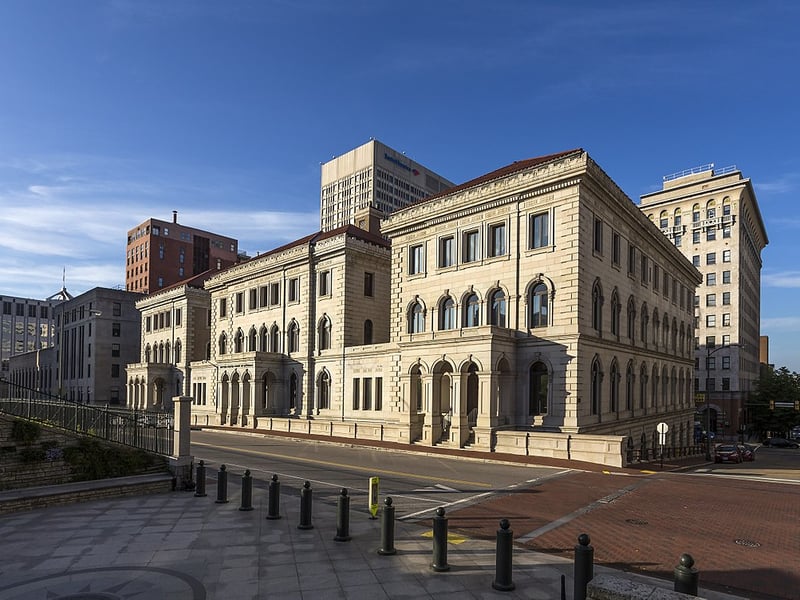
(CN) — Jail detainees argued in the Fourth Circuit Tuesday that a district judge improperly dismissed a preliminary injunction challenging a Maryland county’s controversial pretrial release program.
U.S. Senior District Judge Peter J. Messitte, a Bill Clinton appointee who died earlier this year at age 83, ruled about two years ago that Prince George’s County enjoyed quasi-judicial immunity from liability for how it processed detainees ordered to be released by state judges.
Messitte’s opinion came after the Fourth Circuit ordered the district judge to reconsider his arguments. On Tuesday, a three-judge appellate panel still seemed skeptical that he made the right call. U.S. Circuit Judge Toby J. Heytens, a Joe Biden appointee, said the district judge used an “aggressive, out-of-the-box theory” for finding the county was immune from liability. The circuit judge noted Messitte also appeared to have wrongfully dismissed certain plaintiffs from the suit.
Nine current and former inmates in Prince George’s County argue in the original complaint, filed in the District of Maryland in July 2022, that state judges avoid public scrutiny by approving the release of inmates but leaving the final decision to the county’s pretrial service agency, which ultimately determines whether to enforce the ruling.
The agency has denied inmates’ release because they cannot provide mortgage documents establishing their residency or because they live in a neighboring county, the detainees say. Sometimes, the agency’s staff simply disagrees with the judge’s decision.
Even if the agency agrees to release an inmate, it can take weeks or months to happen, they say.
The detainees argue the program violates their due process rights, replacing a public, adversarial and on-the-record bail hearing with an opaque process operated by the whims of the county’s executive branch.
Messitte denied a motion from the plaintiffs for a preliminary injunction in January 2023, finding the municipality and its pretrial release officers enjoyed quasi-judicial immunity.
The judge reasoned that the pretrial release program operated as an extension of the judicial process. Whatever could be said about the constitutionality of the program, its officers were operating as judicial aides and enjoyed the same protections granted to court staff.
The inmates appealed, leading to Tuesday’s arguments.
The plaintiffs are represented by Civil Rights Corps, a D.C.-based firm; Wilmer, Cutler, Pickering Hale and Dorr, a New York City-based firm; and the Georgetown University Law Center’s Institute for Constitutional Advocacy and Protection.
Elizabeth Cruikshank, an attorney for the law center, argued on Tuesday that the district court “significantly misapplied” the principle of quasi-judicial immunity.
“The Supreme Court and this court have repeatedly reaffirmed that counties are ineligible for absolute immunities under any circumstances,” Cruikshank said.
Associate county attorney Andrew J. Murray conceded there was “ample authority” to show that counties enjoyed no absolute immunity, but he argued the county could not be held liable for the policies and practices of the state judiciary.
U.S. Circuit Judge Julius N. Richardson, a Donald Trump appointee, acknowledged that the state judges grant the county broad discretion to determine if inmates are ready for release, but he questioned the scope of Murray’s argument. If the county instituted a policy that precluded the release of certain inmates because of their race, wouldn’t that be an unconstitutional policy?
Murray acknowledged that would raise due process concerns.
Heytens added it appeared that the county’s policies, not the policies of the judiciary, were causing certain inmates to remain detained. As an example, he pointed to the requirement for inmates to provide a county address to be released.
On the other hand, Richardson expressed skepticism that federal claims could be brought against the state judges, 11 of whom were named as defendants in the suit. He questioned Cruikshank on whether the judges were adverse to the petitioners or simply exercising their adjudicative powers.
Cruikshank said the detainees were challenging the judges’ improper delegation of duties —not any specific bail decision.
Richardson questioned why the inmates did not challenge their detention through habeas corpus petitions.
“I’m extremely sympathetic, as a factual matter, to the situation you find yourself in,” Richardson said, adding later: “But I can’t figure out how I’m supposed to tell the state court judge, by declaration or injunction, how they’re supposed to act.”
Heytens and Richardson were joined on the panel by U.S. Senior Circuit Judge Henry F. Floyd, a George W. Bush appointee.
 Follow @SteveGarrisonPC
Subscribe to our free newsletters
Our weekly newsletter Closing Arguments offers the latest about ongoing trials, major litigation and rulings in courthouses around the U.S. and the world, while the monthly Under the Lights dishes the legal dirt from Hollywood, sports, Big Tech and the arts.