
 Search Articles


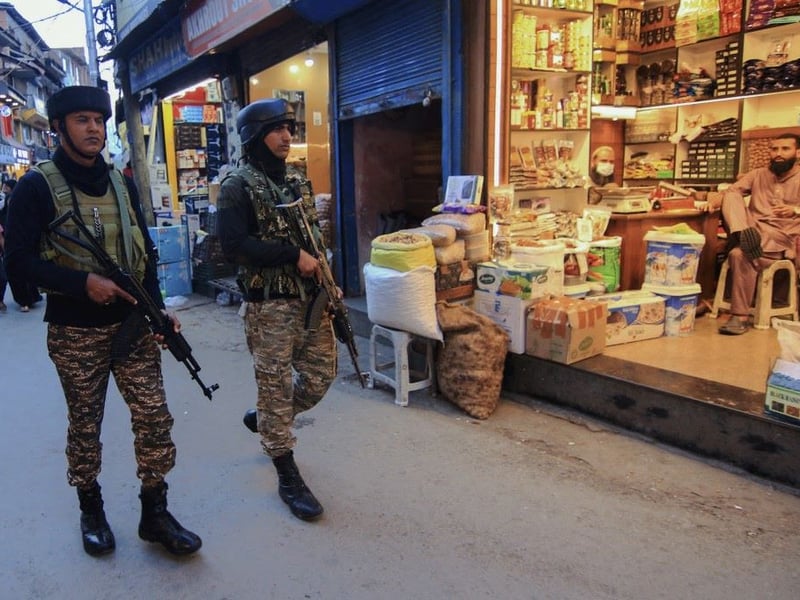
SRINAGAR, Kashmir (AFP) — India and Pakistan accused each other Thursday of failing to control their nuclear weapons, calling on the world to monitor their neighbor’s arsenal just days after their most serious military confrontation in two decades.
Pakistan’s nuclear arsenal should be under the surveillance of the U.N.’s nuclear watchdog, Indian Defense Minister Rajnath Singh said Thursday, while Islamabad said the international community should investigate a “black market” in India.
The latest conflict between India and Pakistan had sparked global concerns that it could spiral into a full-blown war before a ceasefire was brokered on Saturday.
“I wanted to raise this question for the world: are nuclear weapons safe in the hands of a rogue and irresponsible nation?” Singh told troops at a base in Srinagar in Indian-administered Kashmir.
“I believe that Pakistan’s atomic weapons should be brought under the surveillance of the IAEA (International Atomic Energy Agency),” Singh added.
Hours later, Pakistan’s Foreign Minister Ishaq Dar said the IAEA should instead probe “the repeated theft and illicit trafficking incidents involving nuclear and radioactive material in India.”
“These incidents also suggest the existence of a black market for sensitive, dual-use materials inside India,” he added.
But on Thursday, Dar announced there had been “military to military communications” and both sides had agreed to extend a ceasefire until Sunday.
Fighting began when India launched strikes on May 7 against what it said were “terrorist camps” in Pakistan following an April attack in Indian-administered Kashmir in which 26 people were killed.
New Delhi blamed Islamabad for backing the militants it claimed were behind the attack — the deadliest on civilians in Kashmir in decades. Pakistan denies the charge.
Four days of intense tit-for-tat drone, missile and artillery exchanges ensued, leaving nearly 70 people, including dozens of civilians, dead on both sides.
Not on the table
Both India and Pakistan are nuclear powers and members of the IAEA, which regulates the use of nuclear weapons.
India has developed nuclear weapons since the 1990s in the form of intermediate-range ground-to-ground missiles. Long-range missiles are currently being tested, according to experts.
Pakistan has developed short- and intermediate-range ground-to-ground and air-to-ground nuclear missiles that can carry warheads.
Pakistani ministers have repeatedly said the nuclear option was not on the table. They also stressed on Saturday that its nuclear governmental body was not summoned at any point in the recent conflict.
Pakistani military spokesman Ahmed Sharif Chaudhry told reporters on Sunday that escalating conflict between “rival nuclear powers” was “inconceivable and sheer stupidity.”
“That conflict can lead to the peril of 1.6 billion people, so in reality there is no space for war between India and Pakistan,” Chaudhry said.
In a speech this week, Indian Prime Minister Narendra Modi said: “India will not tolerate any nuclear blackmail.”
India had earlier denied targeting Pakistan’s nuclear installations during the brief conflict.
“We have not hit Kirana Hills,” Indian Air Marshal A.K. Bharti told reporters, referring to a vast rocky mountain range where, according to Indian media reports, Pakistan stores its nuclear arsenal.
Fearing further escalation, global leaders had urged restraint from the arch-enemies with U.S. President Donald Trump announcing the surprise truce.
The ceasefire has held since the weekend, following initial claims of violations from both sides.
Militant encounter
However, Pakistan’s Prime Minister Shehbaz Sharif, in a telephone call with U.N. chief Antonio Guterres on Wednesday, expressed “concerns over the continued provocative and inflammatory remarks by Indian leadership, as a threat to the fragile regional peace,” his office said in a statement.
India’s Foreign Minister Subrahmanyam Jaishankar said on Thursday that a key water treaty, which governs river water critical to parched Pakistan for consumption and agriculture, would remain suspended “cross-border terrorism by Pakistan is credibly and irrevocably stopped”.
His counterpart in Pakistan, Ishaq Dar responded calling the treaty “a no-go area”.
“The treaty can’t be amended, nor can it be terminated by any party unless both agree,” he told parliament.
Militants have stepped up operations on the Indian side of Kashmir since 2019, when Modi’s Hindu nationalist government revoked the region’s limited autonomy and imposed direct rule from New Delhi.
Police in Indian-administered Kashmir meanwhile said they killed three suspected militants on Thursday in the town of Tral, in Pulwama district south of Srinagar, the region’s main city.
“All the three militants involved in the encounter in Tral were killed,” a senior police officer told AFP on condition of anonymity.
The officer said that they were not linked to the deadly April attack against tourists near Pahalgam.
Police also said three other suspected militants died in a gun battle with soldiers on Tuesday in the southern Kashmir valley.
Muslim-majority Kashmir is claimed in full by both India and Pakistan, which have fought several wars over the territory since their 1947 independence from British rule.
—
By PARVAIZ BUKHARI with ZAIN ZAMAN JANJUA in Islamabad, Agence France-Presse
Subscribe to our free newsletters
Our weekly newsletter Closing Arguments offers the latest about ongoing trials, major litigation and rulings in courthouses around the U.S. and the world, while the monthly Under the Lights dishes the legal dirt from Hollywood, sports, Big Tech and the arts.