
 Search Articles


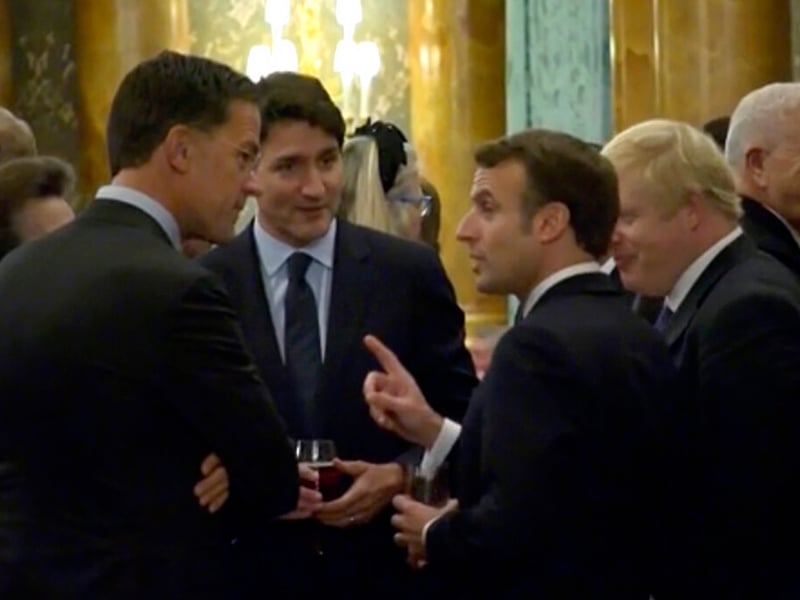
MARSEILLE, France (CN) — French President Emmanuel Macron arrived at the White House on Monday to convince U.S. President Donald Trump that Ukraine is a country worth defending.
“Mr. President, you know how much friendship I show toward you, and I have since your first term. Europe is very clear-eyed about this,” Macron said in a joint press conference with Trump. “We know what we need to do as Europeans, given the threats surrounding us and the responsibilities that we must shoulder.”
Ukraine was the main talking point at the press conference on Monday, but the overarching theme was security — not only for Ukraine, but also for Europe as a whole. Macron seemed to going out of his way to praise Trump’s efforts.
“We have committed to building a lasting peace as Europeans — we are committed to being stakeholders in these security guarantees,” Macron said. “We are also well aware that Europeans need to do more for security in Europe and do more fairly share the security burden that your country has been carrying.”
Abishur Prakash, the founder of the geopolitical advisory firm The Geopolitical Business Inc., sees three main goals for the visit. First, Macron is trying to avoid a U.S.-EU trade war, which is becoming increasingly likely. Next, he’s looking to assess the state of security between the U.S. and Europe, regarding both NATO and Ukraine in particular. And finally, rather than necessarily looking to improve relations between the two countries, Macron could be taking an act of damage control, making sure it doesn’t get worse.
“At some level, as strange as it sounds, instead of raising the U. S. French relationship to a new height, he’s trying to find some kind of floor to make sure he doesn’t go any lower,” Prakash told Courthouse News. “And then more broadly, that the U.S.-Europe relationship, the transatlantic alliance, doesn’t go any lower.”
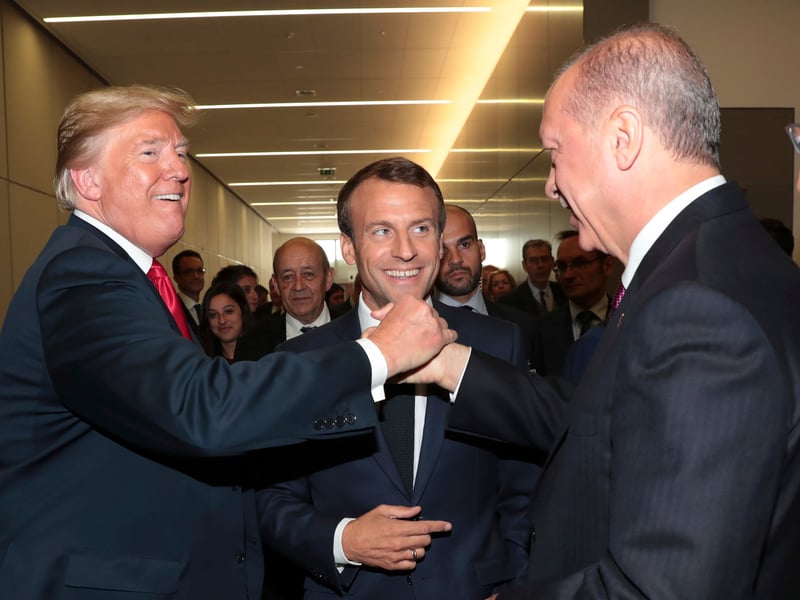
European leaders are in full crisis mode after Trump recently suggested that Ukraine bears responsibility for the war, called Ukrainian President Volodymyr Zelensky a “dictator without elections” and jabbed that a “half-baked” negotiator could have settled the war years ago.
Beyond the commentary, it looks like Trump really isn’t concerned about bringing Ukraine and Europe to the negotiating table; there were no representatives from either side at a high-stakes meeting between the U.S. and Russia in Saudi Arabia last week.
This prompted Europe to marshal its forces. Macron seems to be positioning himself as the leader in charge of the bloc. The French president called for two emergency summits in Paris last week to discuss a coordinated European response to Ukraine, which might include sending troops to the ground.
Hall Gardner is an international relations theorist and the author of “Crimea, Global Rivalry, and the Vengeance of History.” He explained Macron’s tone shift in an interview.
“Macron has taken an increasingly strong stance against Russia and Putin in recent months after previously hoping that he could convince Putin to end the war,” Gardner said. “Having failed, he now takes the hawkish position that Putin will not stop at Ukraine, but could soon pressure the Baltic states and other NATO members, threatening war, while the U.S. appears to be dropping its support for NATO.”
“As Europe’s only nuclear state, not counting the UK which is no longer member of the EU, Macron believes he can speak for Europe … even if not all Europeans agree with him,” Gardner continued. “If France is not at the bargaining table, Macon fears that Trump will take a pro-Russian position on Ukraine that will permit Moscow to in turn pressure EU members in the future.”
Leaders across Europe are sounding the alarm and calling for strength across the bloc.
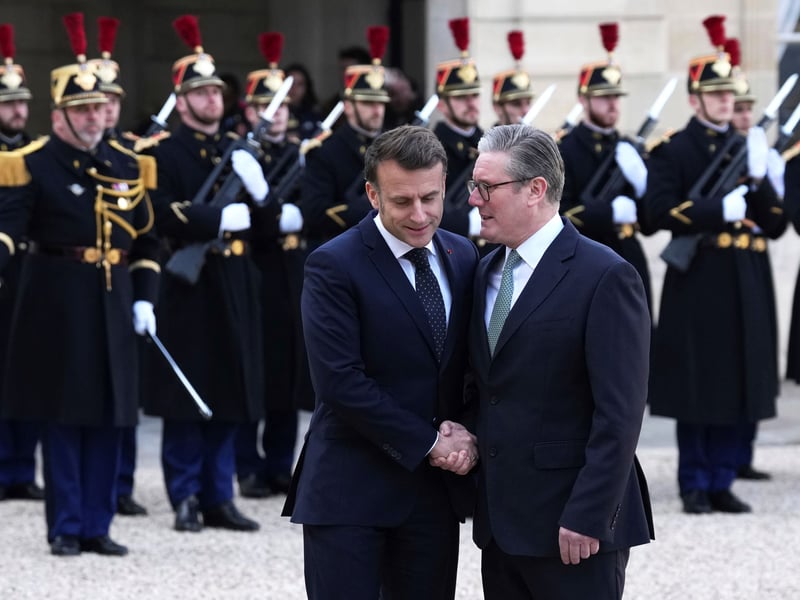
“Let’s be clear: a free and sovereign Ukraine is not only in the European interest, it’s also in the interest of the entire world,” Ursula von der Leyen, the European Commission president, posted on X on Monday. “An investment in Ukraine’s sovereignty is an investment in the prevention of future wars.”
Trump’s recent positioning on Ukraine has been a wake-up-call for Europe as it seeks to strengthen its autonomy and defense capabilities.
“Trump wants NATO members to spend 5% of GDP on defense, upon the threat that the U.S. will not come to their defense,” Garner said. “This means that the EU needs to better coordinate their defense, and become more autonomous — Macron’s visit symbolizes the need for genuine power sharing with the U.S., and the move away from dependence on NATO.”
Prakash cautions that the U.S. and Europe are currently operating under totally different worldviews, which might pose a conflict in the near future. “America first” and “Europe first” are not able to coexist with each other, even though they’re presented that way; in order for each model to be successful, other countries would have to operate under their frameworks, like adopting European green ideas or regulatory measures, for example.
This meeting, and the upcoming visit of U.K. Prime Minister Keir Starmer on Thursday, will set a precedent for future U.S.-Europe relations.
“The outcome of Macron’s visit is going to reveal a lot about the new direction between the U.S. And Europe and the collective West,” Prakash said. “I think it will signal just how stable or unstable this critical alliance is.”
 Follow @lilyradz
Subscribe to our free newsletters
Our weekly newsletter Closing Arguments offers the latest about ongoing trials, major litigation and rulings in courthouses around the U.S. and the world, while the monthly Under the Lights dishes the legal dirt from Hollywood, sports, Big Tech and the arts.